

Profesor universitario, pianista aficionado, perseguidor de conocimiento. Esposo y padre feliz. + en https://xitter.cf/t.co/sxPkosV3jk
Montemorelos, NL, MX
Joined May 2007
- Tweets6.2K
- Following2.1K
- Followers1.2K
- Likes3.8K





@JessieOops me recordó algo q escribiste recientemente

Una frase que leí de joven y se me quedó grabada.
" Un especialista es quién aprende más y más sobre menos y menos, hasta que llega a saber casi todo, de prácticamente nada".
2
77

«Un ser humano debería ser capaz de cambiar un pañal, planear una invasión, descuartizar un cerdo, gobernar un barco, diseñar un edificio, escribir un soneto, cuadrar cuentas, construir un muro, reducir una fractura, consolar a los moribundos, recibir órdenes, dar órdenes, cooperar, actuar en solitario, resolver ecuaciones, analizar un problema nuevo, esparcir estiércol, programar un ordenador, cocinar una comida sabrosa, combatir con eficacia y morir con gallardía. La especialización es para los insectos.»
— Robert A. Heinlein


An English engineer wrote a calculus book in 1910 opening with the line "what one fool can do, another can," and proved that almost everything making math feel impossible was put there on purpose by people who wanted it to stay exclusive.
His name was Silvanus P. Thompson.
He was a physicist, an engineer, a Fellow of the Royal Society, and a professor at the City and Guilds Technical College in London.
He had spent his entire career teaching calculus to working-class engineering students who needed the math to actually do their jobs, and he had watched generation after generation of bright kids walk out of math classrooms convinced they were stupid.
He knew they were not stupid. He knew exactly what was wrong, and he was about to say it in print in a way that would get him quietly hated by every academic mathematician in Britain.
In 1910 he published Calculus Made Easy. He published it anonymously at first, listing the author only as F.R.S., which stood for Fellow of the Royal Society. He did not want his name attached to it until he saw how the establishment was going to respond. Because the prologue of the book was not a polite introduction. It was an accusation.
He wrote that calculus was not actually hard. He wrote that the people writing the standard textbooks were what he called "clever fools" who deliberately took the easiest parts of the subject and presented them in the most complicated way possible, because doing so made them look more impressive.
He wrote that they "seldom take the trouble to show you how easy the easy calculations are" and instead "seem to desire to impress you with their tremendous cleverness by going about it in the most difficult way."
Then he opened the first chapter by telling readers something nobody had been willing to admit out loud. The reason calculus felt impossible was not because calculus was impossible. It was because the symbols had been chosen to feel impossible. The notation looked like ancient ritual on purpose. The Greek letters, the formal epsilon-delta definitions, the abstract limit proofs that opened every standard textbook, were not how Newton and Leibniz had originally thought about the subject. They were a 19th century renovation of the field done by professional mathematicians who wanted calculus to feel like a closed shop.
Thompson refused to use any of it.
He went back to the way Leibniz had thought about it 250 years earlier. The letter d in front of a variable, he told his readers, just meant "a little bit of." That was the whole secret. dx meant "a little bit of x." dy meant "a little bit of y." dy/dx meant "a little bit of y divided by a little bit of x," which is just how steep the curve is going at that exact moment. Integration was the opposite. It just meant adding up all the little bits.
That is calculus. That is the entire subject. Everything else is technique, and the technique only works once you understand what you are doing.
A 12-year-old can follow that explanation. A 12-year-old cannot follow the opening chapter of a typical university calculus textbook. The gap between those two facts is the entire reason most adults walk around believing they are bad at math.
The book became one of the bestselling math books in history. Over a million copies. Still in print 115 years later. Still recommended by physicists, engineers, and self-taught learners as the only calculus book they actually finished. Martin Gardner revised it in 1998 and the foundation of the book did not need to change because Thompson had built it on Leibniz, not on the academic conventions that have come and gone since.
The deeper point Thompson was making is the part that should haunt anyone reading this in 2026.
Difficulty is often a marketing strategy. It is not always a property of the subject. When a discipline is taught in a way that feels impossible, the difficulty is doing a job for someone. It is keeping the field small. It is protecting the salaries and the status of the people already inside it. It is filtering out the kinds of people who would otherwise show up and crowd the room.
This happens in math. It happens in law. It happens in medicine. It happens in finance, in machine learning, in philosophy, in software. Every field has a layer of jargon and notation and ritual sitting on top of a core idea that is usually much simpler than the people inside the field want to admit. The jargon is not there to communicate. It is there to gatekeep.
The way you recognize a real teacher is that they keep stripping the ritual off. The way you recognize someone protecting their priesthood is that they keep piling it on.
Thompson finished his prologue with five words that are the entire spirit of his project. "What one fool can do, another can." He meant it as both a joke and a threat.
If a working-class engineering student in 1910 with no Greek and no Latin and no university privileges could learn calculus from a 200-page paperback, then so could anyone the establishment had been excluding for the previous 200 years.
Most subjects you have given up on were never as hard as the people teaching them needed you to believe. You were not stupid. The course was designed to make you feel that way.
What one fool can do, another can.

1
44

A Chicago philosopher wrote one book in 1940 proving that 95% of the books you have read in your life, you didn't actually read, and Charlie Munger has been telling people to read it for 50 years.
His name was Mortimer Adler.
He spent 40 years at the University of Chicago, ran the editorial board of the Encyclopædia Britannica, and built his entire career on one uncomfortable observation about the people around him.
Most adults who called themselves well-read had not actually read a book in the real sense even once. They had run their eyes over the pages, registered the words, formed a vague impression, and put it back on the shelf.
The book had passed through them without ever entering them.
In 1940 he wrote How to Read a Book. It has stayed in print for 86 years.
Charlie Munger recommends it. Naval Ravikant recommends it. Fareed Zakaria recommends it.
Every serious thinker who builds a career on absorbing information eventually finds their way to this book, and the reason is that Adler had isolated something nobody else was naming clearly.
There are four levels of reading. Almost everyone is stuck on the second one. The fourth level is so different from what most people call reading that you have probably never done it in your entire life.
Level one is elementary.
You learn it as a child. You decode the letters into words and the words into sentences. You finish the sentence and understand roughly what it said. This is reading the way a 7-year-old reads, and almost every adult on earth has stopped developing past this point in some quiet way.
Level two is inspectional.
This is skimming. You move through a book quickly to figure out what it is broadly about. You read the back cover, scan the table of contents, glance at a few paragraphs, and form an opinion. Most adults who claim to have read 50 books a year are actually doing this. They are inspecting books, not reading them. They walk away with a vague sense of the argument and almost none of the evidence that supports it.
Level three is analytical.
This is the level Adler said most people have never properly experienced. You take one book and you wrestle with it for as long as it takes. You identify the question the author is trying to answer. You map their argument from front to back. You write your disagreements in the margins. You force yourself to articulate, in your own words, what the author is claiming and why. The point is not to finish the book. The point is to argue with it as if the author were sitting across the table from you. Most people never do this once in their life, because it is exhausting and slow and feels nothing like the reading they were taught as children.
Level four is the one almost nobody knows exists. Adler called it syntopical reading. The word means "across topics," and the technique is something closer to running a small private research lab in your own head.
You pick a single question that actually matters to you. How does power corrupt people. Why do civilizations collapse. What makes a marriage last. How does a person change their own mind. Then you assemble five or ten or twenty books from different authors, different centuries, different traditions, all of them taking a swing at the same question.
You do not read any of them cover to cover. You move between them. You find the chapter in book three that addresses the same question as the chapter in book seven. You force those two authors to argue with each other inside your own head.
The book stops being the unit of reading. The question becomes the unit. And the authors become voices in a conversation you are now hosting.
This is the level where reading stops being consumption and starts being construction.
You are no longer absorbing what someone else thinks. You are building a position of your own out of the friction between people who disagreed.
Adler argued that this is the only level of reading where you stop being a passive receiver of other people's ideas and start being someone who can produce ideas of their own.
The reason Charlie Munger has been recommending this book for 50 years is that this is exactly how Munger has always thought. He calls it building a latticework of mental models. The technique he is describing is just syntopical reading applied for a lifetime.
You take the strongest insight from psychology, the strongest insight from biology, the strongest insight from economics, and you stack them against the same problem until something new falls out the bottom.
The reason most people never reach level four is not that it is intellectually difficult. It is that it is logistically uncomfortable. It requires you to keep multiple books open at once.
It requires you to take notes that nobody is going to grade. It requires you to abandon the goal of finishing books and replace it with the goal of answering questions.
This is also why AI just changed everything Adler was teaching.
NotebookLM, Claude, and tools like them let you do syntopical reading at a speed that would have looked like magic to a Chicago philosopher in 1940.
You upload 10 books on the same question. You ask the AI to surface every place those authors agree and every place they contradict each other.
The technique Adler said almost nobody on earth had reached can now be run on a Sunday afternoon by anyone with a laptop and one good question.
The technique was always the unlock. The bottleneck used to be time. The bottleneck is now curiosity.
Most people will keep reading the way they always have. A book at a time. Eyes over the pages. No question driving it. No other authors in the room. Adler called that level two for a reason.
You are not behind on your reading list.
You are behind on the level you are reading at.


No me lo van a creer, pero en pleno 2026 siguen existiendo sistemas que te guardan (y te mandan) el usuario y la contraseña así, en texto plano. 🤦♂️ Me acaba de pasar con la app para facturar las casetas de la autopista Canoas - Monterrey.

1
1
70
No puedo asegurar que fue #VibeCoding, pero esa "vibe" me da: mucha prisa por sacar la app y cero respeto por los fundamentos de #CyberSec. Mandar contraseñas sin un mínimo de hash es una red flag del tamaño de la carretera. 🚩
1
24

Ahora que se puso de moda Claude code, quiero compartirles que es muy bueno. Cuando me manda a la congeladora porque me acabe la sesión, uso antigravity para seguir. Incluso lo uso para optimizar imágenes de png a webp con línea de comandos
1
29
Wow!

My CISO called me at 3 AM last Tuesday.
"We caught someone."
I asked, "Caught them doing what?"
He said, "Typing."
Let me explain.
We have an employee in IT. Great worker. Always online. Never complained. Perfect Slack etiquette.
One problem.
His keystrokes were arriving 110 milliseconds late.
One hundred and ten milliseconds.
That's 0.11 seconds.
The average American remote worker has 20-40ms of latency.
This guy? 110ms. Every. Single. Keystroke.
My security team ran the numbers.
That latency doesn't come from a bad router in Ohio.
That latency comes from Pyongyang.
Our "Senior DevOps Engineer" was a North Korean operative.
Running his work laptop through a laptop farm.
In America.
While he worked from a government building.
In North Korea.
He passed the interview. He passed the background check. He passed the vibe check.
He did not pass the speed of light.
Here's what people don't understand about physics:
Light travels 186,000 miles per second.
But it still has to go through China.
And China adds latency.
Since April, Amazon has caught 1,800 of these attempts.
Eighteen hundred.
I called an emergency meeting with my board.
I said, "We need to implement Keystroke Velocity Auditing across all remote employees."
They said, "That sounds invasive."
I said, "You know what else is invasive? The Democratic People's Republic of Korea in your Jira tickets."
They approved the budget.
We now monitor keystroke timing to the microsecond.
If your latency exceeds 60ms, you get a call from HR.
If it exceeds 100ms, you get a call from the FBI.
We've already flagged 47 employees.
Turns out 44 of them just have bad Wi-Fi.
3 of them are "still under investigation."
The lesson?
You can fake a resume.
You can fake a background check.
You can fake an American accent on Zoom.
But you cannot fake the speed of light.
Physics is the ultimate background check.
Hire accordingly.

23
Justo de lo que platicábamos en un panel, no ando tan perdido con las implicaciones

Parece que el gobierno español quiere instalar un bloqueo, siguiendo el modelo el australiano, para que los menores de 16 años no usen redes sociales. Y eso, ahora mismo, podría ser un error.
Os explico esta very impopular opinión en este hilo. 🧵👇
eldiario.es/tecnologia/gobie…

21
¿Subimos o estamos? 🤔 Hace un momento compartí con mis compañeros de trabajo una paradoja de nuestros tiempos sobre tecnología, conexión y presencia. Abro hilo 🧵👇

1
6
Hola amigos, los invito a leer la segunda parte del artículo que escribí sobre la Inteligencia Artificial, la integridad académica, el trabajo profundo y algunos tips. Les puede ayudar en su día a día y si son profes, en su práctica docente. conectate.um.edu.mx/articulo…

1
1
23

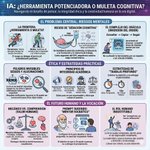
¿Estamos usando la IA para pensar mejor o para dejar de pensar?
En este nuevo post les comparto la presentación completa de la conferencia y una infografía resumen.
🔗 danielgc.com/2025/11/25/la-i…
#InteligenciaArtificial #EducaciónSuperior #PensamientoCrítico #Docencia #IA


Qué triste la práctica de #banregio de correr a las personas por llamada telefónica, sin agradecer los años de servicio , se la acaban de aplicar a un amigo dev :(
1
338