
Ph.D candidate @Yonsei_TGIL Bioinformatics, cancer genomics, data science.
Yonsei University, Seoul
Joined January 2013
- Tweets4.6K
- Following577
- Followers93
- Likes4.6K


Seungho Oh @[email protected] retweeted

A pangenomic method for establishing a synthetic somatic variant resource in HapMap mixtures dlvr.it/TVy58y

Seungho Oh @[email protected] retweeted

🧬🌊 New preprint from our lab: DO1 Cas9, the first Cas9 nuclease characterised from the deep ocean — recovered from a metagenome at 1,500 m in the Atlantic.
❄️Cold-adapted: it cuts DNA efficiently at low temperature, where mesophilic SpCas9 retains only residual activity. 🧵1/4

Seungho Oh @[email protected] retweeted

gRely: Relyability for genome-trained sequence-to-function model predictions biorxiv.org/content/10.64898…

Seungho Oh @[email protected] retweeted
HitSV: Structural variant detection across sequencing technologies nature.com/articles/s41587-0…

Seungho Oh @[email protected] retweeted

AlphaGenome made predictions for all 9B single nucleotide variants, but can you trust them? The models are still far from accurate!
Check out our updated preprint (now a full paper, upgraded from our early pre-CSHL AI symposium draft):
biorxiv.org/content/10.64898…

Seungho Oh @[email protected] retweeted

After many years of effort, deliberation, excitement, angst, joy, and Wednesday afternoon lab lunches, our group's first manuscript on cachexia, led by Venise Jan Castillon, Amy Xie, and really our whole lab nature.com/articles/s41591-0… @NatureMedicine

Seungho Oh @[email protected] retweeted

It used to cost $ 5-10k to process one spatial biology slide 5 years ago, and it's still costs $ 5-10k today. Spatial biology hasn't seen the same Moore's law-like drop in costs that NGS had (see image). Many of the diseases with the greatest burden on health are multifactorial, involving complex interactions between cell types inside 3D tissues, and spatial biology is critical for understanding diseases & designing drugs to solve these multifactorial challenges.
Data per spatial biology slide has definitely increased, but more data per slide doesn't replace the need to measure biological heterogeneity across tissues, patients and conditions. We still need to process a huge number of independent samples and slides. Unlike NGS, where the growth in data density per flow cell enabled barcoding and profiling of greater numbers of samples, spatial is limited by the number of tissue sections you can plate per slide and not easily multiplexed in the same way. This constraint might explain why spatial biology adoption has been more concentrated on applications with high-value samples (e.g. patient samples from clinical trials), rather than early drug discovery, where hundreds or thousands of slides might be needed (e.g. in high-throughput screening).
Spatial data is obviously extremely valuable and fills a key gap missed by other measurement technologies, but this bottleneck is a key blocker slowing the discovery of better drugs against complex diseases. Understanding complex disease requires systematically measuring how tissue biology varies across samples, disease states, and lots of perturbations.
This is also one of the reasons that we ended up building our own in-house custom hardware & automation at Waypoint, to make it possible to profile hundreds (and later thousands!) of spatial biology slides per month. The goal is to enable very large-scale spatial perturbational screens & new types of AI models that learn how tissues respond to these interventions.

Seungho Oh @[email protected] retweeted

After a long wait, tangermeme is out @naturemethods!
tangermeme implements the primitives of genomic sequence-to-function modeling with efficient, tested, and composable functions.
I use it every day in my work, and I hope you find it useful too.
nature.com/articles/s41592-0…

Seungho Oh @[email protected] retweeted

ヒト心臓発生をシングルセル・空間マルチオミクスで解析し、21の組織ニッチやペースメーカー細胞の多様性、心筋成熟の時空間動態を明らかにし、21トリソミーでは心室壁を形成する成熟心筋細胞の減少とアポトーシス増加が生じることを示した論文がNature誌に発表されました。
nature.com/articles/s41586-0…

Seungho Oh @[email protected] retweeted

Our October issue is live! 🎉
nature.com/nmeth/volumes/23/…
On the cover, polygenic risk score prediction in diverse populations is made possible with a new computational tool, SPLENDID. Paper: nature.com/articles/s41592-0…

Seungho Oh @[email protected] retweeted
ASTRA enables zero-shot super-resolution of spatial transcriptomics across capture geometries biorxiv.org/content/10.64898…

Seungho Oh @[email protected] retweeted

Phylogenetic inference should be impossible, and yet it works. Lena Collienne led a project to build deep learning on the classical ideas that make it work. Now out in Systematic Biology.
matsen.group/general/2026/10…

Seungho Oh @[email protected] retweeted

Excited to share our new work in @naturemethods on how neural networks used within a rigorous statistical framework can enable powerful, unbiased case-control analysis of spatial data of any modality. nature.com/articles/s41592-0…. @soumya_boston, @broadinstitute, @MGBResearchNews.

Seungho Oh @[email protected] retweeted
VIMA: a deep learning-based method to identify differentially enriched features in spatial datasets.
nature.com/articles/s41592-0…

Seungho Oh @[email protected] retweeted
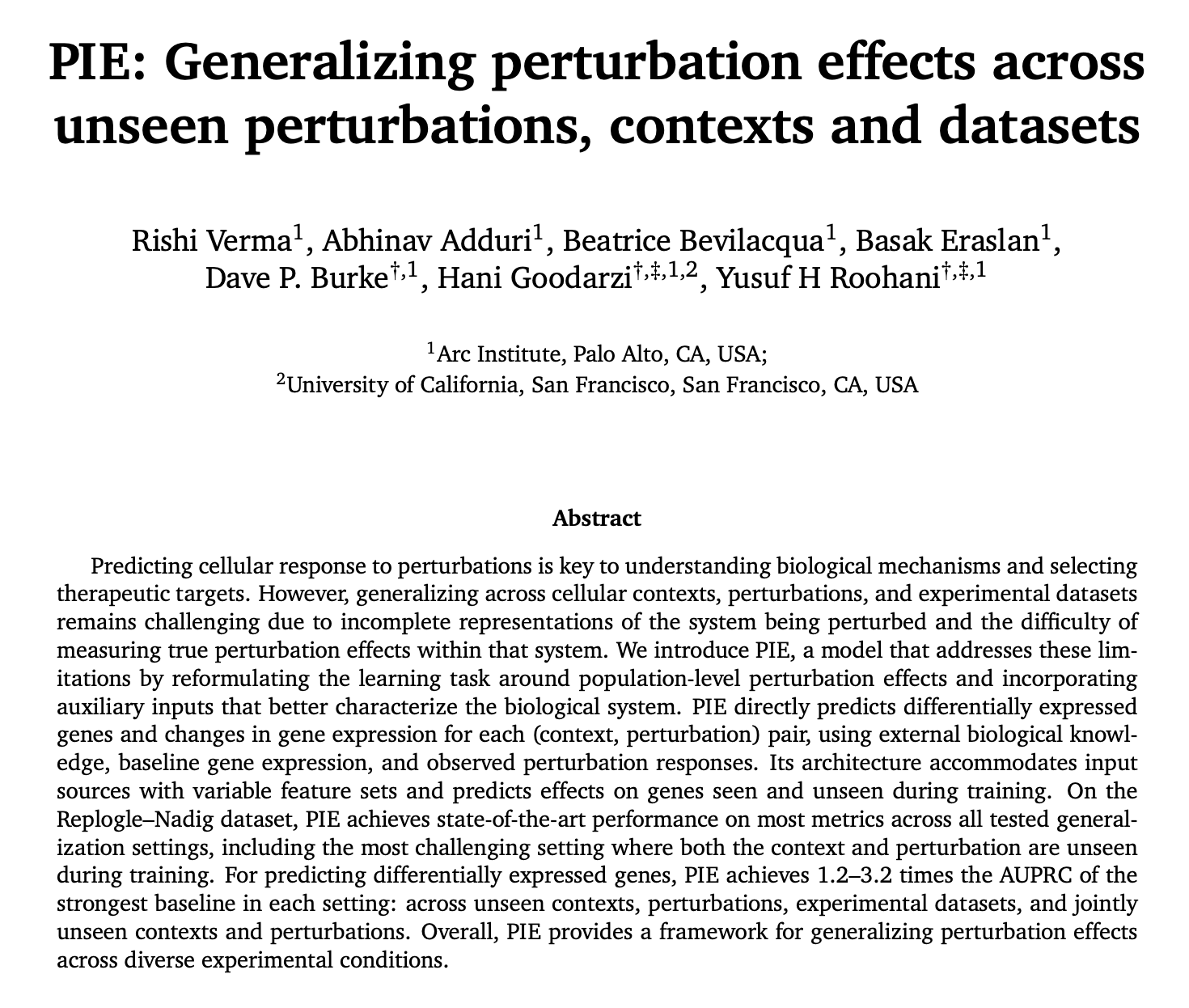
PIE uses DepMap dependency profiles as inputs, so some of its biological priors are themselves perturbation readouts. Its “unseen perturbation” setting can therefore mean predicting an unmeasured transcriptional response to an experimentally characterized intervention.

Seungho Oh @[email protected] retweeted
PIE: Generalizing perturbation effects across unseen perturbations, contexts and datasets biorxiv.org/content/10.64898…

Seungho Oh @[email protected] retweeted

IGVF researchers developed a scalable approach to interpret uncertain genetic variants.
Using experimental and predictive evidence, the team reclassified 75% of 16,115 VUS and preclassified 62% of >90,000 unobserved variants.
biorxiv.org/content/10.64898…

Seungho Oh @[email protected] retweeted

Backprop has been the only credit assignment algorithm capable of training large neural nets.
Introducing Dust, the first zeroth-order method to pretrain transformers to approach and sometimes even *exceed* backprop with large amounts of computation (bitter lesson!)
- Dust is on the order of 1,000 to 10,000x more compute efficient than EGGROLL, the state-of-the-art ES method, for training transformers.
- We chose pretraining transformers because it's arguably the hardest task possible for zeroth-order optimization.
- Search in high dimensions is really misunderstood: zeroth-order usually gets better with overparameterization, not worse, i.e. at a fixed population size, larger models (up to 120x) reach a lower loss than smaller ones.
- Backprop-like gradients emerge from a large population of activation perturbations, and the alignment holds up at every scale we tested, up to 1B tokens, which is critical for scaling.
The core idea is a *virtual population*, which helps scale to large populations in transformers by perturbing activations in parallel.
w/ @bishmdl76, @cs_serdar, @akshayvegesna
Seungho Oh @[email protected] retweeted

Global Central Limit Theorems for Markov chains with normal transition operator
arxiv.org/abs/2610.02282
In my PhD days that I studied "non-normal" Markov chains, i.e. Markov chains whose kernels are non-normal, and wrote up this piece in CPC:
cambridge.org/core/journals/…

