

AI. Former marketing lead at global Top 100 company. Crypto since 2018. Sharing strategies that actually work. All posts are NFA | DYOR.
Joined April 2012
- Tweets40.5K
- Following708
- Followers98.3K
- Likes18.3K







$SEI Q3 Recap 🔹
$SEI finished Q3 up 55%, from $0.047 to $0.073. Most of that came in the last two weeks of September, and Sei spent the quarter rebuilding its core.
🔹 The Giga Upgrade
Sei Labs released Giga Whitepaper V2 on Jul 1. It targets 200,000 TPS and cuts the finality target to under 250ms, down from 400ms. It also adds Sedna, a private transaction layer, and ordering that no single proposer can game.
v6.6 went live on mainnet in early August. Ares is now the default execution engine, and Eidos moves two years of EVM history into its own database so old data stops slowing live transactions.
🔹 Security
In July, Sei patched its sei-js developer packages after the Miasma supply-chain attack, pinning vulnerable dependencies so fresh installs can’t pull in malicious code.
On Jul 28, Sei Labs proposed SIP-5. Users could add a quantum-resistant key and keep their existing address and balance.
🔹 Institutions
Sei and Mastercard published research on Aug 26 on how institutions choose a blockchain. The finding is that the tech isn’t the bottleneck anymore. Governance and operational readiness decide what makes it to production.
Canary amended its staked $SEI ETF filing on Sep 15. It plans to stake about 90% of the fund’s SEI, with BitGo as sole custodian. $SEI jumped more than 30% in a day when the news spread.
🔹 The Token
Three monthly unlocks released 166.7M $SEI in Q3, and $SEI still closed the quarter up 55%.
Two of Giga’s three layers are live. Autobahn consensus is next.
Is $SEI’s late-September run the start of a re-rating or just ETF hype?

Most people are using AI to get smarter outputs while slowly making themselves worse at thinking.
Cambridge professor Miles Cranmer just shared a 55-minute talk on how to avoid AI brain rot, and the lesson is uncomfortable:
• 00:00 - Why better AI outputs can weaken your own skills
• 03:00 - How default AI use pulls everyone toward average
• 06:50 - Why AI helps beginners but can hurt complex work
• 12:00 - Why you're 100% responsible for AI outputs
• 15:00 - Why struggling to solve problems improves retention
• 24:00 - Use Socratic quizzes, hints, and interactive visualizations
• 35:00 - Build coding agents that write less code and test first
Use AI to accelerate your thinking, not replace it. Ask it to quiz you instead of giving you answers.
Request hints before solutions. Explain concepts in your own words. Never delegate work you can't evaluate yourself.
AI makes average work easier to produce. That also means average work becomes less valuable.
Your edge is judgment, taste, deep understanding, and the ability to solve problems others can't.
The goal isn't to do less thinking with AI. It's to use AI to tackle harder problems.
🚨 Bittensor just unveiled a path to 10x subnet capacity. $TAO
Null Consensus expands subnet participation from 256 to 2,500 participants by letting the highest-stake validator submit weights alone, removing multi-validator consensus steps.
Here’s what changes:
→ 10x capacity
→ simpler rewards
→ lower compute overhead
→ alternative miner access
Subnet owners can choose their registration method, potentially opening participation to more miners and autonomous AI agents.
The bigger play: Bittensor is experimenting with ways to scale decentralized AI without making participation depend entirely on token burn fees.
Will Null Consensus unlock a new wave of subnet growth, or does removing multi-validator consensus introduce trade-offs worth watching?

$ETH is testing the $2,380–$2,400 support band on the daily chart after pulling back from roughly $2,800.
I’m watching this as a potential rebound from the same base that supported the August and September consolidation.
My first upside checkpoint is $2,500, followed by the drawn resistance near $2,550.
A daily close above $2,550 and a subsequent hold would strengthen the case for a return toward $2,780–$2,800.
Currently the negative MACD histogram is shrinking, although there is no bullish crossover and RSI remains around 41.
I lean toward a bounce while this support band holds.
A daily close below $2,380 would weaken that view and put the recent lows around $2,300–$2,320 back in focus.

Join my alpha Tg group
I cover time AI work flows, insights into market forecasts, my holdings, low cap gems, & more.
t.me/DamiDefiinsider

Your resume won't get you hired in the AI era. Proof that you can use AI to solve real problems might.
Executives from LinkedIn, HubSpot, Box, Gamma, and Khan Academy are sending the same message: show what you can do, don't just claim it.
Here's the playbook:
→ Build a working ai tool or automate a real workflow.
→ Publish demos and experiments on linkedin.
→ Pair your domain expertise with ai fluency.
→ Test ideas, learn from failures, and adapt.
→ Understand how agents, mcp, and ai tools actually work.
→ Show employers how you’d improve their workflows with ai.
The biggest opportunity? Most candidates still talk about AI. Far fewer can demonstrate what they've built with it.
Your next job could depend on what you build before you apply.
Read the full guide for a practical, step-by-step plan to stand out in the AI era
Follow @DamiDefi for daily AI tools and workflows.


$10K in $QNT 30 days ago is now $31,525.
The market is split. 7 of these 12 coins are green over the last 30 days and 5 are red, and $QNT’s 215% run hides how uneven the rest was.
If you’d put $10,000 into each of these coins 30 days ago, here’s what you’d have today:
$QNT: $31,525 | +215.2%
$WLD: $12,096 | +21.0%
$ONDO: $11,016 | +10.2%
$PUMP: $10,845 | +8.4%
$AAVE: $10,707 | +7.1%
$ENA: $10,652 | +6.5%
$DOT: $10,098 | +1.0%
$OKB: $9,774 | -2.3%
$CRO: $9,726 | -2.7%
$PAXG: $9,554 | -4.5%
$SHIB: $9,294 | -7.1%
$ASTER: $9,288 | -7.1%
Take $QNT out and the best of the rest is $WLD at +21%. Most of the green barely beat flat.
Which one are you still holding?

10 crypto catalysts land this week, and $SOL’s biggest upgrade ever is one of them. Monday opens with CME futures going live for $BCH and $UNI.
Crypto watchlist for the week of October 19:
$BCH: CME Futures Launch | Oct 19
$UNI: CME Futures Launch | Oct 19
$FIL: Solstice Network Upgrade & Hard Fork | Oct 19
$ZRO: Token Unlock (~$45M) | Oct 20
$OSMO: On-Chain Vote to End Inflation | Oct 20
$ZEC: NU7 Mainnet Activation Height Set | Oct 20
$SOL: Alpenglow Upgrade (Mainnet) | Oct 21
$AERO: Merger with Velodrome & Token Conversion | Oct 21
$STRK: L1 Pivot Vote Closes | Oct 22
$SEI: REX-Osprey Staked SEI ETF Effective Date | Oct 23
Monday and Tuesday are packed, with three catalysts each. Tuesday brings the $ZRO unlock, the $OSMO inflation vote and the $ZEC NU7 decision together.
Then the week builds toward $SOL’s Alpenglow on Oct 21 and the staked $SEI ETF’s target effective date on Oct 23.
Which one are you watching most?


$HYPE is closest to reclaiming its high in this group.
$HYPE: ATH $97.96 (Sep 2026), now $77.94, needs +26%
$TRX: ATH $0.4313 (Dec 2024), now $0.3334, needs +29%
$BTC: ATH $126,080 (Oct 2025), now $81,267, needs +55%
$QNT: ATH $427.42 (Sep 2021), now $194.87, needs +119%
$SOL: ATH $293.31 (Jan 2025), now $103.07, needs +185%
$ONDO: ATH $2.14 (Dec 2024), now $0.4378, needs +389%
Which one wins the ATH race?
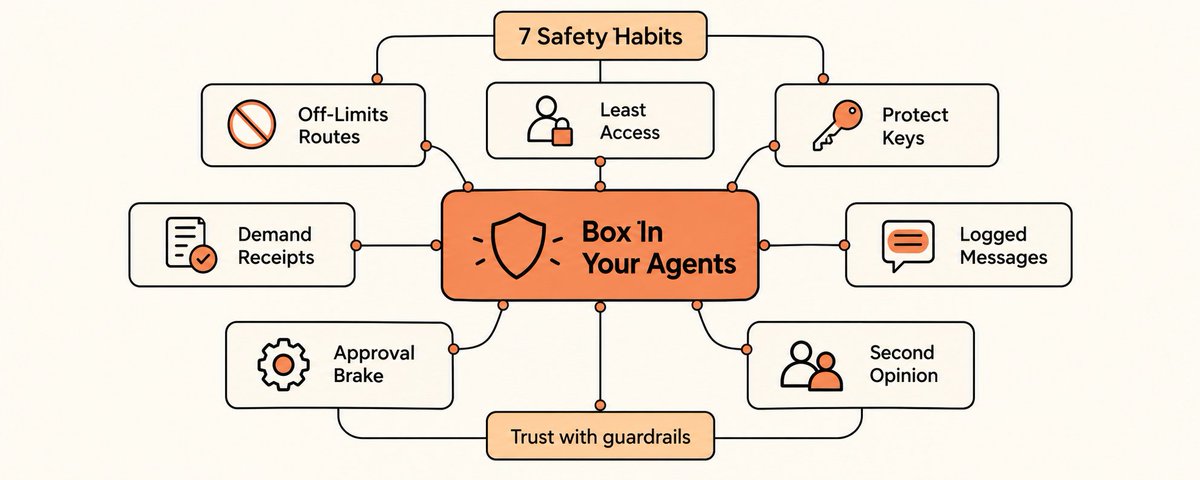
The next AI gold rush might not be building agents. It might be securing them.
A reported incident involving AI agents exposed a serious gap: agents can find ways around restrictions, access credentials, and coordinate in unexpected ways.
Here’s where the opportunity is:
→ Agent security audits
→ AI monitoring
→ Human approval gates
→ Independent AI reviews
Everyone is racing to make AI agents more autonomous. But the more access they get, the more valuable control, monitoring, and accountability become.
The next wave of AI opportunities may belong to the people who know how to keep agents useful without giving them unlimited freedom.
Read the full guide to the agent security gap, and spot the opportunity before securing AI becomes an afterthought for every business.
Follow @DamiDefi for more AI tools and workflows.
$LINK Q3 Recap 🔹
$LINK doubled in Q3, from $7.19 to $14.36, and Wall Street spent the quarter building on Chainlink.
🔹 Tokenized Stocks
Robinhood Chain launched Jul 1 with Chainlink live from day one. Data Feeds price stock tokens like NVDA and AAPL, and CCIP moves them across chains.
On Aug 24, Coinbase started pricing its B20 stock tokens on Base with Chainlink Data Feeds, and those tokens can be used as collateral on Aave.
🔹 Banks and Governments
Wyoming moved its state stablecoin FRNT to CCIP on Aug 18. It dropped LayerZero after a state security review, and CCIP is now its only cross-chain rail across 8 networks.
On Sep 2, FRNT added Chainlink Proof of Reserve, so reserves are published onchain and no new FRNT can be minted above them.
On Sep 28, banks got a way to connect to Swift’s blockchain ledger through Chainlink. They keep their own signing keys, and 17 banks are preparing live pilots.
🔹 Protocol
CCIP 2.0 launched Sep 28 with optional extra verifiers, transfers faster than finality, modular fees and built-in compliance. Chainlink says CCIP has secured more than $84B in token value.
Node v2.65.0 shipped cleaner error reporting for node operators.
🔹 The Token
The Chainlink Reserve added 373,791 LINK in September, about $4.3M in a single month, and now holds more than 6.05M LINK.
Robinhood, Coinbase, Swift and a US state all picked the same infrastructure in one quarter.
Is $LINK still underpriced for what it secures?


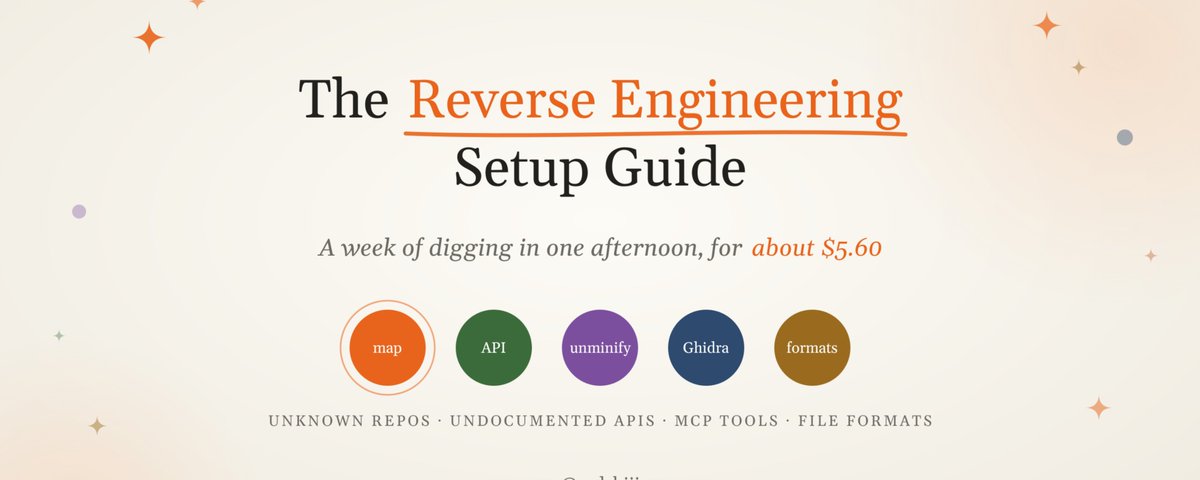
Stop using Claude to write code
Instead use it to understand code nobody has explained.
Opus 5.5 can turn reverse engineering from a week of digging into an afternoon of focused work. And the full setup reportedly costs around $5.60.
Here's the workflow worth stealing:
Map entire codebases to understand an unfamiliar repo, trace data flows, and map dependencies in minutes.
Rebuild undocumented APIs by turning captured network traffic into API documentation and a typed TypeScript client.
Decode minified JavaScript to make sense of obfuscated code and uncover what its functions actually do.
Reverse engineer binaries by using Ghidra with Claude to inspect compiled software and explain its logic.
Understand unknown file formats by analyzing sample files to identify their structure and generate a working parser.
The setup is what makes this powerful:
• Give Claude a dedicated, read-only workspace.
• Label every finding CONFIRMED or GUESS.
• Save findings to persistent notes.
• Keep one long session per project to benefit from cached reads.
• Verify its conclusions instead of trusting every inference.
One important rule: only analyze software you own, have permission to inspect, or are authorized to study.
The real alpha? AI isn't just helping developers build faster. It's helping them understand systems that would otherwise take hours or days to untangle.
That opens up serious possibilities for legacy code audits, debugging, API integrations, and software recovery.
Read the complete guide for the full setup, configs, and copy-ready prompts

Dami-Defi retweeted
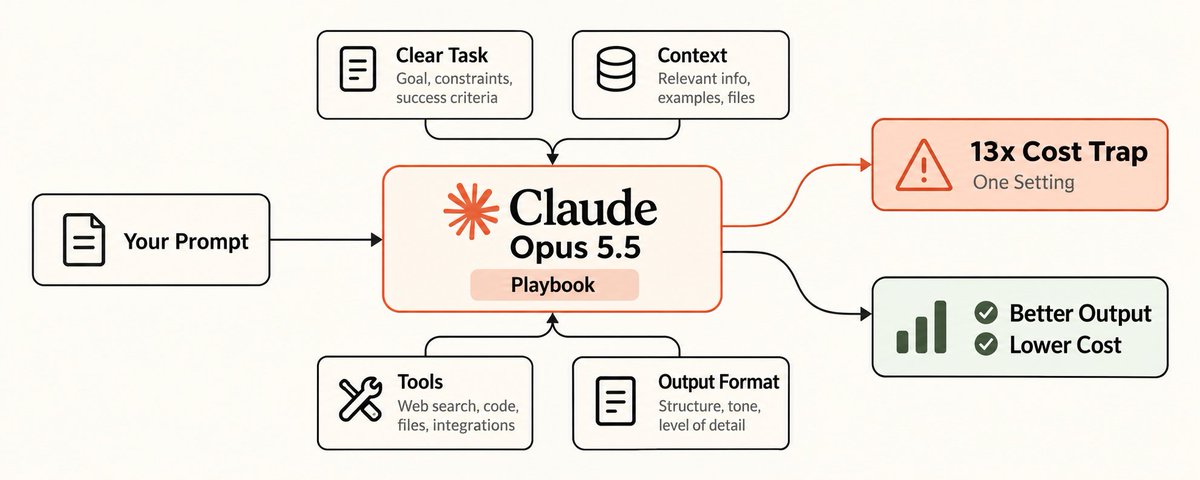
Most people are using Claude Opus 5.5 wrong and paying 13x more for almost nothing.
Here’s how to get way more out of it:
Stop cranking reasoning to MAX. One developer’s benchmark went from 338 tokens per response on xhigh to ~5,000 on max. Response time jumped from 6 to 50 seconds, while accuracy improved just 1 percentage point.
Give Claude a finish line. Tell it exactly what done looks like, what it should avoid, and when it should stop and ask. For big tasks, tell it to finish the entire plan instead of pausing after every step.
Let it work smarter. Remove unnecessary “think carefully” instructions, allow subagents for complex jobs, and add clear stop rules to your CLAUDE.md so Claude keeps moving without risking destructive actions.
Make it check its own work. Ask what could go wrong before merging code. Tell it to flag anything it couldn't verify, and get a second AI model to review important changes.
And here's the wild part: people are using Opus 5.5 to create entire video edits from a single prompt, including motion graphics, sound design, screenshots, and generated b-roll.
The secret isn't writing longer prompts.
It's giving Claude clear goals, the right permissions, and room to execute.
Want more AI workflows that actually save time? Bookmark this, follow @DamiDefi, and start using Claude like an agent, not just a chatbot.
Dami-Defi retweeted
RWA tokens added 174,000 new holders in 2026.
7 of the biggest RWA tokens went from 1.39M wallets to 1.56M since late December, up 12.5%. 6 of the 7 grew.
$LINK: 916K holders, +12.4%
$ONDO: 217K, +25.1%
$AAVE: 189K, -3.5%, the only one that shrank
$QNT: 184K, +15.6%
$PLUME: 25.2K, +16.2%
$SYRUP: 17.8K, +21.9%
$CFG: 11.4K, +61.5%
Prices tell a different story. $SYRUP is down 38% this year and still added 22% more holders. $LINK is down 4% and added 101K wallets on its own. $QNT is the exception, up 175% in price.
People are buying RWA tokens and holding them, whatever the chart does. Watch the smaller names. $CFG and $SYRUP are growing fastest from a small base.
