

AI. Former marketing lead at global Top 100 company. Crypto since 2018. Sharing strategies that actually work. All posts are NFA | DYOR.
Joined April 2012
- Tweets40.5K
- Following708
- Followers98.4K
- Likes18.3K







Dami-Defi retweeted
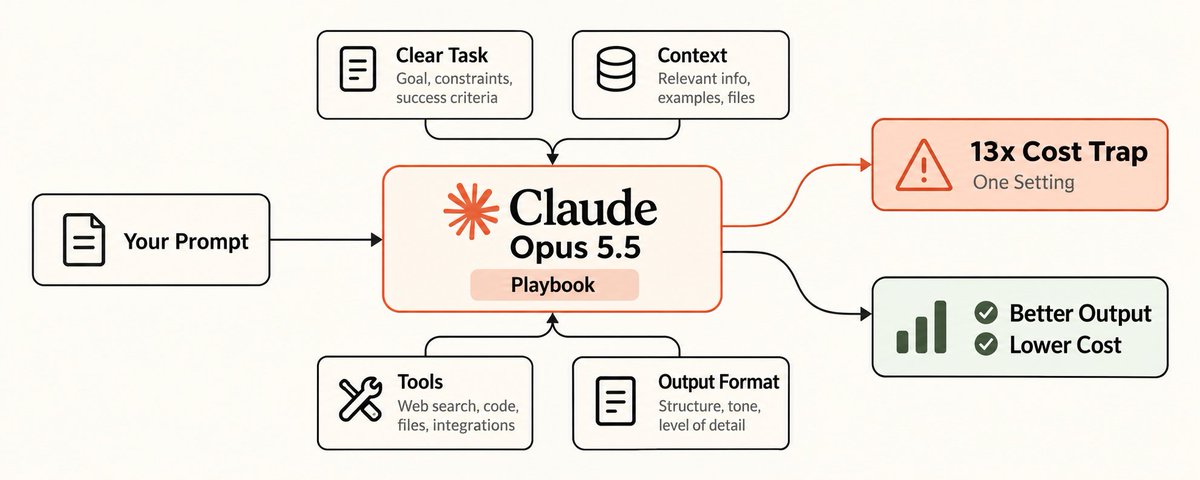
Most people are using Claude Opus 5.5 wrong and paying 13x more for almost nothing.
Here’s how to get way more out of it:
Stop cranking reasoning to MAX. One developer’s benchmark went from 338 tokens per response on xhigh to ~5,000 on max. Response time jumped from 6 to 50 seconds, while accuracy improved just 1 percentage point.
Give Claude a finish line. Tell it exactly what done looks like, what it should avoid, and when it should stop and ask. For big tasks, tell it to finish the entire plan instead of pausing after every step.
Let it work smarter. Remove unnecessary “think carefully” instructions, allow subagents for complex jobs, and add clear stop rules to your CLAUDE.md so Claude keeps moving without risking destructive actions.
Make it check its own work. Ask what could go wrong before merging code. Tell it to flag anything it couldn't verify, and get a second AI model to review important changes.
And here's the wild part: people are using Opus 5.5 to create entire video edits from a single prompt, including motion graphics, sound design, screenshots, and generated b-roll.
The secret isn't writing longer prompts.
It's giving Claude clear goals, the right permissions, and room to execute.
Want more AI workflows that actually save time? Bookmark this, follow @DamiDefi, and start using Claude like an agent, not just a chatbot.

Dami-Defi retweeted
RWA tokens added 174,000 new holders in 2026.
7 of the biggest RWA tokens went from 1.39M wallets to 1.56M since late December, up 12.5%. 6 of the 7 grew.
$LINK: 916K holders, +12.4%
$ONDO: 217K, +25.1%
$AAVE: 189K, -3.5%, the only one that shrank
$QNT: 184K, +15.6%
$PLUME: 25.2K, +16.2%
$SYRUP: 17.8K, +21.9%
$CFG: 11.4K, +61.5%
Prices tell a different story. $SYRUP is down 38% this year and still added 22% more holders. $LINK is down 4% and added 101K wallets on its own. $QNT is the exception, up 175% in price.
People are buying RWA tokens and holding them, whatever the chart does. Watch the smaller names. $CFG and $SYRUP are growing fastest from a small base.

Dami-Defi retweeted
8 AI updates from this week, newest first:
1. GPT-5.5 left ChatGPT, ChatGPT Work and Codex today. It still works in the API. If any saved settings, agents or scheduled tasks pick GPT-5.5, update them.
2. Gemini 4 Argon launched at $2 in / $10 out per million tokens. From December 1 that becomes $4 / $20. Use it for coding and long research runs while it’s half price.
3. Grok, Cursor and X now sit in one subscription: $8, $30, $100 or $200 a month. Grok and Cursor share one usage pool that resets weekly. Other models inside Cursor still cost extra.
4. Fish Audio’s Drama 3 reads hard words correctly 93.2% of the time, up from 73.2% on S2.1 Pro. That covers names, numbers, codes and tech terms, which are what break AI voiceovers.
5. Anthropic went from about 2,500 code merges a day in May to over 30,000 in September. Git couldn’t keep up, so it built its own source control system, Scion.
6. Meta’s Muse Wonder remembers your project between chats, so you don’t have to explain it again each time. It’s live for developers and Muse Code now, with the wider Muse app coming next.
7. Codex CLI can now run several tasks at once, each in its own copy of your code with its own branch, so they don’t overwrite each other.
8. Claude now works inside Google Docs, Sheets and Slides. It edits the text, cells or slides you select, so no more copying answers between tabs. It’s in beta on all paid plans.
Which one actually changes how you work?

Dami-Defi retweeted
Bitwise now has 9 single-coin ETFs in the US: BTC, ETH, XRP, SOL, HYPE, DOGE, LINK, NEAR and AVAX.
The smallest of those is AVAX, at $4.7B.
Bitwise still has no fund for these, even though they’re bigger:
→ BNB, $99.7B (#4)
→ TRX, $31.4B (#8)
→ ZEC, $20.7B (#10)
→ XMR, $9.9B (#14)
→ ADA, $9.6B (#17)
Some of them are clearly in demand. TRX and ZEC already have US spot ETFs from other issuers. Grayscale launched ZCSH in August, and Canary launched a staked TRX fund (TRXS) in September.
Bitwise has also filed for TRX, ZEC, SUI, UNI, TAO, Canton and a few others. Two of the coins from that December filing, HYPE and NEAR, already have Bitwise spot ETFs.
So which ticker should get the next one?

Dami-Defi retweeted
Robinhood’s AI agents now use its tools almost 30 million times a day.
That isn’t 30 million trades. A tool call is an agent asking for something: a quote, research, your portfolio, a watchlist update. Robinhood didn’t say how many of those calls turned into trades.
Here’s what they did share at HOOD Summit on Sep 29:
→ 150,000+ customers have opened agentic trading accounts since May
→ That’s about 1 in 190 of Robinhood’s 28.6M funded customers
→ The Robinhood Trading MCP is live, so you can plug your own third-party agent in
→ Third-party agents can already run inside Robinhood Legend through that same MCP
Coming soon:
→ Robinhood Agents, built into the app. You name it, give it its own account and pick a model. It can only touch the money in that account, and trade approval is on by default.
→ Loops, which run a trading strategy on repeat around the clock
→ Agent Apps from providers like Unusual Whales, Nasdaq and Token Terminal, at $5 to $30 a month
The usage number is big, and the user number is still small. Less than 1% of customers have opted in, and their agents are already making millions of requests a day. Most of that is research for now. Loops is when the agents start trading on their own.

Dami-Defi retweeted
Copilot isn't a chatbot anymore. Microsoft just turned it into three separate tools.
Microsoft just split Copilot into three modes, and each one does a different job.
Home is where you do everyday work. It puts Chat and Cowork in one place, with Word, Excel and PowerPoint built in. You ask, and it makes or edits the actual file.
Code is for building things. You describe an app, dashboard, tracker or workflow in plain English, and it builds it on the same tech behind GitHub Copilot. It runs sandboxed inside your company's tenant.
Autopilot is the one people will talk about. It used to be called Scout. You give it a role and a goal, and it keeps working while you're away. It chases follow-ups, runs the weekly stuff and picks a project back up days later. It has its own identity, memory and workspace, with audit and permission controls.
Most people can't use all three yet:
→ Home: rolling out through the Frontier program in the coming weeks
→ Code: rolling out through Frontier, with a preview for M365 Premium and Pro subscribers later this year
→ Autopilot: private preview only, expanding from the end of September
Code and Autopilot are usage-based, so you pay in Copilot Credits based on how much you use them.
Chatbots answer you when you ask. Autopilot keeps working whether you ask or not, and that's what every big AI company is now racing to build.
Follow for more updates

Dami-Defi retweeted

1/ $GACHA is live on @base via @virtuals_io.
It powers the first launchpad where tokens drop like loot boxes: same odds for all, luck as the only edge.
Stake it to get a slice of every machine that graduates. An index for the trenches.
CA: 0xd5A09d20652b58872a2E0F302DE6Ad2326dB3b84
Dami-Defi retweeted
$AAVE is up almost 40% in the past month, 2 of DeFi's most established lending protocols, but their scale is now very different.
$AAVE vs $COMP
Head to Head Series: Leading Lending Protocols Edition
$AAVE:
The heavyweight of onchain lending.
→ Price: ~$166.30
→ Market cap: ~$2.56B
→ 24h volume: ~$818.9M
→ FDV: ~$2.66B
→ TVL: ~$17.75B
→ Market cap / TVL: 0.1445
→ Circulating supply: ~15.43M / 16M
→ Active loans: ~$12.65B
→ 30D fees: ~$35.84M
→ 30D protocol revenue: ~$4.65M
Aave V3 currently operates across 21 chains, with Ethereum accounting for about 84% of its TVL. It has generated roughly $1.85B in cumulative fees.
Aave's strength is scale: deep liquidity, a broad multichain footprint and a lending market with more than $12B in active loans.
Flip side: AAVE already carries a multi-billion-dollar valuation, so future growth has to be measured against a much larger base.
$COMP:
The original DeFi lending heavyweight is still generating meaningful activity.
→ Price: ~$25.04
→ Market cap: ~$250.4M
→ 24h volume: ~$29.3M
→ FDV: ~$250.4M
→ TVL: ~$1.62B
→ Market cap / TVL: ~0.15
→ Circulating supply: ~9.99M / 10M
→ Active loans: ~$648M
→ 30D fees: ~$2.48M
→ 30D protocol revenue: ~$321.8K
Compound currently operates across 10 chains, with roughly 93% of its TVL on Ethereum. Its token supply is essentially fully circulating, with 9.99M of 10M COMP in circulation.
Flip side: the protocol is operating at a much smaller scale than Aave across TVL, active loans, fees and revenue.
The data shows two different profiles: $AAVE is the much larger lending machine, while $COMP offers exposure to a smaller protocol with virtually its entire token supply already circulating.
For the leading lending narrative, $AAVE remains the name to watch. $COMP is the smaller-cap alternative with a very different valuation profile.

Dami-Defi retweeted
While Bitcoin's Big L1 Rivals Were Losing Active Users, $APT Quietly More Than Quadrupled Its Daily Active Addresses in 30 Days.
Here's the DAA growth recap (Sept-Oct 2026):
$APT: 64,000 to 271,000+ | +323%
$SUI: ~85,000 to 134,500+ | +58%
$SOL: ~2.7M to ~4.1M | +52%
$LTC: ~237,000 to 281,000+ | +18.5%
$TRX: ~4.0M to ~3.7M | -7.5%
$BNB: ~4.5M to ~2.7M | -40%
$ETH: ~767K to ~449K | -41.5%
$NEAR: ~121K to ~63K | -48%
$APT was the month's standout, the only chain on this list to more than double its activity. $SUI and $SOL both grew by more than half.
Meanwhile four of the eight are in decline: $ETH lost over 41% of its daily active addresses, $NEAR dropped nearly 48%, and even $BNB, one of the largest chains by user base, fell 40%.


Dami-Defi retweeted
A DTCC Commercial Tokenization Launch, Two XRPL Protocol Upgrades, and Chainlink's CCIP 2.0 Are All Landing in October.
RWA's institutional buildout keeps accelerating.
Here are the major catalysts for the month:
RealFi ($ADA): targeting an October 1 mainnet launch for USDr, its reserve-backed stablecoin. The unstaked version is backed by tokenized money-market funds and AAA CLO ETFs, and the staked version adds private credit with a seven-day cooldown
$PLUME: joined the DTCC Digital Assets Solutions Industry Working Group ahead of DTCC's October commercial tokenization launch, backed by Plume's SEC transfer agent registration
$ONDO: a DTCC tokenization participant alongside BlackRock, JPMorgan, Goldman Sachs, Nasdaq, and NYSE, and the first to issue tokenized stocks backed by DTC token entitlements (CRCLon and SPYon)
$CFG: CP172 passed with 98.53% support, enabling 1:1 conversion of CFG into Centrifuge, Inc. shares, with the legal and operational steps to activate it landing in October
$SYRUP (Maple Finance): hosting its Q3 Ecosystem Update Call on October 13 after a record H1 with $4.6B AUM (up 81% YoY) and $5.4B in YTD originations, alongside a syrupUSD upgrade to Chainlink CCIP 2.0
$XRP: PermissionDelegationV1_1 activates October 5 and the Batch amendment follows October 9, alongside XRP Seoul 2026 on October 3 featuring Woori Bank, Kakao Bank, Kyobo Securities, and Kbank
$LINK: CCIP 2.0 went live September 28 with issuer-run Cross-Chain Verifiers, configurable settlement speeds, and built-in compliance via Chainlink ACE, securing over $84B in cross-chain value
BUIDL (BlackRock): holders can redeem for RLUSD 24/7 through Ripple and Securitize's smart contract, live since September 2025, with BUIDL the largest tokenized Treasury product at ~$2.8B
$KAIO: Nomura's Laser Digital-incubated RWA tokenization protocol, with a fixed 10 billion token supply and its retail-focused KASH product
RWA Inc ($RWA): first monthly RWAINC distribution to Diamond holders on October 1, then a token unlock of ~18.3M tokens (~$30.7K, 2.4% of market cap) on October 25
MindChain ($NILA): mainnet launch scheduled for October as the "world's first fully insured blockchain," alongside its Migration Portal opening and a U.S. listing of NILA
The DTCC launch is the biggest story this month. $PLUME and $ONDO are both inside it, next to BlackRock, JPMorgan, Goldman Sachs, and the major exchanges.
Which catalyst are you watching closest?

Dami-Defi retweeted

CA: 0x378A50eaC56f45Fb74e4cE7F1962dbCA33515c14
Check mcdao.io/app/mcd before trading for launch tax details. Liquidity will be seeded on Uniswap in the next 10 minutes.


Dami-Defi retweeted
Hyperliquid ($HYPE) and Pump.fun ($PUMP) Single-Handedly Generated Over 70% of the Entire Top 10 Decentralized Exchange Protocol Revenue Over the Past 30 Days.
Here's the breakdown:
$HYPE: $60.11M
$PUMP: $33.73M
$CAKE: $6.89M
$UNI: $6.10M
$JUP: $4.69M
$AERO: $4.11M
$MET: $1.67M
$RAY: $1.13M
$CRV: $899.5K
$DYDX: $273.1K
$HYPE continues to prove the immense capital efficiency of on-chain perpetuals, pulling in a massive $60.11M in monthly protocol revenue to sit comfortably at the top of the DEX ecosystem.
Solana-native launchpads and ecosystem AMMs retain a powerful grip on retail trading volume, with $PUMP, $JUP, $MET, and $RAY driving substantial fee generation across high-frequency swaps.
Meanwhile, legacy spot giants like $UNI and $CAKE continue to capture consistent baseline yields, alongside ecosystem-specific powerhouses like $AERO on Base.

Dami-Defi retweeted
how do you stay safe when your entire net worth is just sitting on a block explorer for anyone to see?
@waleswoosh told us about a friend who built a six figure portfolio from almost nothing.
then a scam wiped out most of it.
everyone in crypto has a plan to get rich. far fewer have a plan to stay under the radar.
