



Our tool *pylifemap* for mapping data onto the complete Tree of Life is ready !
Explore YOUR datasets (metagenomics, ecology, genomics, outreach...) in a FULL taxonomy-aware context, interactively!
Gve it a try!
The doc: lifemap-tol.github.io/pylife…
The draft: biorxiv.org/content/10.64898…


NEW ARTICLE! After showing that ghost lineages (extinct, unknown, unsampled) can distort gene flow detection, we now show that gene flow signals can be used to detect, quantify, and place ghost species in the Tree of Life!
academic.oup.com/evolinnean/…
More to come soon! (hopefully)

📢 A new version of Lifemap will soon be available at a new URL. Automatic redirection will be implemented, but if you develop or use tools or applications that could be affected, please contact me to ensure a smooth transition: [email protected]. 🚀
Hello!
I now post on bluesky. 🦋🦋🦋
See you there!!
bsky.app/profile/damdevienne…
Damien de Vienne 🦋 damdevienne.bsky.social retweeted

Venez visionner les 5 grandes crises biologiques et LUCA le dernier ancêtre commun universel 🦠 avec @damdevienne du @LbbeLyon @popsciences
📅17nov
🕣11h-12h et 15h30-16h30
📍Planétarium - Cour du Collège Graphique
#ÉchappéesInattendues

[2/2] After asking, it seems that our letter was sent to the authors (which is good) and then the editor decided on its own that our letter "did not contribute substantially to the discussion..."
- What did the authors write?
- What does the/a reviewer think?
We will never know
[1/2] Very surprised by the editorial process at @PNASNews.
- We wrote a letter about a published paper
- We got a review fully agreeing with us
- we made the requested (minor) corrections
- We waited 1 month
- We got rejected without any justification...
Très hâte de cette soirée le 15 mai prochain où j'accueille mes supers collègues @melodie_bastian et Sylvain Charlat pour parler d'#evolution à La Girafe, café associatif que j'ai créé avec quelques ami.e.s dans notre village de Sainte-Consorce !!
#pint24
la-girafe.fr – at Sainte-Consorce, France

Parce qu'il s'en est passé des choses depuis Darwin, on parlera d'évolution avec Sylvain (@LbbeLyon) et Mélodie (@melodie_bastian) au cours de la soirée #pint24 !
📆15 mai
🌍Sainte-Consorce
🎟️pintofscience.fr/event/levol…
Damien de Vienne 🦋 damdevienne.bsky.social retweeted

C'est reparti sur @ulule pour @Epsiloon_mag : ce matin, nous lançons un numéro spécial, un nouveau voyage dans la forêt! C'est ici 👉fr.ulule.com/epsiloon/
📢Just a quick reminder that the international
conference SFE2 (Ecology andEvolution) will take place in Lyon next fall. And abstract submissions are still open until May, 15th!
...and note the nice session on "Macroevolution and phylogeny" 😉
@SFE2_2024
Just tried this very nice new extension in Google Chrome, the "Google Scholar PDF Reader". It eases a lot the interconnection between the paper you are reading and other cited in the text!!
A description of this tool here:
scholar.googleblog.com/2024/…

A new version of Lifemap (the NCBI taxonomy explorer) is about to be released. It will simplify the visualisation of data (@IUCNRedList, genome information, age of nodes thanks to @TTOLv5, ...) and link to external resources (@NCBI, @GBIF, @NCBI).
Any requests for YOUR research?
Damien de Vienne 🦋 damdevienne.bsky.social retweeted

How do "ghost" lineages impact use of branch length methods to infer timing of #HGT events? @toni_gabaldon &co discuss key considerations regarding the potential effect of such missing lineages: plos.io/4crpJLl Response by @damdevienne &co: plos.io/49YqVEl

PhylteR was developed and written over the years with great students/colleagues, @AuroreComte, @theo_treecou, Eric Tannier, @joseph_julien, Aurélie Siberchicot, Simon Penel, @allio_remi, @freddelsuc and Stéphane Dray.
Thanks! 🙏
For more details read the paper!
And **GIVE IT A TRY!!**
PhylteR is a package written in R language available on CRAN (cran.r-project.org/web/packa…), but also as singularity and docker containers.
Extensive documentation can be found at damiendevienne.github.io/phy….

Well, this was quick, but you get the idea!? At the end, PhylteR users obtain a list of identified outliers. Their choice then to do what they want with it (filter MSAs, prune gene trees, explore outliers, etc.).
Here is a small demo of using PhylteR. It's quite simple!
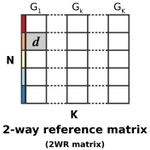
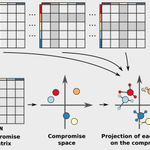
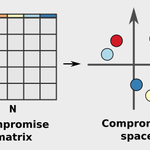
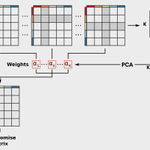
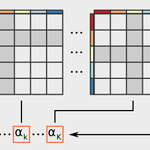
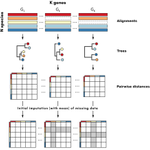
5/ From this 2WR matrix, we detect outlier values, we store them in a list, we remove these outliers directly in the initial distance matrices, and we compute the new compromise matrix. If the compromise is improved, we continue this new loop and find new outliers (if any). Etc.

