

Still life painter. Paintings, art, and other things worth looking at.
Joined January 2009
- Tweets1.6K
- Following219
- Followers2.7K
- Likes2.1K




One of the more difficult things about making a painting is knowing when to stop.
There's nearly always something else that could be adjusted or improved. Given enough time, I could probably keep tinkering with a painting for years.
But eventually you have to put down the brush.
It's difficult to think of marbles simply as children's toys once you've spent some time looking closely at them.
There are extraordinary little abstractions inside the glass, with colors that seem to twist and flow around one another.
Miniature: Marbles No. 3
Oil on wood, 2.5 x 2.5 inches

A collector once told me that he loved pears because they reminded him of people.
I'd never thought about them quite that way, but I immediately understood what he meant.
One of the pleasures of sharing paintings is discovering what other people see in them.
One of the things I love about blue-and-white porcelain is that it's rarely just blue and white.
Here the ginger jar has picked up faint orange reflections from the fruit around it, while its painted decoration gradually disappears into shadow.
I've returned to this jar in quite a few paintings, and I still find new things to appreciate about it.
Oranges, Olives, Ginger Jar
Oil on linen, 9 x 12 inches

One of the things I love about painting in the still life tradition is the sense of being in conversation with people who lived centuries ago.
The objects have changed less than you might expect. And many of the questions about light, color, and arrangement are much the same.
I've always admired paintings of groups of people, especially when each figure has its own character but the arrangement feels completely natural.
I find something similar happening with these marbles. Their different sizes, colors, and the spaces between them create a kind of visual rhythm, almost like notes in a musical phrase.
Forum No. 15
Oil on panel, 2 x 5 inches

I don't think every work of art needs to be translated into words.
When I listen to a piece of music, I don't expect it to tell me what to think. It can be beautiful, unsettling, or difficult to explain.
I think paintings deserve the same freedom.
The orange espresso cup catches your attention immediately, but I'm just as interested in the green velvet beneath it.
Most of the cloth disappears into the darkness, with only a few folds catching enough light to reveal their shapes. I've always loved that sense of things emerging from shadow, only to disappear again.
Espresso Cup on Green Velvet
Oil on panel, 5 x 5 inches

I once watched Tibetan monks dismantle an elaborate sand painting they'd spent days creating.
I knew in advance that its destruction was part of the ceremony. Actually witnessing it was another matter.
An entirely different way of thinking about what a work of art is for.
A tangerine seems like a simple enough subject, until you start looking at it carefully.
The deep crease, the uneven shape, the violet reflected into the shadows from the blue cloth... there's quite a lot going on in one piece of fruit.
Tangerine No. 2
Oil on panel, 4 x 4 inches

In 2012, I visited an exhibition of Willem van Aelst's paintings at the National Gallery in Washington.
I'd known his work for years, but seeing it in person was a revelation. I spent my entire visit in those rooms and had no desire to look at anything else.
There's a great deal of red in this painting, but it never quite stays the same color.
The brocade is almost incandescent in places, while the glass catches those same reds in fragments of light.
And I think the blue book is essential. Amid all that warmth, it gives the eye somewhere else to go.
Evening in Red
Oil on linen, 16 x 12 inches

A mentor once suggested that I should experiment with as many painting materials as possible, even if I eventually settled on one.
I mostly work in oils, but I've found his advice valuable. Working with acrylic, for instance, makes me much more aware of the extraordinary freedom oil paint gives me to change things as I go.
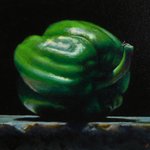
I've painted green peppers a number of times, and I keep coming back to the extraordinary shapes they can take.
This one seems almost sculptural, with that great curling fold across the front and the rest of the form gradually disappearing into shadow.
Green Pepper No. 3
Oil on panel, 4 x 4 inches

I spent years painting landscapes before turning almost exclusively to still life.
Over time my subjects have become increasingly simple. Lately I've been concentrating on individual teacups.
It's an interesting paradox. The narrower the subject becomes, the more there seems to be worth investigating.
The gold trim and blue brocade are doing their best to make this a rather grand occasion.
But that little tea bag tag dangling over the edge brings the whole thing cheerfully back to earth.
Golden Teacup
Oil on panel, 10 x 10 inches

There's a common assumption that realistic painting is largely a matter of including enough detail.
But sometimes the most convincing passages are those where the painter deliberately leaves things unresolved. An edge disappears, a form merges with the background, and the viewer's eye completes the illusion.
I'm not sure I'd recommend a squeeze of lemon in a glass of port.
But I do like the way they look together, especially when their colors turn up again in the reflections on the silver tray.
Port and Lemon
Oil on linen on panel, 6 x 8 inches

My formal education was in music, studying violin and composition.
I've come to think about color much as I think about musical harmony. A particular note can sound quite ordinary by itself, but become something extraordinary when placed alongside others.
Colors behave much the same way.
I've always loved seashells. There's something rather wonderful about a creature spending its life building such an elegant piece of architecture, without the slightest interest in making something beautiful.
And here I am, giving it a gold frame.
Miniature: Seashell No. 2
Oil on wood, 2.5 x 2.5 inches
