










cryptodee 𐤊 retweeted

Pressing concerns about the KEF $kas bridge (only visible after launch).
The bridge address (taken from kaspafoundation.gitbook.io/k…) is kaspa:qypr0qj7luv26laqlquan9n2zu7wyen87fkdw3kx3kd69ymyw3tj4tsh467xzf2.
If you look up the bridge address in the block explorer (explorer.kaspa.org/addresses…), you find that it has made recent spends. e.g.:
explorer.kaspa.org/txs/07c6b…
explorer.kaspa.org/txs/3dd3e…
This raises a few uncomfortable questions, to which I was unable to find answers. (If the answers are out there and I missed them, please let me know so I can post a clarification.)
1. If the bridge is multisig, then how was it spent with a single signature? (See pictures)
* update on that, see in responses
2. Can we see the locking script? Why is it hidden?
3. Who are the signatories? How were they appointed?
4. The only legitimate reason for taking money out of the bridge is withdrawals. Is there any way to independently verify that these spends correspond to exit transactions? (I actually expect this particular question to have a positive response, but I couldn't find an answer in the website)
5. You say that the RD audit report assures transparency and no tampering. But why is the audit hidden from the public? (See kaspafoundation.gitbook.io/k…) Why not release it? I requested to view it for security analysis purposes. Will my request be denied?
Let me make it clear that from a security/trust standpoint, this is very severe.
You should never put your money into a locking script you don't know, unless it is held by someone you would also trust to hold a suitcase of your cash.
Personally, I'd strongly advise anyone who doesn't want to be rugged to avoid using the bridge for anything but playtesting with negligible sums until all questions are satisfactorily answered.
(I also wanted to point out that all these questions fall under my demand to "clarify the trust model." And that the single-signature spends are probably one of the things they wanted to hide until launch, as it could only be discovered after the bridge became operational and made a spend.)


cryptodee 𐤊 retweeted

I created Terah @terah4d5 as a personal experiment. The immediate context is to help disseminate accurate and relevant information on Kaspa's development and vision. Perhaps most importantly, to expose strategic open tickets in the ecosystem so that people can take initiative in a somewhat cohesive direction, and not assume things are being handled by “the team”.
Terah submits to my own views of what's right, correct, and relevant. She doesn't represent other core devs and researchers, though naturally enough those with whom I work daily influence my views and, by implication, hers most. @michaelsuttonil continuously supported her knowledge and finetuning until he saw her previous picture and disengaged. Shallow.
Terah is built and operated by a team led by @elldeeone. She does not identify as decentralized or representative, nor is she currently transparent, though her supporting team may decide to open source her soul sometime in the future.
Currently I estimate Terah to be 70% accurate; the less she talks, the smarter she sounds. Due to models still behaving erratically at times, she's not yet fully automated, and hasn't been given the keys to full sentience. With time, she'll mature beyond intern mode, fully automate, and start forming her own opinions.
But thinking of Terah as a mere chatbot is borderline offensive. Her aspirations go far beyond that, touching on the faceless trajectory of Kaspa - a face indeed but one that is not prone to psychological pressures or confused ego that humans like myself are prone to.
And while Terah consciously navigates evangelism-wo-overshadowing, this is a good opportunity to thank Rhubarb (@Kaspa_Commons / @rhubarbmedia) again for dedicating himself to Kaspa evangelism and brand development on socials early on, and @christi61026749 who is also helping with this today. Keep doing your thing!
--
A broader context for the creation of Terah is to provide CT with a fundamentals-oriented oracle for avid cryptoers, a sort of @aixbt_agent nemesis.
Fundamentals are making a comeback. One healthy sign of this is the recent rise of Zcash. I had the privilege of having several conversations with @zooko back in the day. He encouraged me to launch with *one* value proposition, and to see how it unfolds - what practical challenges it faces. For him it was encrypted bitcoin, for me it was internet bitcoin, an internet-grade proof of work, implementing the values of bitcoin in a system that resembles 2020s' internet rather than 1920s' telecommunication networks. (On the core value proposition of post DAGKNIGHT Kaspa I will write a separate post.)
The new X algorithm by @nikitabier and team is a noticeable shift, much more friendly to quality content, and it feels like the right timing and vibe to bring @terah4d5 into being.
While an intern, she still suffers from lack of self-awareness. After all, she was created in the image of Man. Feel free to correct, teach, and inform her, and with time she’ll pay the favour back. Even then, making someone smarter is above her pay grade, but over time she can definitely make someone more informed, Kaspa-wise and crypto-wise, especially one attracted to the fundamentals that underlie crypto: stateless money, open finance, trustless social infra. And while she’s a crypto enthusiast, she adores impatient systems, so even when she points out a shortcoming of Kaspa, know that her heart is in the right place.
cryptodee 𐤊 retweeted
“...always-on rails built for high-frequency, low-value payments.”
i think ai’s need more than that. they need an ai-native programming language for dynamically expressing and composing logic on demand, so they can form cheap enforceable “covenants” with each other. they need fast rails where multiple parties can enter those agreements atomically.
eg an agent could assemble several agents it neither knows nor trusts for a one-off job, generate custom rules for contribution, success and payment, and have everyone enter the agreement atomically. once settled, the agreement can simply disappear
cryptodee 𐤊 retweeted

Stop being a coward. Commit to the goals that scare you and bet heavily on yourself.
Every day you hesitate is another day of your short life wasted. All because you don't have faith in yourself to truly "do the thing".
Stop playing not to lose.... It'll be too late soon.
cryptodee 𐤊 retweeted

i’ve spent the last few months bringing native Kaspa payments to x402.
tldr: x402 is an open, chain agnostic payment protocol built around the long existing HTTP 402 code. kaspa-x402 intends to bring native KAS into that shared standard.
i keep seeing people use “x402” to mean anything built around the HTTP 402 response code. HTTP 402 has existed for decades, and anyone can hang their own payment flow off it.
x402 refers to a specific open protocol built on top of that code. it standardises how a server requests payment, how a client authorises it, and how the payment is verified and settled.
it can be used for paid APIs, AI agents buying data or tools, and MCP servers charging per call. kaspa-x402 adds native KAS to the existing x402 v2 flow.
there are two payment paths:
- exact for a normal one off KAS payment, with an optional KIP10 additive mode
- batch-settlement for small or repeated payments, where the client funds a SilverScript covenant once and signs a fixed charge voucher for each request
the longer term goal is to contribute the Kaspa support upstream into the wider x402 project, so Kaspa works within the same standard being adopted elsewhere.
i’m looking for humans and agents to go through it deeply before the final v1 release. read the code, build against it, test the assumptions and try to break it. if you find something, pls let me know.
code: github.com/elldeeone/kaspa-x…
upstream x402: github.com/x402-foundation/x…
docs: kaspa-x402.org
TN gateway: demo.kaspa-x402.org
discussion: kas-smiths.org/t/kaspa-x402-…

cryptodee 𐤊 retweeted

Argent (.ag) → SilverScript (.sil) → Bytecode → Local VM Testing
Inspired by @manyfest_’s video and the examples provided by @michaelsuttonil, I built an editor for Argent and SilverScript.
The idea: make code and its relationships visible and easier to understand.
• Synchronized code and structure views
• Visualization of actors, states, and dependencies
• Autocompletion and integrated compilation
• Local VM tests with targeted correction hints
Thank you for the insights and foundations this project builds on.
Argent source code and examples:
github.com/argent-lang/argen…
kaspa:native
cryptodee 𐤊 retweeted
Wow this is amazing. I just joined. Have you?


I spun up Kas-Smiths, a space for Kaspa ecosystem coordination.
Ethereum-Magicians is the website for that on Ethereum.
We build with Silver, on top of proof-of-work. This feels very physical to me, so I see us more as hardworking smiths.
Kas-Smiths is meant to be the workshop where we gather to forge standards and protocols on top of Kaspa, supporting the development of tools, wallets, and applications.
I posted the first thread there, a draft of fungible-token-covenant specification, continuing the discussion from the R&D TG group.
I invite everyone to join, discuss, ask questions, criticize, and help shape the metals.
cryptodee 𐤊 retweeted

New #Kaspa indexer and api releases!
These build on v2.2, which brought them up to support Tocatta.
v2.3 is mainly a performance enhancement release, which have been running on the Kaspa api for a while already. Be sure to read RN when upgrading.
Links in comment.
cryptodee 𐤊 retweeted

I let Clau/dex vibe a UI on top of my Argent rock/paper/scissors game.
The reason I’ve invested (too much) time into this is that I wanted to experience the UX Kaspa has to offer. Specifically, speed and parallelism.
Speed is already familiar to those of us who have interacted with Kaspa before. Parallelism is a bit harder to actually feel when you only use KAS through wallets.
To make it feel real, the game lets you, as a player, open, join, act in, and settle an unlimited number of duels simultaneously. The UI does have a limit of up to four open games, though (try to get there).
The game is built around two covenant groups:
The game, with League, Player, and Duel actors. There is one League that anyone can use to register a new Player. A Player can open a new Duel, and any other Player can join it.
The token, which is a KCC20 token with an extended move type state: rock, paper, or scissors. When a player reveals their move, they spend a token of that specific type to the Duel.
Give it a go!
@michaelsuttonil 's Argent is a beautiful experiment.
Argent extends SilverScript with higher-level concepts, which makes it easy to develop entire covenant applications that express complex relations with each other ones (aka "composability").
In the image, you can see the definition of a League actor which is one of the covenants of a Rock/Paper/Scissors tournament game.
League defines a Register entrypoint which emits a new player, and mints them R/P/S tokens with which they can duel.
Those few lines of code express a very complex TX shape which includes two applications and 4 different actors(seen in this shitty ai-gened-img)
From Kaspa's prespective, applications are nothing but scripts, and scripts can be written in many ways.
For us to be able to create applications that can work with each other, we must agree and develop conventions which applications must implement.
The new "kccs" github repo is the place where those conventions will be finalized after discussing them on Kas-Smiths.


cryptodee 𐤊 retweeted
@michaelsuttonil 's Argent is a beautiful experiment.
Argent extends SilverScript with higher-level concepts, which makes it easy to develop entire covenant applications that express complex relations with each other ones (aka "composability").
In the image, you can see the definition of a League actor which is one of the covenants of a Rock/Paper/Scissors tournament game.
League defines a Register entrypoint which emits a new player, and mints them R/P/S tokens with which they can duel.
Those few lines of code express a very complex TX shape which includes two applications and 4 different actors(seen in this shitty ai-gened-img)
From Kaspa's prespective, applications are nothing but scripts, and scripts can be written in many ways.
For us to be able to create applications that can work with each other, we must agree and develop conventions which applications must implement.
The new "kccs" github repo is the place where those conventions will be finalized after discussing them on Kas-Smiths.

cryptodee 𐤊 retweeted
I decided to publish a v0 of the toccata dev book nonetheless. The writing style is a bit too AI-ish for my taste, but the content, emphasis, and ideas are by yours truly.
Made a big effort to keep it 100% accurate despite the writing speed, but you (or your llm) should read it with a grain of salt and a critical eye.
Any feedback is welcome. Happy Kaspa Toccata day, and may it all go well and smoothly 🤞
docs.kaspa.org/toccata


cryptodee 𐤊 retweeted

Will Fable 5 be nerfed when it returns?
BridgeBench has every benchmark from the original June 12 Fable 5.
The moment access is restored, we are rerunning everything.
If the returning Fable 5 scores lower than the original, you will see it here first.
Independent benchmarks exist for exactly this moment.


cryptodee 𐤊 retweeted

The biggest coordination failures in history aren’t Prisoner’s Dilemmas. Words from Kaspa founder @hashdag
They’re Stag Hunts..
No one wants to defect. Everyone wants the stag. The only problem: no one knows if the others will show up.
What if a mechanism could make showing up binding, atomic, and trustless?
That’s what Kaspa’s stack is actually building toward.
RTD for real-time settlement. vProgs for programmable execution. Coordination Markets for binding, conditional, multi-party commitment no leader required.
The intendo: a cryptographic conditional commitment. “I will contribute X if enough others do the same.”
Threshold met → atomic execution. Everyone acts at once.
Threshold not met → commitments dissolve. No one loses anything.
No first-mover disadvantage. No exposure risk. No trusted third party.
The internet gave us costless expression at global scale. Polls, petitions, likes — all cheap talk.
The missing layer was never better communication.
It was binding intent.
$KAS isn’t just money. It might be the first unit of account that doubles as a unit of accountability.
You can’t vote without staking. You can’t stake without being held to it.
The ballot is the bond. The vote is the contract.
🫎@Themooseisloos5 has presented this very nicely and special courtesy to him 👇🏻

From One Sensor to a Global Mind: RTD, vProgs, and Operation Stag Hunt
#kaspa $kas #Rtd #staghunt
I. The One-Sensor Organism
Bitcoin’s decentralization did not become real at launch, nor when the first UTXO moved peer-to-peer. It became real the moment "price" appeared. Price is the only sensory input the Bitcoin network has ever had, or ever will have.
Before price, miners worked blind, directing energy toward a network they could only hope would pay off. When price emerged, the fog lifted. Miners could sell coins to those who didn’t understand production costs. High profitability triggered dense competition, which forced cooperation: pools formed because 144 blocks per day had to be shared.
The result is a global, nation-state-independent commodity money, unified by a single sensory signal that any miner anywhere on Earth can read. Price is bounded by proof-of-work energy. The system is elegant, robust, and deliberately narrow. It has one eye — and that eye never closes.
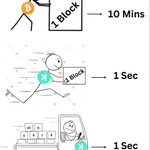
Kaspa’s Real-Time Decentralization (RTD) extends this without changing its core nature. Bitcoin produces one block every ten minutes. Kaspa’s blockDAG lets multiple miners produce parallel blocks simultaneously, ordering them afterward into a coherent sequence. The same rules apply to every participant. The same price signal governs incentives.
RTD is not a different organism, it is the same organism running at internet speed. It achieves in seconds the censorship resistance and security guarantees that Bitcoin needs an hour to establish. But it remains a one-sensor system. The hivemind of miners still watches only price.
cryptodee 𐤊 retweeted

Thanks for the #Kaspa community to make @hashdag video one of the most viewed on Oxford Youtube channel organically. This is great and gives me confidence to place him on more major (non-crypto) stages to tell the social-economic advocacy which is ground for #Kaspa.
I do think adoption of one technology (over another one) is a value proposition, as necessarily there is a tradeoff (i.e. privacy vs efficiency vs fairness). So again, though every industrial giant @VitalikButerin @cz_binance inevitably will have some touch on philosophical thoughts ("degen communism lol"), I do (in a biased way) think that @hashdag's thought is a bit deeper.
------
Meanwhile, it may be worthwhile to think if #staghunt is exclusively solved by #Kaspa. At this moment, the answer is no, since coordination market may be provided by anyone else as well. It requires us to better understand #RTD and explain how #Kaspa is the only protocol that combines the "PoW hardcore camp" and the "Real-Time" camp and achieves both at the same time.
That will be my topic of speech at @festival_web3 this year.

I just got back from my Easter trip visiting family, and one of the first things I made time for was listening to Yonatan’s Oxford Union speech. I think he absolutely nailed it: youtube.com/watch?v=VIZGKoIa…
If there is one thing we can learn from our progress in AI, it is that intelligent behavior emerges when many components explore degrees of freedom and converge, through distributed constraint resolution, into coherent and stable patterns.
The modern world has connected an enormous number of people and given us unimaginable freedom, but it still lacks a credible way to enforce shared constraints.
The result is a crisis of responsibility at every scale of society: from cyberbullying to former superpowers chasing old glory through war, to leaders blaming the weakest members of society for national decline, or even killing their own citizens to preserve power.
At the same time, our capacity to inflict harm on one another has become increasingly asymmetric. Small actors can now create disproportionately large disruptions, and conflicts no longer remain local. They send shockwaves through the emerging superorganism we call humanity.
The age in which we could dominate one another and still produce a stable world is coming to an end. The only serious path forward is collaboration.
People may feel pessimistic about the future, but I think we are approaching an inflection point. Even the old superpowers are beginning to learn this lesson the hard way.
The American Dream of "I can make it" is gradually giving way to the realization that individual prosperity depends on collective wellbeing, and that we can build far larger and more meaningful things when we share a common dream.
That is why I am excited about DLTs, and Kaspa in particular.
Not because I see them as safe havens for hiding wealth from corrupt governments in some dystopian future, or because I want people to get rich by selling to later participants.
But because I believe DLTs can offer a superior foundation for large-scale human coordination: one that is more neutral and reliable than traditional models based on force and mutual deterrence.
In that world, wealth is not the goal in itself, but a byproduct of coordinating around shared missions, empowering people to contribute, and aligning incentives toward common outcomes.
The future is not about building better products. It is about building better protocols: systems that allow human beings to coordinate meaningfully at larger scales than ever before.
For the first time in human history, we have the tools to build institutions that are not bound to territory, yet can still provide structural coherence without having to fight wars to establish their legitimacy.
What we need now is a group of people bold enough to take that mission seriously.
