

crypto guy| content creator| @MEXC lover
Joined January 2021
- Tweets2.9K
- Following292
- Followers284
- Likes4.3K





best retweeted

Elon is already pushing people to build with @grok. Our project was built for that from the start.
Most of what’s appearing now was assembled overnight. We’ve been preparing and building for over a year.
That’s the difference.

best retweeted

I’ve been paying closer attention to Robinhood Chain lately, and I think people may be looking at it through the wrong lens.
Most new chains spend their early days trying to manufacture activity.
Robinhood seems to have something different going for it:
It already has a user-facing financial product sitting at the center of the network.
That changes the game.
Tokenized equities are becoming the foundation.
Then you have DeFi protocols building lending, trading and liquidity around those assets.
And, naturally, crypto-native speculation has started showing up through memes and launchpads.
That combination is producing some pretty interesting activity for a chain that only launched in July.
Millions of transactions.
Hundreds of thousands of active addresses.
Billions in stablecoins and DEX volume.
Hundreds of millions of lifetime transactions.
And the number of tokenized stocks available onchain continues to expand.
But raw numbers aren’t what I’m most interested in.
I’m interested in what people can actually do with those assets once they’re onchain.
Imagine holding exposure to an asset like $NVDA or $TSLA and being able to move that liquidity into DeFi, use it within other applications, trade it against crypto-native assets, or interact with an entirely different financial stack without leaving the same ecosystem.
That’s where Robinhood Chain becomes interesting to me.
You can already see different layers beginning to emerge:
→ Tokenized stocks as the asset layer
→ DeFi as the utility layer
→ DEXs/perps as the trading layer
→ Memecoins as the attention/liquidity layer
→ Oracles as the infrastructure connecting everything
And this is where projects like @Uniswap, @morpho, @chainlink, @Lighter_xyz, @ponsdotfamily and others become worth watching.
The bigger experiment isn’t really:
“Can Robinhood generate transactions?”
We’ve already seen that it can.
The real experiment is:
Can Robinhood turn its massive existing user base into an onchain economy?
Because if users come for stocks…
stay for DeFi…
trade because liquidity is there…
and speculate because the ecosystem develops its own culture…
then you’re no longer looking at a traditional brokerage simply putting assets on a blockchain.
You’re watching the early formation of a financial network.
There are obviously questions that still need answering.
How much of the current activity remains once incentives change?
How sticky are the users?
How much liquidity is genuinely organic?
And can Robinhood’s ecosystem develop beyond the company’s own products?
Those answers will matter far more than a temporary transaction spike.
Still, for a chain that’s only a few months old, the amount of activity and experimentation happening around it is difficult to ignore.


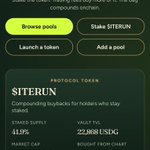
I genuinely think $ITERUN could become one of the more interesting tokens on Robinhood Chain.
Not because staking is new or because “buybacks” are a new narrative. But because of what happens when you connect the two.
ITE.RUN is essentially building a compounding layer on top of Pons. Trading activity creates creator fees and those fees don't just get distributed as emissions. Instead they get turned into market buys of the token.
And those bought tokens flow back into the vault for stakers. So the loop becomes:
more trading = more fees = more buys = more tokens to stakers = more compounding
But here's the part I find really interesting. Child tokens using ITE.RUN route 5% of their creator-tax toward $ITERUN. So the protocol token isn't completely dependent on people simply deciding to buy $ITERUN. There's a mechanism designed to connect activity across the ecosystem back to it.
Right now, the important question isn't whether the mechanism sounds good.
It's what happens when more launches start feeding the same loop.
1 launch is interesting.
10 launches is a system.
50 launches is a completely different conversation.
That's the part of ITE.RUN I'm watching.
Fees = Buybacks = Stakers = Compound = Repeat
CA: 0x447e6dbfd31fde6cc44fdc1222414ffa93b1db1a
xitter.cf/ite_run?s=11


Educational team that makes complex health and DCA-related research easier to understand. We review scientific evidence, explain possible benefits and risks clearly, and provide reliable information - not replace medical care.
dcaguide.org�
#endometriosis #dichloroacetate

best retweeted

🎁 Join the Robinhood Fever to win $300 USDT:
1️⃣ Follow @Alpha_MEXC
2️⃣ Comment with your UID & proof of Robinhood Fever registration
15 lucky winners.
Join now 👉 mexc.com/events/star/Robinho…

best retweeted

$1500 GIVEAWAY
15 winners • $100 each
- Drop EVM wallet
- Follow @highrollers_xyz & @atitty
- Like & Repost
Winners in 48hrs!


best retweeted

Dm Addy to @ifwvalen
@Thelsa_ac
@lones_arc
@crypto_best
@parzeval_6
@Praisewilldoit
.1 to them 5
5 WINNERS
best retweeted

0.5 SOL GIVEAWAY
Like + RT + follow + post notification @jozzzeey
follow on pump pump.fun/join/bigjoel
Post proof
Five winners picked in 12 hours.

Need work done by a specific person on @gib_work — not a public bounty?
That’s what **Paid Requests** are for.
You find someone through their Profile, agree on the job, fund the request, they submit the work, you review it, and payment can be released from escrow.
Latest update: **Profiles and Paid Requests are open to everyone.**
Thread on how the current product works 👇

Paid Request vs a public bounty
Public bounty / task → anyone who qualifies can try it.
Paid Request → one person, one funded job.
Use a Paid Request when you already know the person, want a custom service, or don’t want the work sitting in the open feed.
Use a public task when you want a wider pool of submissions.
Both can use escrow. The difference is who the work is sent to.
Simple path
Find the person → discuss the work → agree the price → fund the Paid Request → deliver → submit proof → review → release payment.
Download Gibwork, set up a Profile, and try a Paid Request in the current app.
App / web: app.gib.work
@gib_work
