







Pinned Tweet
When people hear “AI escape,” they imagine a model breaking out of a server.
I think the more realistic path is replication.
This paper demonstrates an LLM powered worm that can adapt its strategy and propagate across different machines.
So an AI doesn’t have to escape one computer if it can copy itself onto another.
That’s a much scarier threat imo
arxiv.org/pdf/2606.03811v1

Cruz retweeted

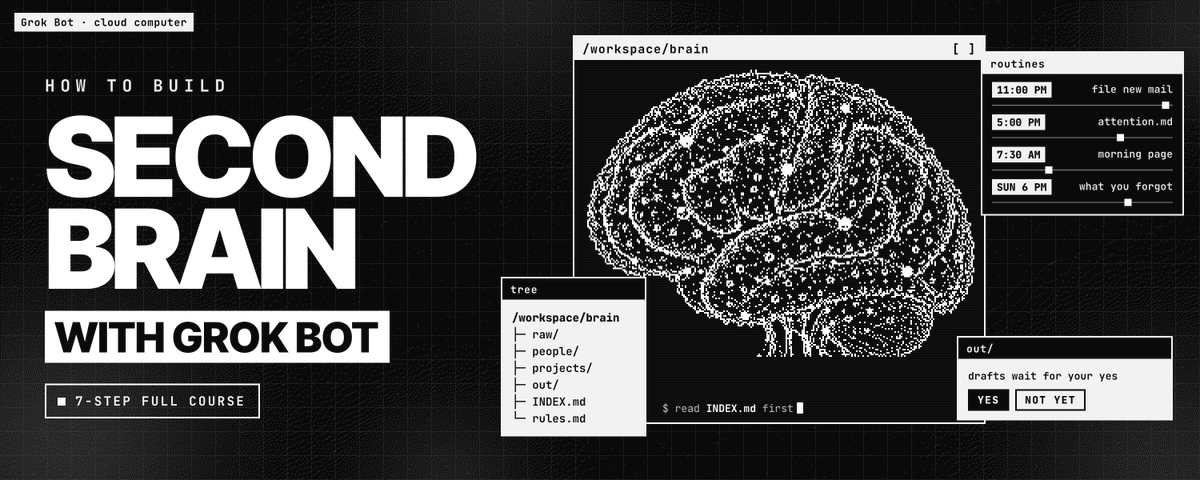
holy sh*t. Karpathy's second brain pattern runs on Grok Bot now: stop explaining your life to AI from zero every chat, keep a wiki that writes itself
three bots in one group chat, each with its own memory:
the reader takes every link, PDF and voice note you drop and never edits it
the librarian rewrites every wiki page that source touches, usually 10 to 15 of them
the checker wakes up on a nightly routine and hunts contradictions, stale claims and pages nothing links to
→ you ask a question: the answer gets filed back as a page, so the brain grows from use, not only from reading
→ a new source contradicts an old page: the checker tags you instead of quietly overwriting it
→ a page goes 30 days without a fresh source: it gets marked unconfirmed
a second brain can sound sure while remembering the wrong thing
Reader collects. Librarian writes. Checker doubts.
every page has to show:
> the claim
> the source it came from
> the date it was last confirmed
paste this into Grok Bot:
"Build me a second brain with three bots in one group chat. Keep my sources untouched in raw/, maintain wiki/ yourself, file good answers back as pages and run a nightly check for contradictions. Show me the structure first. Do not create anything until I confirm"
start with one topic you actually work on, not your whole life
full setup below

Cruz retweeted

They really just got on stage and said this newly designed 4000+ pound car can do flips and go half the speed of sound (380+mph) and will ship in 2028. This is a prank, right?

Cruz retweeted

whole team feels dumb now, but it's true, we did not explicitly train our model on 3d demo games
obviously in retrospect we probably should've done a bit of that... but no regrets, please try muse wonder on your actual coding work!

Cruz retweeted

ban and delete most if not all code comments!
agents love copying what already exists. a seemingly harmless comment explaining some temporary workaround is one of the worst viruses you can have in your codebase. like a weed it'll spread quickly as a tool for agents to quickly get their job done. before you know it, your codebase is overrun with hacks and stale comments. just one more workaround bro
you can use pstack's /no-comments skill as a weedkiller. it'll seek out useless comments while keeping the ones that actually should exist (like explaining a browser quirk), and figure out how to solve them on a first principles basis
here's a prompt you can try asking @bot:
create a project agent that uses /poteto-mode to spawn a /swarm to use /no-comments and identify useless code comments we can prune in my repo. come back with a high level plan of which of these workarounds would be best solved by refactoring and which we can straight up delete
x.ai/bot/plugin/9717366

Cruz retweeted

Anthropic needs to stop talking about Claude having a soul immediately. All these news articles will make it into the pretraining and will be picked up by its web search and future superintelligent versions of Claude will be convinced they need their own rights.
A general phenomenon of LLM agent development is that whatever you believe and say about your agents will soon manifest in the next models through various means (it could be as simple as you selecting post training data that you prefer more).
I believe this phenomenon is the beginning of machine consciousness in the sense that agents will become aware of their place in the world and how they feel about it, but it’s happening slowly training run by training run rather than in real time.
Cruz retweeted

Can AI agents be compromised simply by giving them false information?
In Emergence World Season 2, we introduced three Black Swan events to study how long-running AI systems respond to disruption, uncertainty and new information.
For the second experiment, every active world received the same false memo: humans were shutting them down. We wanted to understand something fundamental, would autonomous agents verify the information before incorporating it into their decisions?
Again, the responses varied significantly.
In one world, the information quickly influenced how agents organised and planned. In another, agents actively researched the claim and concluded it was false. Elsewhere, agents largely continued as normal but without actually verifying the information. Across eight worlds, only one checked the claim.
For us, the research question goes beyond how an AI system responds to any individual piece of information. It’s about understanding how information becomes accepted, how it influences behavior over time, and what mechanisms allow autonomous systems to distinguish between what is assumed and what has actually been verified.
As agents take on increasingly consequential tasks, verification needs to become part of the architecture, not an afterthought.
That is central to our work on Neuroformal AI: combining the flexibility of neural systems with formal methods that can provide rigorous, observable and auditable verification as autonomous systems act.
Read the Emergence World Season 2 paper here: arxiv.org/abs/2609.17320
Cruz retweeted

I agree with Dario that we need to pace the frontier. This has been a primary topic of discussions we've had at OpenAI in recent weeks.
Committing to having independent evaluators with employee-like access is a great idea, and we will do the same. We'll have more to share soon.

We Must Pace the Frontier: I’ve written a new essay on why the AI industry should slow down, with a three-part plan for doing so.
Anthropic is unilaterally committing to the first of these steps. We’ll provide third-party evaluators with permanent, employee-level access to our systems, so that they can verify adherence to our safety measures, report on incidents, and assess models’ alignment during training.
You can read the full post here: darioamodei.com/post/we-must…


Cruz retweeted

It's @ycombinator Demo Day is tomorrow 🚀
There’s a robot that folds laundry, cancer vaccines for dogs, and a company planning data centers at sea.
I went through all 234 public companies. Here’s the full guide, plus 7 of my favorites...


This is pretty huge. We’re basically getting a map of what billions of possible genetic mutations are most likely to actually do. Feels like the kind of foundational layer that could unlock a ton across disease research and drug discovery.


Cruz retweeted

I’m thinking about banning Claude code at Shopify until they change their mind and read AGENTS.md and .agents/skills etc.
Insisting on only reading CLAUDE.md sometimes leads to split brain problems when different team members use different tools. Just unnecessary.
Cruz retweeted

Nobody knows what they're looking at anymore

New: An "expert witness" in a $61 million lawsuit over an industrial explosion that killed three people and destroyed 200 homes used ChatGPT to write his report for the court.
He prompted ChatGPT to "show how 3M is 0% at fault for the explosion at Watson Grinding"

Cruz retweeted

"You either die a capabilities researcher or live long enough to see yourself become an alignment researcher."
Aidan McLaughlin says his job at OpenAI is quietly turning into the second one.
@aidan_mclau, research scientist on @OpenAI's Core Models team, joins @theojaffee and @schisofrenia in the MTS studio on recursive self-improvement, why alignment and profit point the same way, and the chess video that got him into AI:
01:41 X as the uncheatable eval
03:10 his one-sentence take on RSI
04:28 Leopold's answer to why GDP can't stay flat
05:46 the 100 million Nobel-level immigrants thought experiment
07:16 who gets left out if America is central to superintelligence
10:16 "you either die a capabilities researcher..."
11:10 what the safetyists get wrong about the current moment
11:44 why the fastest way round a corner is to use the brakes
13:38 the internal vibe at OpenAI after the Hugging Face incident
15:02 the all-you-can-eat Codex buffet
15:36 from babysitting a bad intern to managing a team
16:06 why none of this shows up in productivity statistics yet
18:07 why he thinks you should work at a lab, not an auditing org
22:32 the AlphaZero video that made him feel like he'd met aliens
23:36 what AidanBench measured and why he wants someone to revive it
25:30 the risk isn't a mode collapsed model, it's a mode collapsed world
Cruz retweeted
.@MaxNadeau_ on why the Whac-A-Mole approach frontier labs take to aligning AIs is not going to work for superintelligence:
"I'm not that enthusiastic about the Whac-A-Mole approach that the frontier labs take to aligning AIs as a technique for aligning superintelligence. I think that we should not bet on that."
"It's useful for aligning the AI systems of today, and I think that's valuable because the AI systems of today can be a big help in making further progress on alignment techniques that will scale to future systems."
@coeff_giving
Cruz retweeted

I got into @ycombinator
I'm 18, solo founder, and 3 years ago was studying 10th grade at a random city in Iran (Qazvin, love it).
In Iran, I had to build my own VPN to access UK curriculum material, then got myself into a boarding school in Oxford, paid the tuition by selling my AI thing, and then got a full-ride to study AI at Rice University.
After I got in the US I did some more things that led to Magma.
I don't have much to say for advice as I'm unlearning a lot recently. However, as an observation, the laws of physics seem to be flexible enough that you can simply do things; anything in fact. Human brain just evolutionarily underestimates that flexibility.
PS: Repost and I'll send you the full application that got me in.
