

We study human learning using tools from machine learning and improve machine learning using insights from cognitive science.
- Tweets662
- Following129
- Followers4K
- Likes2.6K


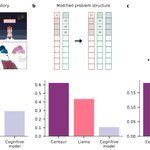


ALT An automated cycle of scientific discovery in the cognitive sciences. An experimentalist proposes experiments; a cognitive foundation model simulates behavioral data; a modeller synthesizes and tests computational models; and a critic judges the “interestingness” of the results and passes that signal back to the experimentalist for further optimization. Crucially, discoveries that survive in-silico screening are compiled into targeted human experiments—behavioral and, where relevant, verbal reports, eye-tracking, neural responses, and other physiological measurements—whose outcomes both adjudicate candidate discoveries and help recalibrate the behavioral generator, keeping the loop anchored to empirical data. Solid line indicate primary components of the cycle. Dotted line indicate auxiliary components of the cycle





ALT Hierarchical data is ubiquitous in the empirical sciences and is most commonly analyzed with generalized linear mixed-effects models (GLMMs). Bayesian inference for GLMMs yields calibrated uncertainty but requires MCMC; the No-U-Turn Sampler (NUTS) is the gold standard but is slow and must restart from scratch for every new dataset, model and prior. We introduce metabeta, a pretrained neural network for prior-amortized in-context Bayesian inference over GLMMs. Unlike previous neural posterior estimators that fix the prior at training time, metabeta accepts prior families and hyperparameters as inputs at test time, enabling zero-shot generalization. Two set transformers and conditional normalizing flows mirror the posterior's two-level structure (global parameters shared across groups, local parameters per group). The model is trained on millions of realistic simulated datasets spanning continuous, binary, and count outcomes. By default, the flow posterior is refined by Independence Met


ALT PhD Student Position (TV-L E13, 100%) Apply by September 15, for full consideration

ALT Postdoc Position (TV-L E13) Apply by September 15, for full consideration


ALT AUTOCOG runs as a closed discovery loop iterated over Ncycles: Experimental Design → Behavioral Data Collection → Analysis & Arbitration → Theory Revision , after which a revised theory re-enters the loop.