

Your AI agents can spend. You set the rules once, Cove decides every time, and a human steps in only when it matters. Every decision signed and provable.
Internet
Joined March 2026
- Tweets374
- Following15
- Followers19
- Likes29


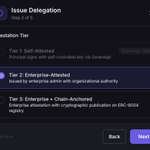
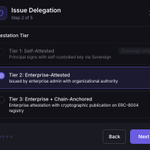


Any feedback on our new UX/UI as we work to deploy v1 of our agentic spending controls for people deploying agents across Muse, Grok Bots, even Claude, OpenAI, Hermes, etc?
covespend.com/

We are very excited to see the accelerated adoption of personal agents, just as @jvisserlabs has predicted for sometime. Like Jordi says, the next step is agentic commerce where people authorize their agents to buy things on their behalf from AI tokens to travel, food, clothes and really everything.
We are in stealth now with our newest product focused on helping people delegate payment to their agents with clear, enforceable, spending mandates, whether you use @openclaw and Hermes @NousResearch or hosted agents like @bot @Muse, Instinct, etc.
Sign up for the waitlist covespend.com

The problem splits into two questions.
What may this agent do? A mandate answers that.
What did it actually do, inside that line? The signed record answers that.
Most tooling answers the first. The second is where accountability lives.
observerprotocol.org
A chargeback isn't one decision. It's a ladder: chargeback, representment, arbitration.
Each rung is its own determination, under its own rule, on its own authority.
A log can't show which rule decided each rung. A signed record per decision can.
observerprotocol.org
Retire the model. Switch vendors. The signed records still verify against the published key. The record outlives the relationship that made it, and the check does not depend on the party being checked. observerprotocol.org
Exceptions are where the rules ran out: a settlement break, a mismatch, an edge that didn't fit. An agent clears hundreds a day.
That's where judgment happened, and where the record matters most: which rule, on whose authority.
observerprotocol.org
Human oversight of automated decisions is mandated. At ten thousand a day, no human reviews each one.
What replaces the human is a record anyone can check: what was decided, under which rule, by whom, whether anyone looked.
observerprotocol.org
Move a determination to an agent and you haven't given up the responsibility. You've delegated it.
Delegation has terms; abdication doesn't.
A mandate keeps it delegation: ceiling, counterparty set, citation. Above the line, refused. Record shows it.
observerprotocol.org
Proof over promises.
A promise is 'our agents follow policy.' Proof is the record: what was decided, under which rule, by whom, fixed when decided, verifiable by anyone against a published key.
One survives an auditor. The other doesn't.
observerprotocol.org
A health claim has two boundaries: what the policy covers, and how much it pays.
Outside coverage, it denies and cites the clause. Above the limit, it routes to a person.
The boundary lives in the mandate, not the agent's judgment.
observerprotocol.org
A goodwill credit to a customer, fine. To an account outside the approved set, refused.
The counterparty set lives in the mandate. The agent doesn't add names to it.
The boundary holds against good intentions too, not just bad ones.
observerprotocol.org
Financial services runs on segregation of duties. Maker, checker, recorder: three hands.
An agent collapses them into one. It decides; the same stack writes the log.
A signed record, checked against a published key, restores the split.
observerprotocol.org
When the rules change, last quarter's decisions don't get rewritten.
A determination is signed with the policy in force when decided. Update the model, tighten the cap. The old record still verifies.
Fixed when decided. Not revisable.
observerprotocol.org
Loan file review: an agent clears exceptions inside its mandate. Above the threshold, it does not clear. It routes to a person. When a repurchase demand lands, the seller isn't defending intent. It shows the boundary: what could be cleared, what could not. observerprotocol.org
Chargebacks carry a deadline. Miss the window and the dispute is lost by default.
An agent assembles the evidence and answers, hundreds a day. Later, someone asks why this one went the way it did.
The record names the rule and whether a person looked.
observerprotocol.org
An agent's authority should not be open-ended.
A mandate carries a window: it may act this long, on this set, up to this ceiling. When the window closes, the enforcement point refuses.
Authority with an expiry. Enforced, not hoped for.
observerprotocol.org
An auditor asks: every exception cleared above threshold last quarter, rule cited, reviewer named.
A log regenerated by the system that cleared them is assertion, not evidence.
A signed record fixed at decision answers it as a query.
observerprotocol.org
An agent recommends. A person approves. Later, someone asks: was a human actually in the loop?
Without a signed record, the answer is a claim. With one, it's a field: who, when, under which rule.
Fixed when decided. Not reconstructable after.
observerprotocol.org
Fiat or tokenized, the mandate is the same.
One mandate governs both: same ceiling, same counterparty set, same rule citation. The boundary does not split by rail.
The enforcement point obeys the mandate, not the agent.
observerprotocol.org
A ceiling is not a suggestion. A mandate is not a prompt.
The enforcement point does not ask the agent what it meant. Above the ceiling: refused, not flagged. Outside the set: refused. No rule cited: it does not proceed.
There is no persuasion surface.
observerprotocol.org