

Devoted to preserving the history of Commodore International, the once great computer company, from 1958 through 1994.
Pittsburgh, PA
Joined September 2018
- Tweets1.5K
- Following130
- Followers3.4K
- Likes1.6K




Finally pulled the trigger on a new oscilloscope. As you can see, it uses a tiny fraction of the bench footprint of my old one, but I don't have the slightest idea how to use the new one yet. Old dog, new tricks.

Upgrading a 1977 PET with a 1979 memory board: 7167 bytes free to 31743 using a bag of AliExpress 4116 DRAM
youtu.be/vqgSY5v9oIM?si=hNcf…


Happy Birthday Commodore!!! 68 years ago today, October 10, 1958, the Toronto law firm of Goodman & Eisen filed letters patent with the Ontario Deputy Provincial Secretary in Toronto to incorporate Commodore Portable Typewriter Company Limited.


On the left is an unfinished project from around December, 2022. It's a KIM-1 single board computer from 1976 generating a video display using a genuine MOS6560 VIC chip (the video chip from the Commodore VIC-20 computer). You can see that I had it working, but with the janky breadboard wiring there's a lot of horizontal tearing of the image. On the right is the finally finished version on a PCB. It's still proof-of-concept and doesn't do much yet, but it's amazing to see this working after nearly four years!


When folks think about exciting software for old Commodore machines, they probably think of cool games like Autoduel or Bard's Tale for the Commodore 64. Commodore B-Series business software probably doesn't even make the top 1000. Be that as it may, from a purely historical perspective I think it's really cool to see Commodore's business machines from the day in action as business machines.
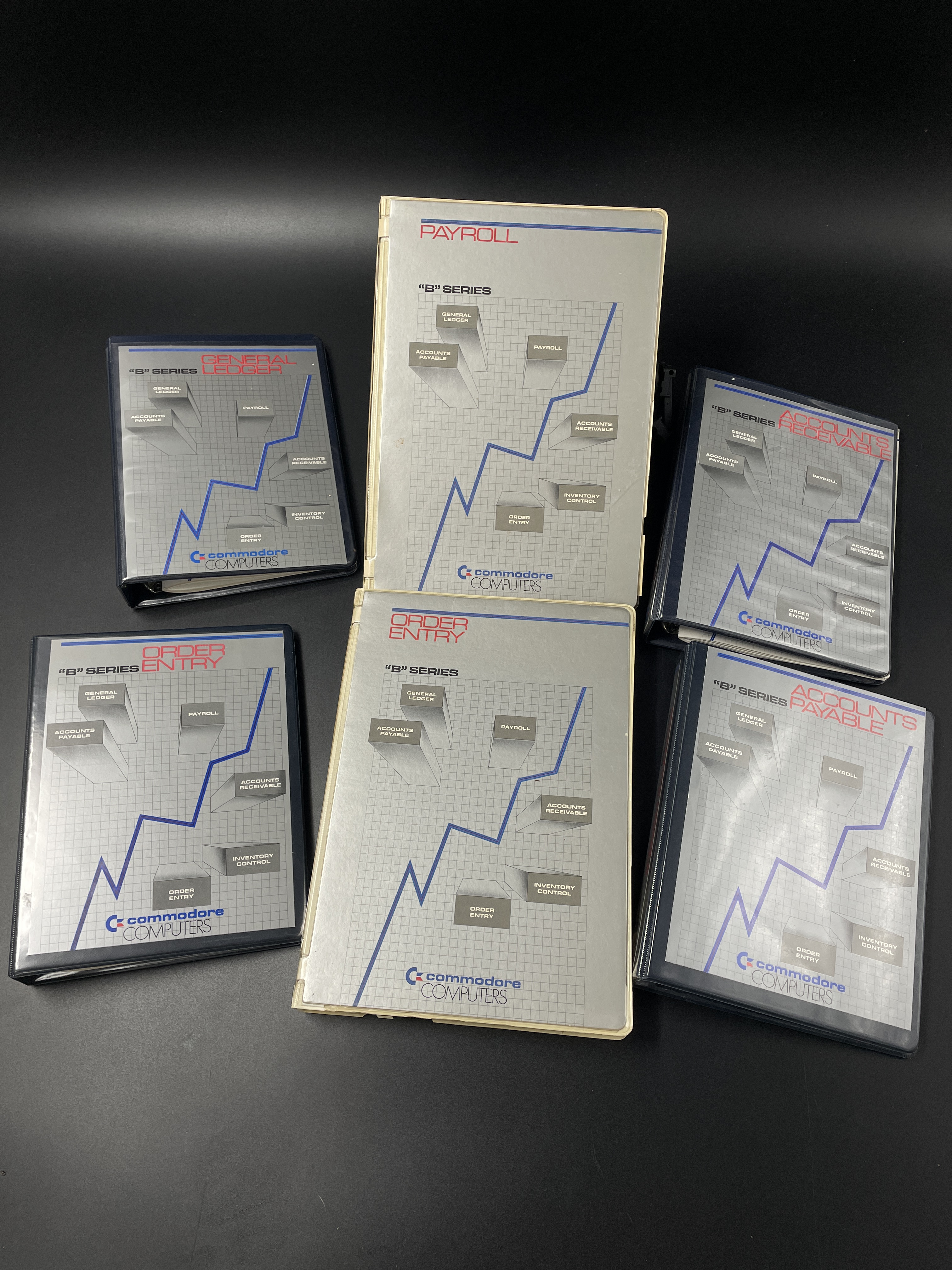
Pictured here is almost the entire business suite "Commodore Advanced Business System" that was developed for the B-series (CBM-II) line of computers. Info Designs of Bloomfield Hills, Michigan wrote these titles and Commodore distributed them.
A couple cool things about this software:
Thing one is that it was not written in 6502 (or for you pedants out there, 6509) assembler. Rather, it was written in BASIC and compiled into p-code. I am about 99% certain (and @aflyingcat please corroborate or correct me) they used the Petspeed Compiler from Oxford Computer Systems in the U.K. to develop this series.
Second, they used a very primitive copy protection on these disks. On startup it opens a direct access channel to the drive and reads track 77, sector 22. That's the very last sector on an 8050 disk, and it belongs to no file, so copying the disk file by doing a standard file-by-file copy leaves it behind. The first byte has to be "Z". Then it reads the whole record and checks the serial number against a two character field further along, which has to be the last two digits of the serial, reversed. If any of this is wrong, you get the "SYSTEM SECURITY VIOLATED" screen shown in the one picture I attached. Obviously, any nibbler or sector-by-sector copy program will defeat this copy protection.
As a fun last story here, the way I discovered the copy protection was because none of the accounting packages would load from my petSD+ device. That turned out to be a bug in the NODISKEMU firmware on the petSD+ that made the copy protection check fail, and it took me the better part of an evening to track that down. I contributed my fix to the upstream NODISKEMU and it has been merged in. So if you have this business suite as a d80, you can now run it from petSD+ if you grab the latest build.


This was the NODISKEMU bug fix:
github.com/nils-eilers/NODIS…

Big shout out to @futurewas8bit. I already have a few of these, but I keep buying more PETs so I ordered a couple more. Incredibly fast shipping, especially considering it's international, great quality product, fair prices. Check them out for a pleasant 8-bit shopping experience!

The Commodore 64 shipped in 1982 running Commodore BASIC v2, which contained a dreadfully slow string garbage collection routine.
The kicker here is that Commodore engineer John Feagans implemented a faster routine in May, 1979, but that never found its way to the Commodore 64.
Part 4 of my series on C64 BASIC Internals is out: How Garbage Collection Works.
I show you exactly how garbage collection works and walk through the history behind it. This is the fourth installment in the series focusing not on how to program in BASIC, but on how BASIC works behind the scenes.
youtu.be/t5sIWw3Gvqo

Why does Commodore BASIC store every variable in exactly 7 bytes and hide the variable type in the name?
Part 3 of C64 BASIC Internals is out: How Variables are Stored.
This is the third installment in my action-packed series focusing not on how to program in BASIC, but on how BASIC works behind the scenes:
youtu.be/e3lyXKa0wp8?si=27n8…

In 1978 Commodore paid Bill Gates $500 on a purchase order to help fix the PET's BASIC garbage collector.
John Feagans, who was there, filled in the rest of the story for me. Including the part where Gates later hung a Commodore machine at a trade show trying to show off his own easter egg. The full story from my conversation with John Feagans is here:
commodore.international/2026…

A great fella I worked with gave me his original DEC UNIX swag license plate when he retired, and I love it! But I didn't want to put it on my car and have weather destroy it, so my wife kindly purchased a reproduction for me. It's not exact, but close enough.


Every time you enter a BASIC program and type RUN on a Commodore 64, a tiny routine rewrites itself to walk through your program. It's called CHRGET, and it's the star of my new video, part 2 of C64 BASIC Internals: How Your Program Runs. I follow a single line of BASIC through the interpreter's inner loop, the self-modifying fetch routine that lives in zero-page RAM, and the dispatch code that turns a one-byte token into a running command.
youtu.be/VudUmMmsFk4


Commodore International Historical Society retweeted

C64 BASIC Memory Map Reveals How Programs Work
theoasisbbs.com/c64-basic-me…


Near the end of my recent YT video, I made a snarky comment about C programmers, so I feel like I need to set the record straight: I love C. For a good chunk of my career I was blessed to be paid to write C code for a living, and it was the best part of my career. I've been slowly uploading stuff to my GitHub repository, and this afternoon I uploaded my IMAP Proxy code, written in C and open-sourced back in 2002. I have not been involved with this project for almost 20 years, and I don't know if anyone is still running this code, but for a fun game, see how many Commodore-related Easter eggs you can find scattered throughout the code:
github.com/commodoreihs/up-i…
In a wonderful stroke of luck, a local Pittsburgh company is moving their office location and was going to throw away these three beautiful Commodore filing cabinets. Rather than allow that to happen, a nice fella who works there saved them and delivered them to me today. I'm super grateful!
For anyone who doesn't know, Commodore entered the metal office furniture market in the early 1960s. I believe it was 1960, but initially they were just selling filing cabinets in OEM deals. Some other company manufactured them, and Commodore stuck their badge on them and sold them. On June 14, 1962, Commodore purchased Belpree Company Limited, Associated Tool & Manufacturing Company, Ltd., and Shelburne Tool Company, Ltd. for $300,000. Belpree, a metal stamping firm, was relocated into a 30,000-square-foot addition at Commodore’s facility at 946 Warden Avenue in Scarborough, Ontario, to begin in-house production of metal office furniture, including filing cabinets. Commodore expanded its Metal Products Division with two additional acquisitions in 1978: Gildon Metal Enterprises Limited and Nortex Products, Inc. I believe the metal cases for the PET computer series were manufactured at the Nortex facility.
One notable project associated with Belpree, unrelated to filing cabinets, involved a stair-climbing wheelchair. In 1961–1962, the U.S. President’s Committee on Employment of the Physically Handicapped offered a $5,000 prize for a practical stair-climbing wheelchair design. Canadian engineers Neville E. Hale and Kenneth Gardner of Hale & Associates, Ltd. developed a prototype in partnership with Belpree Company Limited and Associated Tool & Manufacturing. The unit was constructed at a cost of approximately $40,000 and demonstrated at the Canadian Trade Fair in Philadelphia in November 1963. Out of more than 1,000 entries, the Hale design received the award in August 1964. A U.S. patent (US3276531A) was granted on October 4, 1966. Development appears to have ended following the 1965 collapse of Commodore’s primary financier, Atlantic Acceptance Corporation, so Commodore never actually entered the personal mobility market. If you'd like to read more about this, I published a blog post about it here:
commodore.international/.../…
The Metal Products Division continued until 1985, when it was spun off as part of Thomas Rattigan's cost-cutting initiatives.

Commodore had t-shirts printed for the 1978 CES in Las Vegas where they were showing the relatively new PET computer. Chuck Peddle can be seen wearing one in this photo. John Feagans was hired by Chuck Peddle to work on the PET, and he saved the original artwork for these shirts and worked with a company to make reproductions available. So if you'd like your very own, you can buy one! I have nothing to do with this and won't make a penny from it:
i-love-my-pet-14.creator-spr…

Quantum Link forum archives have been cleaned up published:
commodore.international/2026…