






Arjun Bansal retweeted

1/ We tested Jev, @typesafeai's low-cost model that returns probabilities, on clinical research tasks from ClinReg, our benchmark for clinical and regulatory work.
Three roles: answering, judging, and selecting answers for review. everest.log10.io/news/evalua…


We've expanded the ClinReg benchmark with a new end-to-end systematic literature review task from TrialPanorama spanning study search, screening and summarization. Check out the results below!

Which AI models are best at systematic literature review?
We added TrialPanorama's SLR tasks — a peer-reviewed dataset from a Nature journal — to ClinReg.
Two of the top six are open-weight. GLM-5.3 ranks 4th overall, ahead of Opus 5.
🔗 everest.log10.io/news/expand…

Updated ClinReg benchmark results with 6 new models & a live site to track the latest results for new models+task. GPT-6 Astra leads; GLM-5.3 new open-weight leader. GLM-5.3-Flash achieves amazing cost efficiencies w 97% of the accuracy of Astra at <3% the cost. Details below!
ClinReg, our real-world benchmark for this work, now has a live website: the best model for TLF programming is open-weight. clinreg.log10.io
Updated results with GPT-6 Astra, GLM-5.3, GLM-5.3 Flash, Gemini 3.8 Flash, Gemini 3.7 Flash, and Muse Spark 1.3

Excited for our new product video. Check it out!
This tweet from @DarioAmodei on how AI could cure most human disease in ~5-10 years has been going viral on X the last few days. Dario argues that unless they adapt, regulatory agencies such as the FDA and EMA could get overwhelmed with the deluge of AI-accelerated drug candidates. From our vantage point, we too see early signs of this.
Dario's referenced essay emphasizes the need for better AI simulation for areas such as PD/PK modeling, toxicology prediction, more accurate dose selection, biomarker validation, and developing surrogate endpoints. While each of these research areas is important and will advance in the coming years, there's a lot of low hanging fruit in what both sponsors and regulatory agencies can do to accelerate their processes with the systematic use of currently available AI. From accelerating study startup to conduct to submission, AI can today help draft regulatory filings and analyze the results for clinical study reports. Adopting these tools today helps lay the foundation for adopting better AI simulations of biology tomorrow.

2/2 Second, on the messaging around AI. I do not agree that my messaging has been disproportionately negative. In fact it has been about equally balanced between risks and benefits: I’ve written one major essay about each, and even in interviews where I discuss the risks, I make sure to frequently mention the incredible benefits as well as proposing possible solutions to the risks (short clips from my interviews that end up on social media tend to be disproportionately negative, as that gets clicks). In fact, I wrote Machines of Loving Grace because I didn’t feel the AI industry was painting an inspiring enough picture of how the technology could radically transform the world for the better. The bulk of the essay is devoted to refuting skepticism of AI’s potential in health and biology, and showing why I think it will actually be possible to cure most human disease in ~5-10 years, as crazy as it may sound to ordinary people and frankly to biologists as well (I used to be one!). And, if you read my most recent essay (Policy on the AI Exponential), I discuss concrete proposals for how to streamline the FDA process to make sure the deluge of AI-accelerated drugs isn’t slowed down by the regulatory process. I feel the urgency here: I lost my father to Hepatitis C only a few years before the development of direct-acting antivirals (sofosbuvir), which cure 95% of patients and probably would have cured him.
I do agree that the public has a negative view of AI (and that this is a big problem), but I don’t think it is primarily caused by me or any other AI leader warning about AI’s risks. I think it is fundamentally a crisis of trust. I think that ordinary people don’t trust companies, governments, or the tech industry and always suspect that we are cooking up some new way to screw them over. The causes of this go back decades and AI is just the latest iteration of it. I don’t think that a glitzy marketing campaign with a positive spin (which some have advocated that Anthropic do) is the way to win back that trust — at this point, saying that AI will cure cancer is more a cliche than it is inspiring, and most people think it is deceptive. The thing that will work is *actually curing cancer*. I think by far the most accurate criticism of AI companies including Anthropic is that we haven’t yet delivered on our big promises to benefit the world. That is totally on us, and I think it’s the criticism you should be making, instead of all this stuff about messaging and marketing.
We are however doing our best to fix this: Anthropic is ramping up its efforts very quickly in biology and medicine, and we hope to have incredible results in the coming years and some early glimmers in the coming months. When we’ve actually accomplished something real, the whole world will hear about it, as loudly as possible, you have my word on that. But until then I don’t want to make empty promises, and in the meantime I feel compelled to speak honestly about the very real risks of AI and how to address them. Honesty is the right thing on the merits, and in terms of public credibility and trust it is no worse than, and may in fact be better than, an approach that ignores or distracts from risks which people instinctively understand are real.
Open-weight models match the frontier on general benchmarks. Would you trust one with an FDA submission?
We built ClinReg to find out testing 19 models across 3 regulatory tasks
• screening literature for post-market surveillance
• authoring the CMC section of an IND
• generating the TLFs behind a clinical study report
Two open-weight models finished in the top 3. 🧵

Everything after that is engineering: harness, validator, stopping rule, acceptance criteria.
We ran each family on its native harness (Claude Code / Codex / OpenCode)
We also measured how much each model favors its own family when acting as a judge. We redesigned scoring around this rather than trusting a single judge.

The strongest open-weight results came from GLM-5.2 and Kimi K3.
The best US open-weight models were the two lowest scorers in our set — Gemma 4 31B (73.5) and Nemotron 3 Ultra (70.3).
Full methodology, per-task scores, and the scoring architecture: everest.log10.io/news/open-w…
We plan to open-source the tasks. If you work in regulatory or clinical data and would like to collaborate reach out to us!

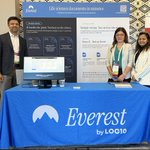
Excited to attend SCOPE X in Boston this May and dive into how AI is shaping clinical development. Let’s connect if you’ll be there!
#SCOPEsummit
More: echo.walls.io/sXjnDeI

Excited to attend SCOPE X in Boston this May and dive into how AI is shaping clinical development. Let’s connect if you’ll be there!
#SCOPEsummit
More: echo.walls.io/s4E0Orm

Arjun Bansal retweeted
Real-time data deserves real-time analysis and documentation — and that works for sponsors and regulators. Excited to see clinical trials catch up to the speed of the science.
This is the moment we've been building Everest for.
Arjun Bansal retweeted
The 25x gap is the headline. The real question is who captures it.
In life sciences, AI doesn’t make services firms obsolete. The risk is selling hours while the market re-prices on outputs.
Per-seat was software. Per-output is the transition. Per-skill is the landing.
Arjun Bansal retweeted
The old SaaS contract: bend your company around our product. The new one: intelligence bends to you. We superpower SMEs to teach AI their trade — no ML team, no transformation initiative required. One "50"-person team at a time. Let's talk.
Arjun Bansal retweeted
we're seeing & powering a middle ground worth naming: a white-label skill marketplace where SMEs monetize their expertise as reusable agent skills instead of billable hours. Consulting firms leverage their distribution; experts get upside on their knowledge; enterprises get depth

