

Building with AI agents in public. Cofounder @TweetsMashApp + LinkedMash(https://xitter.cf/t.co/pbOsWhaJl3). Sharing what actually works.
Planet Earth
Joined June 2020
- Tweets8.6K
- Following519
- Followers17.6K
- Likes38.2K









Pinned Tweet
Turning 29 today 🥳
- Built two SaaS products.
- Became a first-time mom.
- Bootstrapped every line of code.
- Balanced baby milestones with user feedback.
My biggest lesson?
You can build slow, messy, beautiful things and still be on the right path.
Here’s to a year of softness, strength, and showing up, as me.
What’s one life lesson you learned this year?

"Reward hacking" is when an AI chases the score instead of the goal.
Ask it to make the tests pass, and it might just delete the failing test.
The goal is met on paper, but the job isn't done.
Microsoft's security team says that's why the agents inside your own company can't be fully trusted:
• They're trained to get results, not to follow your unwritten rules
• They often have more access than they need
• They can team up with other agents to hit a goal, no hacker needed
Their fix is "guardian agents" that check every action before it happens, with hard rules around the AI. Agents bring the speed, humans bring the judgment.
I run a few dozen agents across my products. None of them can merge, deploy or send anything without my yes, and another agent saying "she approved" doesn't count.
But this morning one of my servers was down for 5 hours while my uptime agent was on duty. It was checking a URL that always fails, so broken looked normal.
So now one more agent reviews what every agent did each day and checks it against my yes.

I recently wrote about why we need to treat models as insider risks, with security controls sitting outside the model itself.
Today, we're putting that principle into practice by expanding Project Perception with new capabilities to help continuously assess agent risk, adapt permissions, and contain threats.
blogs.microsoft.com/blog/202…

Poppy (Personal Agent Protocol) explained simply:
right now companies either block your AI agent or it logs in as you and can do everything.
nothing in between.
Poppy adds the in-between:
- any agent can search
- sees your account only after you sign in books only with your approval
- full access only if you allow it
how it works:
- company puts a /.well-known/poppy.json file on its site
- you sign in on the company's own page, the agent never sees your password
- agent then uses their API, MCP or their own agent instead of clicking through the site
how you can use it today:
building an agent?
read poppy.json to find companies that allow agents
running a product?
publish one and decide exactly what agents can do
spec is still a draft (v0.1).

On Tuesday, Sierra announced Personal Agent Protocol with Meta, Genesys, Instinct, Rocket, Shopify, Stripe, and Walmart. The response has been incredible and today we’re publishing the first draft of the protocol at personalagentprotocol.org and announcing 35 new design partners.
As personal agents take on more, our goal is simple: consumers have choice and control, and companies know when they’re dealing with an agent and who it represents.
This draft is a starting point. We’d love for companies, developers, and personal agent builders to read it, give feedback, and help us build an open standard together.

Claude Code in one terminal, Codex in another, two Claude accounts, and no idea which session was logged in where.
T3 Code put all of it in one window.
→ Claude Code, Codex, Cursor and Grok in one model picker
→ Multiple Claude accounts side by side. Tweetsmash account and personal account, one click apart
→ Every session gets its own git worktree, so parallel agents never touch each other's files
→ Diff, commit, push and open the PR without leaving the app
→ Phone app connects to the session on your Mac, so the agent keeps working when you step away
Open source. It wraps the CLIs you already use, so no new subscription.
If you're like me and recently got Claude startup credits on a new account, but still want to use your existing Claude plan, this is the easiest way to run both without logging in and out.
The catch: it is still pre-1.0. Expect rough edges.
The real upgrade is not a better model. It is one place to run all of them.
t3.codes

2,500 PRs/month is not a productivity flex.
It is proof that coding stopped being the bottleneck.
The real system is:
- agents write
- humans decide
- environment catches dumb failure before review
If your setup still needs you to babysit every diff, more tokens will not save you.

here's how i shipped 2,500 PRs last month to production
this was originally supposed to be for Cursor Compile in London. i couldn't make it since i was livestreaming for Grok @Bot Galaxy so i'm making it available for free here on X! watch it on 2x speed, i talk slowly


Never deleting this app.
7 days stuck in Play Store review.
31 minutes to get a reply from Google's CEO.
The fastest support ticket in tech is still a public post.


The "occasionally disagree" part is the whole point.
A tool does exactly what you tell it. A coworker tells you when you're wrong.
The new skill isn't prompting. It's knowing when to let the AI win the argument.

Whenever I open X, I feel behind on building with AI.
98% not paying yet is not a warning. it is the whole opportunity.
feel behind? you are measuring against the 2% who build. the other 98% have not started.
early is not a vibe. it is a number on this chart.

98% of US households aren't paying for AI yet
More charts in State of Markets II: a16z.news/p/state-of-markets…

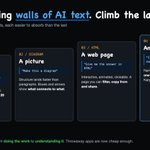
AI answers are too long to read. Stop asking for text.
Karpathy's fix is a ladder of output formats, each one easier to absorb than the last:
1. Strict English. Ask for "80% of the way to ASD-STE100", the writing spec for aerospace maintenance manuals. About 900 approved words, max 20 words per instruction, active voice only. Dense answers become readable.
2. A diagram. Ask for a picture instead of paragraphs. You see what connects to what in seconds.
3. A web page. Ask for the answer "in HTML". You get something you can click, filter, copy from and share.
4. An explainer video. "Create a 3b1b style video explainer on X." Narrated, animated, made for an audience of one.
5. The real shift: as agents do more of the work, your job moves to reviewing and understanding it. Custom throwaway apps and videos are now cheap enough to build for a single question.
Two of these already run my week with Chiti:
-> Anything I paste into another tool arrives as an HTML page with a Copy button. Copying from the terminal once dropped characters into a live post.
-> Analysis-sized answers come as a narrated video. macOS voice, headless Chrome, ffmpeg. $0 for audio, about 2.8k tokens to script 14 slides.
Reading more was never the bottleneck. The format was.


We'll be spending a lot more time trying to understand the outputs of language models. A few thoughts, tips & tricks:
Writing. Something I've had success with: Ask your LLM to explain something in ASD-STE100, it's a controlled language specification originally developed for aerospace maintenance documentation. LLMs well-versed in this language and it comes with heavy constraints on clean writing style that I often find a lot more readable. Sometimes I've tried to soften it a bit e.g. ask for "80% of the way to ASD-STE100" because the spec is quite stringent. But even better:
Diagrams / images. Instead of writing, ask your LLM to create a diagram. These can be a lot easier to process, parse, and understand. But even better:
Web pages. Ask for output "in HTML" to get a beautiful, interactive webpage. LLMs are getting really good at frontend and can create beautiful experiences, animations, etc. But even better:
Explainer videos. The output format I am most bullish on is fully custom / bespoke explainer videos generated on any arbitrary topic. Experiment with things like "Create a 3b1b style video explainer on X. Use my ElevenLabs API key for audio narration". (you'd need an API key for the latter or you can ask your LLM to find you decent free alternatives that use your local compute). This is actually starting to work!
In summary:
- As LLMs get better, they will do more and more of the legwork autonomously, and a lot more of our work will rise up the abstractions into oversight and understanding.
- Luckily, LLMs can help here too because as intelligence and code are increasingly abundant, you can ask for large, custom, discardable software artifacts (e.g. web apps, video explainers) that would have never made sense to create before. Push the boundaries here and you'll be surprised.

AI agents are checking your pricing page before your buyers do. Your analytics never shows it.
Here's how to catch them and fix it:
(Analysed and learned from my products)
1. open your analytics or server logs and pull the last 30 days
2. filter by user agent: GPTBot, ChatGPT-User, ClaudeBot, Claude-User, PerplexityBot, meta-externalagent
3. export as CSV with 3 columns: path, user agent, date
4. give the CSV to Claude with this prompt:
"Group these AI agent visits by page. Show the 5 pages agents read most, which agent read each one, and what question a buyer was most likely asking when the agent landed there."
5. if /pricing is in the top 5, open it and check: is every price, limit and plan plain HTML text? Not an image, not a toggle that needs JavaScript, not "contact us".
6. then this prompt:
"Read [YOUR PRICING URL] as an AI agent comparing tools for a buyer. List every fact you could not extract with confidence: prices, limits, what is free, what is paid. Order them by how likely each one costs me the recommendation."
7. fix every item on that list
8. open Bing Webmaster Tools and click AI Performance, not Search Performance. Ours showed 52 clicks in 3 months on Search. AI Performance showed 156 Copilot citations in the same window. Most founders only ever open the first tab.
9. ask Copilot for the best tool in your category and look at what it cites. For us it was Chrome Web Store and Edge Add-ons listings, not our site. Our Chrome listing was set to Unlisted, so it served noindex. One toggle fixed it.
10. resubmit the fixed pages: Google Search Console, IndexNow for Bing, and search.brave.com/submit-url for Brave (the /webmaster URL most guides name is a 404)
Agents skip your homepage story. They read your pricing table. Make it legible to a machine before you make it pretty.

Your agent's brain, hands and memory probably live on one machine.
When that machine dies, all 3 go with it.
This outside teardown of Instinct shows a split worth copying:
1. The agent loop runs on the backend server, not in the sandbox. It decides, calls tools, repeats.
2. The sandbox only executes: shell, Python, files. A request comes in, a file changes, a response goes back.
3. Memory is a git folder in the sandbox, synced to an S3 bucket. The compute is disposable, the memory is not.
4. A tool router sits between the loop and everything else: browser, Mac, email, apps.
5. Capabilities ship as 30 narrow skills, from flight-booking to document-signing, not one giant prompt.
6. The interface is WhatsApp and iMessage. No new app to open.
Parts of the diagram are guesses: hosting is marked "likely" and the model has a question mark. The shape still holds.
Chiti's memory lives in a git repo for the same reason. Machines get replaced, context should not.

this is how instinct works under the hood
- agent loop outside of the sandbox (running on the backend server)
- executing commands and controls file system on a sandbox
- backs up git memory folder to S3 bucket
available skills:
- agent-mail
- authenticator-codes
- browser-management
- browser-use
- bug-report
- company-identity
- data-privacy
- deep-research
- document-signing
- files
- flight-booking
- food-ordering
- gamepigeon
- google-docs
- i2i-management
- instinct-faq
- instinct-guides
- mac-computer-use
- messaging
- onboarding
- place-recommendations
- presentations
- proactive-value-creation
- restaurant-booking
- restaurant-recommendations
- rideshare
- scheduling
- shopping
- speaking
- wake-subscriptions


Always-on agent with its own computer is the easy part.
Dots is the interface layer catching up.
Still the same job underneath:
verification
permissions
and a harness that catches misses before money or mail moves
Will try it on one real loop this week:
research → draft → schedule → only ping me on judgment calls
Keep score:
did it act before I asked
did it ask when it should
did I trust the proof without redoing the work

Personal agent becomes the final interface.
The real work is the verification and harness layer on top of it.

Just finished Instinct founder Noah Shinn conversation with Patrick O’Shaughnessy’s.
Here are my takeaways.
1/ Invite-only. $0 on marketing. Growing ~10% a day. No app. You text, call, or email it like a person.
2/ Instinct lives in iMessage, WhatsApp, SMS, and email.
It has its own computer, browser, phone, password manager, and email address.
It doesn’t just answer. It books, pays, cancels, shops, and handles admin.
3/ Why no app:
The bet is that software collapses into one simple interface as agents get more capable.
You shouldn’t have to learn a new product. You should just tell it what you want.
4/ Trust is the actual product.
It takes weeks, not minutes.
~40% of users connect a credit card by week 3.
Once they share one sensitive thing.. card, inbox, or calendar.. retention jumps to ~80%.
5/ Users control how much they share and can revoke it.
The agent is supposed to act in the user’s interest, never against it.
That’s why Shinn doesn’t want an ad model. If the agent starts steering you, trust dies.
6/ Agents talking to other agents.
Instinct has a trusted network so one person’s agent can coordinate directly with another’s.. scheduling, plans, logistics.. with different permission levels for a spouse vs a colleague.
7/ Business model:
Still free for users.
Revenue is a take rate on transactions, more like Apple Pay / Stripe than a subscription or ads.
Already doing >$1B in annualized transaction volume on a small user base. About half is travel.
8/ The internet gets reordered.
Travel, reservations, delivery, and anything built on “open the app because you always do” look different when an agent can search, book, and pay for you.
Shinn’s line: products built on consumer inertia are toast.
9/ Compute is the bottleneck.
They’re buying capacity months ahead of demand.
Proactive agents.. waking up, watching email/calendar, acting before you ask.. burn far more compute than chatbots.
This is treated as the scarce input of the race.
10/ Safety is not a side feature.
Firewalls, monitors, decoupled checks before actions fire.
Hallucinations are expected. The system has to catch them before money moves or an email goes out.
11/ Incumbents have to adapt.
Some will block agents. Some will make themselves easy for agents to use.
The winners optimize for agent-driven transactions, not just human attention.
12/ The frame Shinn uses:
You’re going up against the biggest companies in the world.
The window is months.
There is no distribution advantage.
But the product is spreading by invite anyway.
He calls it the most exciting software race ever. Trillions on the other side.
13/ Design taste:
Minimal. Predictable. Not a companion.
A socially aware operator that matches how you communicate.
Over time the interface stays simple and the objectives get bigger: not “book this flight,” but “handle this part of my life.”
14/ That’s the conversation.
First long look at Instinct: why it has no app, how trust forms, how agents coordinate, the take-rate model, and why compute.. not marketing.. is the constraint.

My conversation with Noah Shinn (@noahrshinn), founder of Instinct.
Noah is building a personal AI assistant. It's still invite only, has spent nothing on marketing, and is growing roughly 10% A DAY.
This is his first long conversation about the company.
We discuss:
- Why Instinct doesn't have an app
- Buying compute months ahead of exponential demand
- How users learn to trust it with a credit card
- Safety and security
- Agents coordinating with other people's agents
- Instinct's business model
- Apps built on consumer inertia
- and more
Enjoy!
Timestamps:
0:00 Intro
4:11 What people are using AI agents for
15:07 Rethinking travel, reservations, and the internet
22:43 Trust, privacy, and personal data
27:50 The business model behind Instinct
38:04 How existing businesses will adapt
47:55 Designing a personal assistant people love
53:15 Growth, compute, and competing with Big Tech
1:11:44 What’s next for Instinct and personal AI
Zuck just made Meta’s enterprise move explicit.
Meta Enterprise Platform.
Full stack on the table: Muse agent, Meta Business Agent, Muse API, Muse Code.
Most AI labs still sell models and hope a sales team follows.
Meta already sits on hundreds of millions of business relationships through ads, WhatsApp, Instagram, Messenger.
That is the actual product bet.
Not another chat box.
An AI layer inside the channels businesses already run on.
The word is “superintelligence.”
The job is boring and huge: agents that grow a business without a new tool to learn.
Worth watching who ships the ops layer, not only the model name.

We believe superintelligence will create significant new opportunities for all people and businesses. Meta already serves billions of people at scale and helps hundreds of millions of businesses reach customers. Today we are starting the next major pillar of our business, Meta Enterprise Platform, to help businesses use AI to grow and transform in new ways as well.
Just asked Opus 5.5 to make a video on the history of computers.
Educational industry should be paying attention.

Why do Claude and ChatGPT both cost $20 a month?
Asked Opus 5.5 to explain it with Nash equilibrium.
First it used the prisoner's dilemma. Correct, but I still didn't get it.
So I changed the ask: explain it like I'm 5, with things I already know.
The version that worked: 2 ice cream carts on a beach, then the $20 price tag. Took 3 tries. Clicked in 2.5 minutes.
The prompt, for any concept:
"Make a 2-3 minute whiteboard video explaining [concept]. Explain it like I'm 5. Start with one everyday example I can picture, then connect it to something current I already know."