







Pinned Tweet
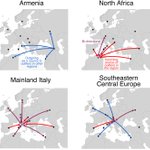
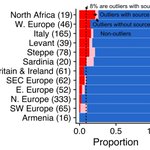
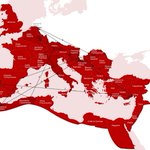
We’re excited to share our new preprint, with ~200 new genomes from the Roman empire and beyond! We find highly diverse populations, use genetics to reconstruct and quantify individual mobility, and discuss population structure through time! More below! 🧵
biorxiv.org/content/10.1101/…

Clemens Weiss retweeted

A shift in the way people move in the Roman Empire - traveling, but not settling down. We analyzed hundreds of ancient human genomes, discovered high migration, & showed how the results fit with present-day population structure. Check out our new paper! 🧵elifesciences.org/articles/7…

Clemens Weiss retweeted

@raungar and I are thrilled to share our paper on the trainee-led course on genetics, ethics, and society that was developed at Stanford: biorxiv.org/content/10.1101/… (1/9)

Clemens Weiss retweeted

Measures of gene constraint like pLI and LOEUF have been hugely useful in human genetics, but they lack power to detect constraint in the shortest 25% of genes. Here, we introduce an empirical Bayes framework (GeneBayes) to solve this problem. biorxiv.org/cgi/content/shor… 1/n

Clemens Weiss retweeted

How do plants respond to climate change?
We study the genomes of 200-year-old pressed plants and find that they may have evolved fewer leaf pores (but it is complicated - read the paper!👇)
biorxiv.org/content/10.1101/…

Clemens Weiss retweeted

Our paper "Genetic diversity loss in the Anthropocene" is out in @ScienceMagazine!
We study how genetic diversity is lost by habitat loss to help define @UNBiodiversity #Sustainable targets
science.org/doi/10.1126/scie…
@CarnegieScience
@CarnegiePlants
@CarnegieEcology
@Stanford

Clemens Weiss retweeted

The Major Histocompatibility Complex (MHC) plays a critical role in immunity. It’s also very unusual, with 1000s of alleles, 1000s of GWAS hits, and trans-species polymorphism (TSP). Just how old is this TSP?? A 🧵 about my new preprint w/@jkpritch: (1/13) doi.org/10.1101/2022.06.28.4…
Clemens Weiss retweeted

Excited to share my first postdoctoral work (w/ @jchuetter , @jkpritch , and Aviv Regev) about building causal models of gene regulation from pooled genetic screens data (aka. Perturb-seq), with a focus on scaling inference to thousands of variables. arxiv.org/abs/2206.07824
Clemens Weiss retweeted

10,048,466! That’s a lot of #SARSCoV2 genomes in the single largest phylogeny ever that we update and optimize every single day! Here, I’ll explain how we are doing pandemic-scale phylogenomics.

… as well as members of the Pritchard Lab, especially @antmarge and @ziyue_gao, but also @spence_jeffrey_ and @mootspoints. I also want to thank @WalterScheidel here at Stanford for great input and discussions …