

Founder of https://xitter.cf/t.co/mDsiTtGO5O | Former Principal SA @AWSCloud
NYC
Joined October 2021
- Tweets676
- Following179
- Followers829
- Likes10K






You don’t need to be a math expert or know ML algorithms to become a Forward Deployed Engineer (FDE) or Gen AI SA.
This misconception is keeping a lot of good engineers and architects from even considering the role.
Last week at the AI Engineer conference in NYC, I spoke with several FDEs. What stood out was how much of their work involved understanding customer problems, making architecture decisions, influencing executives, and building Gen AI solutions on top of existing applications - often in the cloud.
You don't have to take my word for it - just look up open FDE roles in Google, OpenAI, or CloudFlare.
I have many good friends at AWS becoming Gen AI SA from General SA without ML background, proving the same.
If you’ve been building applications, working with cloud infrastructure, or helping customers solve technical problems, you are closer than you think. Don't let anyone tell you otherwise.
Keep learning and keep rocking 🙌 🚀

Takeaways from attending, giving a talk, and talking with numerous FDE, leaders, Architects at AI Engineer Conference, NYC.
- You are not late to learn or adopt AI. Serious companies are adopting the stable and tested features of AI. No one is implementing fancy tools with "trust me bro" benchmark
- Harness and Eval are hot topic. Financial companies are tweaking harness for better output, and using custom evals to measure the quality
- The folks who understands customer problems, knows system design, and added Gen AI to their existing skills are thriving. 99% are NOT from ML background.
Finally, thanks to the amazing Linda Haviv to share the stage with me. She is smart and an amazing human being. The talk was recorded, will share once out.
Cohort 10 of my SA Bootcamp + GenAI (including for FDE roles) program launches October 17th.
Register for free launch workshop: sabootcamp.com/

Popular interview question candidates get wrong - How did you do Disaster Recovery (DR) for your AWS application?
Common but average answer - I will replicate it to another region.
What the interviewer is looking for is how DR strategies are chosen, and what are the different strategies. As an SA, you will be responsible for talking to the app team and coming up with an appropriate DR strategy. This is even more important in light of yesterday's event!
A great answer is - There are different DR options to choose from depending on RTO (Recovery Time Objective) and RPO (Recovery Point Objective). The available DR strategies ordered by highest to lowest RTO/RPO (and lowest to highest cost) are:
- Backup and Restore
- Pilot Light
- Warm Standby
- Multi-site Active/Active
Then explain one of the DR strategies in detail. Preferably Multisite Active/Active because it’s used in most critical prod applications. Architecture attached.
- The most critical part for DR is the database. In this case, we are utilizing Global Table of DynamoDB for active-active mode. If you are using SQL database like Aurora, keep in mind that Aurora Global Database is Active-Passive, but new Aurora DSQL is active-active.
- Application stack is running on EC2 with Auto Scaling Group. You run minimum two EC2s in each region to keep it highly available
- Load Balancers are regional service, hence we are using one load balancer in each region, distributing the traffic to that region
- Route53 sends traffic to one of the two Load Balancers based on geolocation and latency
- RPO/RTO is minimum in this architecture because data is constantly being replicated, and EC2s are up and running with minimum count of two in both regions. In some cases, applications make the desired count higher to keep higher number of EC2 running in the second region for lower RTO
If you get this question in your interview, make sure to knock it out of the park!
---
Explore other popular interview questions with the average and great answers: app.cloudwithraj.com/freegui…

After launching my startup, I can confidently say that non-developers, and non-architects can't vibe code a production app. Here's why:
- App website had 150K malicious traffic in one week! Denial of Service, prompt injection, trying get access keys, spoof logins, and more. Screenshot attached!
- Without my working enterprise and public sector architecture experience, I'd not have deployed all the countermeasures beforehand.
- Gen AI is great as a coding companion only if you know what you are trying to protect against or in general perform tasks. If you don't know, it's hard to ask for it. One common example - it'd put critical validation in front end JavaScript which is easy to bypass.
Lastly, I am biased, but AWS native security tools are quite good. I am using WAF, Shield, Cognito, Guardduty, Inspector, and a few custom techniques I picked up throughout my career.
I have many such example in security, cost, performance optimization, and other well-architected pillars. Don't ignore studying these. Else you'd have hard time in yous vibe coded app and interview!
---
Download Cloud Gen AI practical interview questions and answers (FREE): app.cloudwithraj.com/freegui…

I recently built an AI agent for my customers but it almost got hacked.
The agent could send the customer's invoice, give payment status, and perform other invoice related activities. Basically, a finance agent that never sleeps.
Here's what the endpoint had:
✅Authentication? Yes.
✅Parameterized query? Yes.
✅Unsafe input flowing anywhere? No.
✅SAST clean. SCA pass. Code review approved.
But we ran into a problem - any logged-in user could read every other customer's invoice.
Change /invoices/1001 to /invoices/1002 in the url and you're reading someone else's data.
The agent wasn't compromised. The bug was one missing line.
The code checked that you were logged in. It never checked that the invoice was yours.
This is an IDOR (insecure direct object reference). It isn't invisible because there is a flaw in the scanner, it's invisible because there's nothing pattern-shaped to catch.
The code is syntactically correct and does exactly what it was written to do. What's wrong is a question of intent: a check that should exist and doesn't.
That's not a bug a signature can find, because it was never a matching problem to begin with.
I started looking at other areas:
→ A single-use coupon you can apply ten times
→ A checkout flow where you can skip the payment step
→ A login endpoint with no limit on attempts
I figured out that Sonar Hunter Agent can help me fix these.
How it works:
→ Run multi-step sequences of specialized prompts that reason through your code the way a security researcher works through a manual code audit.
→ Hunts for broken access control, business logic, and auth/session flaws
→ Pins confirmed findings to a file and line, in your existing SonarQube issue list
I also like the separation of duties. The agent reviewing the code isn't the AI that wrote it. With so much code now AI-generated, that matters.
According to Sonar, it has already found 200+ zero-day vulnerabilities in open-source applications.
If you're shipping code into multi-tenant apps, this is worth a look:
fandf.co/4xqGLm0
Massive thanks to Sonar for building this innovative tool and also collaborating on this post.
fandf.co/4xqGLm0?trk=public_…

Raj Saha | Building Cloud Colosseum retweeted

Super excited to be speaking at one of my favorite conferences of the year next week, AI Engineer (AIE) NYC!!
I'll be sharing the stage with the uberly talented @cloudwithraj at the @OracleDevs booth for our talk: "Build a Self-Improving Portable Agentic Second Brain for Your Team, and Enterprise"
We'll talk about agent memory that grows with you 🧠 and how you can go from a second brain for yourself, to a team brain, to then an enterprise brain, without rebuilding and with the ability to be portable across tools.
📍 Oracle booth #4 · Tuesday Oct 13 · 2:15 PM (raffle right after 😉)

One of the biggest mistakes I see in GenAI architecture is treating the AI layer like it exists in isolation. It doesn’t.
Your AI application still needs access to operational data, search, transactions, retrieval, memory, and all the systems your business already runs on.
MongoDB just wrapped .local conference at NYC, and these are some of the noteworthy announcements on their fully managed database, Atlas:
✅ Atlas Infinite (Public Preview) - scale compute from storage independently, giving every workload the elasticity, responsiveness, and retrieval accuracy necessary.
✅ Atlas Agent Engine (Public Preview) - Build, deploy, and govern your agents on top of your Atlas infrastructure.
✅ Atlas Ephemeral Clusters (Public Preview) - spin up temporary MongoDB Atlas databases in seconds, removing human-in-the-loop friction to accelerate building and prototyping applications.
MongoDB Atlas can be used for things like:
→ Operational data + vector search together - combine live application data with vector embeddings on the same database
→ Agent memory - Use same database as memory for AI agents
→ One platform for multiple data patterns - transactional workloads, search, analytics, and vector embeddings in one platform
→ Less infrastructure complexity - Atlas is managed, so developers don’t have to build and operate as much database infrastructure themselves
→ Multi cloud support - supports AWS, Azure, GCP
Try MongoDB Atlas today: fandf.co/4yreLjo
Thank you MongoDB for partnering with me on this post.

Poland tour complete - Warsaw, Auschwitz, Krakow. Don't laugh, but being a Solutions Architect actually helped me connect with more people on this trip!
I met these two fine gentleman in Warsaw. One is a Polish author who writes about the country’s culinary scene and has his own line of vodka. The taller gentleman works with counterterrorism departments around the world and was in Poland to give a talk.
10 years ago, I probably would’ve never struck up a conversation.
But, as a Solutions Architect:
- You ask questions.
- You listen.
- You understand someone else’s world.
- You take complicated ideas and explain them simply.
- And you find common ground.
Those skills don’t disappear when the customer meeting ends.
They help you talk to a CTO, a student, an entrepreneur, or someone you randomly meet thousands of miles from home.
Maybe that’s one of the underrated benefits of a career in Solutions Architecture: You learn technology - but you also learn people.
Until next time, Poland. 🇵🇱
---
Cohort 10 of my SA Bootcamp + GenAI including FDE, program launches October 17th
Register for free launch workshop: sabootcamp.com/

One of the best AI conferences is AI Engineer (AIE) because the speakers talk about real-world implementation, and not just theory. And next week, I will be speaking at AIE, NYC!
Excited to announce that I’ll be sharing the stage with the talented Linda Haviv, at AI Engineer NYC on Oct 13th at 2:15 PM at the Oracle Booth about Agents, memory, and Second Brain, along with a demo.
In addition, things I’d do while attending AIE:
- Hands-on workshops on Agent memory
- Understand what is more important - trying newer products like Jev or mastering tried and tested concepts?
- Learn the tradeoffs and pitfalls from other projects so I can avoid mistakes on my own product
I’ll be spending most of my time around Booth 4 (Oracle).
If you have a question on AI, how it can save or doom the world and your career, come say hi. Thank you Oracle for bringing me to the event, genuinely excited to learn and explore.

Only 3 months left in the year....
And this is usually the quarter where a lot of people start to coast.
Holidays. Travel. Shorter days. Less motivation.
But here’s the thing - the most active hiring starts around mid-January and continues into February.
Which means if you start preparing when the jobs open, you may already be late.
Summer bodies are built in the winter. Careers work the same way. I’ve always gone harder during the periods when the world slows down because that's a sure shot way to get ahead.
I joined AWS at the end of January. I joined Verizon in February. And when people tell me I look in shape in the spring, that work was usually forged in the dead of winter.
See the pattern?
Four of my students recently landed roles at AWS (2X) and Google (2X).
While others were saying, “It’s summer, I’m taking it easy,” they were studying, practicing, doing mock interviews, and getting ready.
Then when the opportunity showed up, they were ready to capitalize.
So yes - enjoy fall and holidays.
Enjoy the colors. Have the eggnog. Spend time with your family.
But also prepare.
Study system design. Practice your behavioral stories. Sharpen your technical fundamentals. Do mock interviews.
Because when January and February arrive and hiring picks up, you don’t want to start getting ready.
You want to already be ready.
Make the last quarter count. Onwards and upwards 🙌🚀
---
Download Cloud Gen AI interview questions and answers that hundreds of students used to crack interviews (FREE): app.cloudwithraj.com/freegui…

Popular interview question candidates get wrong - what is an AI agent?
The average answer:
Agents can perform complex tasks with prompts. Then mention random Gen AI terms like MCP, LLM, Tool.
Why average?
This answer doesn't have the depth that SAs need to showcase. And you need to correlate the terms in regards to AI Agent.
Think of it like this - if interviewer asks you What is a microservice? And you just say the name of AWS services like EC2, Lambda, ALB, API Gateway, that won't be a good answer
Great answer :
- An AI agent is a software process that autonomously and independently makes decisions and takes actions until task completion.
Standalone large language model cannot take action and cannot go back and forth till the task is done.
- Then you mention an example. Lets say I have AI agent for troubleshooting. I can send a prompt like identify issues in my AWS application and fix them.
And to fix this, the agent may need to go to different places, logs of the application, infrastructure or database, some metrics, etc.
- And it's done with agentic code interacting with large language model and a bunch of tools. And you don't have to code or specify how many times a tool needs to be called. Its all happening automatically. And once the issue is found, this agentic code using a tool can also go fix it.
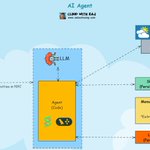
- Say this part to delight the interviewer - so, the main components of AI Agents are the LLM, some sort of code also known as harness, and tools connected via MCP. But all modern agents give you the capability of resuming your session and that is done via memory. So this agent code has also access to short-term memory and long-term memory.
Study these components of the AI Agent and how to secure and monitor them, and you'd be all set for any follow up questions!
If you get this question in your interview, make sure to knock it out of the park!
---
Download this and other Cloud Gen AI interview questions and answers (FREE): app.cloudwithraj.com/freegui…

This week, the US Government rebranded Artificial Intelligence as Super Intelligence. Important question is, what does this mean for jobs?
First of all AGI is NOT here. The rename is to emphasize that AI mimics human, and SI will amplify human capability.
All the companies will now self-regulate AI, and an independent committee will oversee this. This means, no AI slowdown (though there was no slowdown anyway).
And I actually think there is some good news here. Govt. announced that AI-related jobs to be “massive” in the presence of these CEOs.
Data is actually showing this - according to LinkedIn's latest workforce data, U.S. hiring increased 1.9% month-over-month. But Technology hiring jumped 8.1%. You can see more open roles now, than in Jan.
So, what do you do?
- Learn AI related to the business and technology domain you are in. For example, if you are in financial, learn AI use cases that banks are using
- Do small small proof of concepts. No one has years of experience in Gen AI yet. All my students that got jobs in AI, including FDE, have shown real-world like projects
- Articulate the value of your judgement. No one going to hire someone who just prompts. You must be able to use your experience to drive the AI.
Whether we call it AI or SI, that is where the opportunity is.
Cohort 10 of my SA Bootcamp + GenAI + FDE program launches October 17th. Register for the free launch workshop: sabootcamp.com/
Onwards and upwards 🙌 🚀

My favorite way to study is still physically printed pages. There is something about highlighting sections, writing notes, and folding pages!
For AI - I study cloud agnostic concepts first, and then think about implementing it with a cloud.
I want to share a valuable deep dive resource hub that I often study the Gen AI concepts from.
You don't have to trust my word. Check out this real-world, step by step explanation of Agent memory: fandf.co/4cZwBBz
Some of my other favorites in the same website:
- How to expose selective data, and not everything, with MCP servers
- Context engineering explained from basic to advanced
- Building adaptive agents
Whenever I am traveling, I always print out good content to read. Please share other valuable material you found useful in comments below, I am always looking for those.
fandf.co/4cZwBBz?trk=public_…

What is the difference between CPU and GPU? The average answer vs delightful answer:
Average answer:
CPU is good for general purpose applications, and GPU is good for running AI ML workloads
Why average?
This answer doesn't highlight the superpowers considering this is a Gen AI interview question. Think of it like this - if interviewer asks you What is the difference between EC2 and Lambda? And you answer EC2 is servers/Virtual Machines on the cloud, and Lambda is Serverless, that wont be a good answer.
Good answer:
A CPU or Central Processing Unit has a small number of powerful cores optimized for sequential, general-purpose tasks such as application logic, branching, database operations.
A GPU or Graphical Processing Unit has thousands of simpler cores optimized for parallel workloads where you're doing the same operation on massive amounts of data simultaneously.
Gen AI inference is basically matrix multiplication at scale, which maps perfectly to GPU parallelism. A CPU would work through that sequentially; a GPU processes it in parallel and is orders of magnitude faster. That's why LLM training, and inference is best in GPU because that's essentially a lot of parallel processing.
Then add an AWS example to delight the interviewer - some examples of CPU EC2 instance families are M, C series, and sample GPU instance families are P4, P5.
---
Download this and more Cloud Gen AI interview questions and answers (FREE): app.cloudwithraj.com/freegui…

Why can’t you just shove everything in the context, why do you even need Agent Memory?
The simplest analogy is this - the context window is the desk, memory is the filing cabinet.
A bigger desk is useful. You can spread out more notes. But the desk gets cleared. The filing cabinet is what lets you come back tomorrow, open the right folder, and pick up where you left off.
A few other reasons:
- Memory is not just saved context. For example, User Preferences Memory stores derived choices, styles and preferences. Agent can infer them instantly without processing the long context again, making it faster and cheaper
- Multiple agents can read/write into the same shared memory. For example, a customer intake agent can record user facts into long-term memory, and a downstream fulfillment agent can immediately access those facts without needing copied context
- Memory is a database. It’s hard to compete with databases when it comes to concurrency, indexing, and scaling
This is the same reason the agent markdown files, which were so popular, are kind of gone now.
👉 Check out the real-world explanation: fandf.co/4cZwBBz
I have to give a shoutout to Oracle Developers for publishing deep dive blogs on Gen AI concepts. I often print them out and study them. Thank you for collaborating with me on this post.
linkedin.com/showcase/oracle…

Forward Deployed Engineer (FDE) is the hottest role right now. One of my bootcamp students recently landed an FDE role at Google, and here is what you need to prepare:
FDE formula:
FDE = Solutions Architect Skills + GenAI + Coding
You need to be comfortable with:
• Coding
• Cloud concepts
• Cloud + Agentic System Design
• Agent orchestration patterns
• MCP, A2A, RAG, memory, security, observability, evals
• Frameworks like LangChain, LangGraph, ADK, or Strands
• Behavioral and customer-facing communication
And you don’t necessarily need years of experience in that company’s cloud.
My student came primarily from OCI and AWS knowledge and still landed Google. Interviewers look for strong fundamental concepts. i.e. RAG strategies or agent orchestration patterns stay the same irrespective of the cloud, and that's what Big Tech interviewers look for.
Finally, don’t prepare for one job title.
Build a skill stack that can open doors to Solutions Architect, AI Architect, GenAI Specialist, and FDE roles.
Cohort 10 of my SA Bootcamp + GenAI program launches October 17th covering the roles above.
Register for free launch workshop: sabootcamp.com/

"I Use GenAI to Code" Is the Worst Answer You Can Give in an Interview.
"How are you using GenAI in your day-to-day work?" This question shows up in almost every interview now, and almost everyone gives the same answer:
"I use GenAI to write code."
"I use it to generate documents."
"I have a bot that automates part of my job."
These are bad answers. Not because they are false, but because they tell the interviewer nothing about YOU specifically.
What the interviewer is actually trying to find out is whether you know how to use your own judgment on top of the output, because at the end of the day, every one of these models is nondeterministic.
Here are concrete examples you can adapt and use in your own interviews.
Unnecessary validation logic:
GenAI tends to over-engineer. If you accept a field from the front end and just need to insert it into a database, the model will often add validation checks that duplicate what already exists on the front end. Left unchecked, this bloats your codebase and makes it harder to maintain.
Catching and removing that redundant logic, and being able to explain why you removed it, shows you are thinking about long-term maintainability, not just shipping something that runs.
DynamoDB and the missing global secondary index:
Going little deeper on this one. If you have built serverless applications, this is a strong one. "I was recently coding a serverless microservice using API Gateway, Lambda, and DynamoDB.
My tables had both a primary index and a global secondary index. When I asked GenAI to add a new feature, it generated a DynamoDB scan instead of a query. A scan reads the entire table with no index, which is inefficient and expensive at scale. I reviewed the generated code, caught that it ignored the GSI, and told it explicitly which fields to query on instead."
That answer shows you know how to review AI-generated code for performance, not just correctness.
Infrastructure as code that is not secure by default:
If you are a Solutions Architect, DevOps engineer, or cloud engineer, this example lands well.
GenAI-generated CloudFormation or Terraform is inconsistent. One run might generate a security group open to the entire internet. One time it might generate in YAML, next run in JSON.
The fix is not to catch this manually every time. It is to create a skill, a reusable instruction set, that tells the model: always generate CloudFormation in YAML, never JSON, never leave a security group open to the internet, and require additional approval for any internet-facing load balancer.
Mentioning "skills" and "nondeterministic" by name in an interview signals that you are current with the latest patterns, not just the basics.
I am at LinkedIn word limit. Read the detailed version with more examples here: sabootcamp.kit.com/posts/i-u…

Are Frontier Labs like Anthropic and Open AI here to stay?
I have been thinking about it a lot. Let’s dissect:
An enterprise AI Agent = LLM + Harness + Integration with existing app and data + Design factors such as security, cost etc.
LLM - Frontier labs have an advantage over LLM, but open weight models are catching up. AWS just announced that Kimi K3 is now launched in Bedrock.
Harness - Harness used to be the moat, but it’s not any significant advantage anymore. The thing is, even if you start with an average harness, you can now trace the calls, and optimize it. For example - with Strands and Amazon Agentcore.
Integration with the existing ecosystem is something that ALWAYS comes up in real-world use cases. Agents need to run where the data is. You can MCPify the existing APIs on any cloud.
Design factors - If you invoke frontier models via API, you can’t control all the knobs, whereas, if you run their model on the cloud you can control the security, cost and other factors.
The peripheral things like Skills, Cowork are just a thin layer, that we have alternatives for already.
In conclusion - For Architect, DevOps, and FDE roles, study the cloud part and deprioritize learning niche features of Claude/Codex.
What's your take?
---
Download Cloud Gen AI interview questions and answers (FREE): app.cloudwithraj.com/freegui…

Hackathons at my community is always intense, 8-10 teams participating, and judged by FAANG architects. Shoutout to Austin Adams, Sushmaa Firoj Shaikh, Sivaprasad Kancharla, Sneha H Bhat, and Sushyanth P. for building an AI solution that generates audience specific briefs from meeting recordings.
What makes PilarPrep real-world is that it was designed around an actual customer-facing workflow rather than starting with AI and looking for a use case.
→ Integrates AuthN/Z with Cognito auth, JWT tokens, encrypted storage. Also implemented Gen AI security with Guardrails
→ Fully serverless on AWS (Bedrock Agentcore, Lambda, S3, API Gateway, zero servers to manage)
→ Role-specific preparation - an executive, account manager, Solutions Architect, or technical stakeholder doesn't need the same information. PilarPrep creates context around what matters to each role instead of producing one generic AI summary.
→ Stakeholder and decision-maker strategy - it helps identify who influences the decision, what their priorities are, likely objections, and how the team should approach the conversation.
The beautiful part is folks from all different backgrounds, and experience came together and won this tough hackathon. They are the real deal.
Check out the really well documented github repo: github.com/aadams35/pilarpre…
Onwards and upwards 🙌🚀

Gen AI term of the week is Jev which is 193.6x faster, 444.6x cheaper than LLMs! What is it, how is it different from trad LLMs, and will it help achieve AGI?
- What is it?
Instead of generating free-form text, you define the possible outputs upfront and Jev returns probabilities and confidence that your software can directly act on.
Traditional LLM approach: “What is the capital of America?”
The LLM answers "Washington DC"
Jev can't answer the same question. But you can reframe it as "Which one of these is the capital of America?"
Then , you pass choices: Washington DC | Philadelphia | Boston | San Francisco
And the result looks like:
Washington DC: 0.94
Philadelphia : 0.04
Boston : 0.01
San Francisco: 0.01
Jev input is always Context + Questions.
It can’t generate text back like traditional LLMs. So forget about using it as an interior decorator which is my fav ChatGPT use case these days.
Traditional LLMs evaluate next token based on current token which makes it sequential and slow. Where as Jev can work parallelly to determine the probability and confidence for each choices. Hence it’s faster.
- What is a good use case?
It excels in determining the confidence of answers, hence will be suitable to evaluate LLM output with Eval
- Will it achieve AGI?
Nope. The more important question is - should you study this for interviews? Not yet, it needs to prove it’s scalable, secure, and accurate.
I just got access to Jev, subscribe to my newsletter to get the detailed analysis (FREE): app.cloudwithraj.com/newslet…
