cofounder & CMO @cloneisyou | love to learn new language 🔤 and food 🍱 | community: https://xitter.cf/t.co/UFtpMp1Smr
SF
Joined April 2026
- Tweets2.1K
- Following707
- Followers581
- Likes1.9K






Pinned Tweet
We’ve put a lot into Clone.
So happy to finally share the beta!
Astra, Fable & more are free to try. Drop your use case on the original post for a $1 first month of Plus (then $20/mo).

Introducing Clone, the Personal AGI that predicts your next prompt.
Press Tab twice, and your Clone keeps prompting your agents.
Clone-in-the-Loop just killed Human-in-the-Loop.
Available now (Beta): clone.is/you
Comment your use case, and we’ll DM you a $1 first-month coupon for Clone Plus ($20/mo).

Jun retweeted

@garrytan this is the personal agi that actually feels like a self-driving rocket.
Introducing Clone, the Personal AGI that predicts your next prompt.
Press Tab twice, and your Clone keeps prompting your agents.
Clone-in-the-Loop just killed Human-in-the-Loop.
Available now (Beta): clone.is/you
Comment your use case, and we’ll DM you a $1 first-month coupon for Clone Plus ($20/mo).
They are solving real problem when I felt using TTS!

Your AI voice sounds human. So why can't it say your product's name?
A great AI voice reads "Porsche Taycan" as TAY-can. Porsche says TIE-kahn. It guessed from the spelling, and nobody caught it, because nobody listens to line 1,200.
Today we're launching Onepin: the production step after text-to-speech. It checks every line of voiceover before it ships using the voices you already work with.
Onepin can:
➤ Check people's and product names against a 4-million-word pronunciation dictionary
➤ Spell out prices and dates before the voice speaks
➤ Score every line of audio for naturalness, clarity and word accuracy
➤ Fix the one wrong word in the same voice, without re-rendering the take
Works with your voice subscription on @ElevenLabs, @OpenAI, @Google and 30+ more. No phonetic spellings to type. No re-rolls. No switching providers.
Free to start, no credit card required. Hear the before and after in the thread ⬇️
Jun retweeted

AI 正在淘汰 PhD 训练中那些原本被误认为是研究能力的机械劳动。
现在一个很强的人配合 agent、coding model、自动化实验系统,可以把相当一部分压缩掉。Stanford 2026 AI Index 的数据已经非常说明问题:AI 能力仍在快速增长;2025 年超过 90% 的 notable frontier models 来自工业界,而编码 benchmark 的能力也在一年间大幅提升。
博士的任务,是寻找知识前沿。
很多人把 PhD 想象成2027年我决定研究 diffusion model,然后2032我会成为 diffusion model 专家。这当然非常的荒谬。因为,2032 年 diffusion 甚至可能已经不是一个值得单独讨论的研究对象。
我和 Isola 最大的分歧是关于AI Research的部分。他说,在 frontier lab 外做公开研究,也许反而更能影响未来。这个价值判断我理解,但现实结构已经发生巨大的变化。现在的情况是,AI frontier 越来越依赖compute、data、engineering、infrastructure、talent concentration和capital的组合。
芝加哥大学 2026 年一项追踪约 42,000 名 AI researchers 的研究显示,AI 人才长期从 academia 向 industry 集中;截至其历史样本中的 2019 年,68% 的 AI researchers 已在 industry。研究者转入产业之后,平均论文数量下降、专利活动显著增加,收入则上升。
所以,今天必须把AI research拆成两种:Frontier scaling research和Idea-constrained research。
但我特别赞同他的第 7 条,Slow Science。
Isola 写道,技术越来越快,但人的深度理解不会同比例加速,擅长未来科研的人,依然会是愿意花时间理解材料的人。
AI 让你在自己还没有理解的时候,就产生了已经理解的错觉,这是博士训练最大的敌人。
我观察许多人,epistemic leverage 很高,internal representation却很浅。而 PhD 训练的,其实恰恰是后者。
听说美国 NSF 今年已经启动一个 $47 million、五年期的四年制 PhD pilot,让博士生直接获得 industry R&D placement,并由 academia 与 industry 共同指导。
与此同时,2026 年美国 PhD funding 环境又比以前紧张。AAU 收集的 55 所研究型大学数据显示,Fall 2026 doctoral admissions 相比 Fall 2025 整体下降约 15%;AAU 还特别提到,包括 AI、quantum computing、advanced engineering 在内的一些领域也受到 funding uncertainty 的影响。这个数据不是专项统计,但却可以说明整个美国科研训练体系正在承受压力。
Don’t do a PhD to learn the tools.
Do a PhD to learn how to decide what deserves to exist.
去读博士,是为了学习如何判断什么问题值得存在。因为未来的情况一定是PhD会被AI强迫回到它原本应该是什么的状态。
独自面对未知,是一种孤独的勇气。

Students sometimes ask me if it still makes sense, in this accelerating age, to pursue a PhD in AI.
Perhaps counterintuitively, I think it's a great time to do so.
I wrote up some thoughts on this here: web.mit.edu/phillipi/www/wri…
I'm getting used to handing more and more purchasing decisions over to AI. Recently, I've used GPT 6 Astra to:
1. Find a vendor to 3D-print a laptop lid stopper for Clone.
2. Find a dermatology clinic near our office.
3. Recommend literature to read: poetry, novels, and so on.
I was pretty happy with the reading recommendations. I gave it plenty of context about the writers and books I already loved, and the suggestions felt right.
The first two were less satisfying.
What interests me is how easily all that dissatisfaction gets filed under “the AI wasn't good enough.”
But a disappointing outcome can have very different causes:
1. I may have given it the wrong criteria. For a dermatology clinic, perhaps I should have asked it to weigh reviews, pricing, and other factors together, rather than prioritize proximity to the office.
2. The relevant information may simply not be available online. When I asked for nearby 3D printing vendors, it found businesses near here. Only after placing the order did I learn that their actual production facilities were all in quite far from here.
3. Its answers may have been skewed by the flood of AEO/GEO-optimized content.
4. The choice itself may have been sound. Sometimes you simply happen to get a disappointing product or service.
If I felt I had made the decision myself, I might have been more satisfied with exactly the same outcome, for two reasons.
First, visibility. Having explored the range of available options, I'd understand why this was the best choice, or at least a reasonable second-best.
Second, rationalization. Even if it wasn't either of those, it's easier to convince myself I made the right choice when the choice was mine.
Will this feeling fade as we get used to making more decisions through AI? Will interfaces get better at showing us the options and trade-offs? Or will they get better at making us feel as though we made the decision ourselves?
There's another problem: AI can’t get feedback.
Unless we make a deliberate effort, our satisfaction or dissatisfaction never becomes part of the context the AI can learn from. Whether the recommendation works out or not, we tend to go quiet once we have an answer. Why spend more tokens on a conversation that already feels finished?
With programming, the feedback loop runs largely inside the computer. Errors, test results, and other signals can keep flowing back to Codex.
For decisions like these, the loop breaks at the point where I have to go out into the world and experience the result myself. The AI gives me a recommendation. I live with the outcome. Unless I come back and tell it what happened, the loop stays open.
I'm going to try keeping detailed reflections on these decisions and feeding them back. But I'm still unsure whether that's an efficient or useful habit, or whether I'll be able to tell if it actually leads to better decisions over time.
1. This is the most thought-provoking piece I’ve read in a while. The author’s incisive analysis gets to the heart of what intelligence is.
2. How I came across it makes it all the more interesting: through a carousel posted by a Korean Instagram account, rather than on X itself. With Instagram’s format built so firmly around images, I was used to encountering lighter, more mainstream content there. I was surprised to find a real audience for a post like this.
3. Even on an internet that seems to be growing flatter, then, there is still plenty of room for translating value and for arbitrage. Once, there was plenty of value to be captured simply by translating Steve Jobs’s Stanford commencement address into Korean. Today, automatic translations let people watch videos of well-known figures directly, even when English isn’t their first language.
4. Translation is now needed for discovery, rather than comprehension. With the editorial discernment to spot a Chinese-language post on X and turn it into an Instagram carousel, you can still cultivate a real audience. A line from Anna Tsing’s The Mushroom at the End of the World, which I’m currently reading, has stayed with me:
“Translations across sites of difference are capitalism: they make it possible for investors to accumulate wealth.” (p. 62)
This may not be the most faithful use of a passage from a book that explores the possibilities of survival in pericapitalist worlds. Still, her words have become entwined with this post in my mind, and I wanted to put that connection into words.

在机器学习和信息论中,有一个著名的直觉叫流形假说。
现实世界产生的数据,在名义上往往拥有极高维度:一张高清图片可能对应数百万个像素维度,自然语言、声音、蛋白质序列、行为轨迹也都存在于极其庞大的状态空间中。
但有意义的数据并不会均匀散落在这些空间里,它会被压缩在一个极小、极其特殊的结构区域中。
一张随机生成的百万像素图片几乎不可能恰好构成一张真实人脸,因为自然图像同时受到身份、姿态、光照、透视、物体结构和物理规律等大量约束。
流形,只是这种低复杂度结构的一种几何表达,更一般地说,机器学习真正能够成立,是因为现实世界的数据根本不是随机噪声。
这也是理解智能最重要的起点。
智能存在的第一条件,在于这个世界必须具有可预测结构。
假如一个宇宙中的未来和过去完全独立,那么无论是人脑、Transformer还是无限大的超级计算机,都无法通过观察过去提高对未来的预测,因为这个世界根本没有留下任何可以学习的规律。
白噪声无法被理解,也无法被预测。
因此,智能能够存在,本身就意味着宇宙不是最大随机性的混沌,而包含大量跨尺度稳定的统计依赖、几何约束、组合结构、动力学规律和因果关系。
从这个角度看,机器学习做的事情是在巨量观测中寻找可以压缩的规律。
模型看过十亿张人脸,并不需要在参数里存储十亿份像素副本,它需要形成的是关于身份、轮廓、姿态、光照、空间关系等潜在变量的生成结构,最终用一个远短于全部训练数据本身的模型去近似。
因此,Learning在很深的意义上就是Compression。
如果一个庞大的数据集合能够被一个更短的生成程序描述,那么模型获得的就是规律。这与Kolmogorov Complexity的直觉高度一致。
生成或描述这些数据所需的最短程序究竟有多长,是一个重要的问题。
但是,数据不均匀本身仍然不足以产生智能。一个变量即使99%的概率取0、1%的概率取1,它的分布极度不均匀,却未必具有任何复杂结构。
重要的是变量之间存在可以利用的依赖。知道 (X) 之后,是否能够减少对 (Y) 的不确定性,这才是信息。
Mutual Information (I(X;Y)) 所度量的,本质上正是这种关系。
所以,智能依赖的是世界内部存在稳定的dependency;
统计规律、几何结构、层级结构、因果关系以及时间上的连续性共同构成了学习能够发生的基础。
这也给出了理解大模型的一种更准确方式。
一个随机初始化的神经网络最初只是一个巨大的、没有意义的函数族,而梯度下降不断利用数据排除那些与现实分布不一致的函数。
经过海量训练之后,原本随机的参数逐渐形成高度结构化的内部表征。
语言结构、空间关系、人物与概念关系、程序结构和部分物理规律也进入其中。
这里,我们不能简单说神经网络与现实世界同构。因为同构是一个过于严格的数学概念。
其实,模型是在自己的计算介质中形成了一套能够保存现实世界部分稳定关系的内部表示。
它是世界结构在另一种介质中的压缩投影。
于是,所谓智能涌现也没有那么神秘。
如果模型只能捕捉局部统计相关性时,它表现为模式匹配;
当它能够形成更长程、更抽象、更稳定的表示时,就出现泛化;
当不同领域的内部结构能够被重新组合,就表现为类比和联想;
当模型能够利用已有结构,对训练数据中没有直接出现过的状态进行推断,就表现为推理。
记忆、泛化、类比和推理,只是同一种机制在不同尺度上的表现:利用一个内部世界模型,在未观测区域重建结构。
模型规模之所以重要,是因为复杂世界需要足够大的函数空间才能被表示。
而某些能力的突然涌现,有时只是评价指标造成的阈值效应,有时也可能对应grokking或内部表示重组这样的真实非线性变化。
我想,我们需要更多地去关注参数空间在学习过程中发生了什么结构重组,使新的计算能力成为可能。
如果继续把这个问题推到信息论和统计物理层面,会得到更加统一的图景。
生命,依靠持续消耗自由能维持自身远离热平衡,而大脑和机器同样需要消耗能量进行信息处理。
由于Shannon entropy和热力学熵并不是同一个概念,我们可以更准确地定义,智能系统不断丢弃与任务无关的变化,同时保存对于预测和行动有价值的信息。
这与Information Bottleneck极其接近。
内部表示并不需要保存输入的一切,而只需要保留足够多能够预测未来、指导行为的结构。高级智能的标志,是知道什么必须留下,什么可以被遗忘。
由此,智能可以粗略地被写成Compression、Prediction、Control。
Compression意味着从海量观察中提取规律,Prediction意味着利用这些规律推断尚未看到的世界,Control意味着利用预测去改变未来。
一个有限的系统面对一个远比自身复杂的宇宙,通过观察世界、压缩世界、建立内部模型,再依靠这个模型预测并干预世界,这就是智能最一般的形式。


1. Outsourcing execution
2. Accelerating execution
With these two shifts brought about by agents, I feel we are moving toward a way of working that makes it harder and harder to stay absorbed in a single task for long. Losing that sense of immersion is frustrating in itself, and it also makes us less effective at our work.
To get the most out of agents, you inevitably end up running many sessions in parallel. Yet, as Garry pointed out in a recent YC talk, our working memory has room for only about the “magic number seven.” Juggling different kinds of work, each complex and laden with context, is an ordeal. I feel like a seven-digit computer suffering a cache miss on every read.
Most of my “bio tokens” now go toward reading and making sense of what I have read, because agents handle most of the writing and execution. Reading, meanwhile, demands an “Extra High” level of mental alertness and focus, so the number of hours I can devote to it each day is more limited than I would expect. Lately, I cannot shake the feeling that, despite having the ability to put agents whose knowledge far exceeds my own to work in parallel, my biological limits keep me from making full use of them.
How can I create the conditions for deep, sustained focus again? I have been trying what I can at a personal level. I tend to eat smaller meals, for instance, because I find it hard to concentrate unless I am a little hungry. But I wonder how long I can keep a clear enough view of everything to manage what feels like running an entire city. And as we run a race toward a destination already set, I wonder whether we really have the luxury of choosing between speed and the scenery.
Jun retweeted

Anthropic’s Economics team is sharing a new model of how AI might affect economic growth, jobs, wages, and more by 2030.
Explore the scenarios, tell us what you think will happen, and see how your answers compare to more than 10,000 Americans. anthropic.com/institute/econ…


The thing is, using an appropriate model for each task and connecting it to real workflow.
Make it repeatable system.
openai.com/index/how-enterpr…
ramp.com/data/ai-index-augus…

Jun retweeted

Google Brain founder, Andrew Ng:
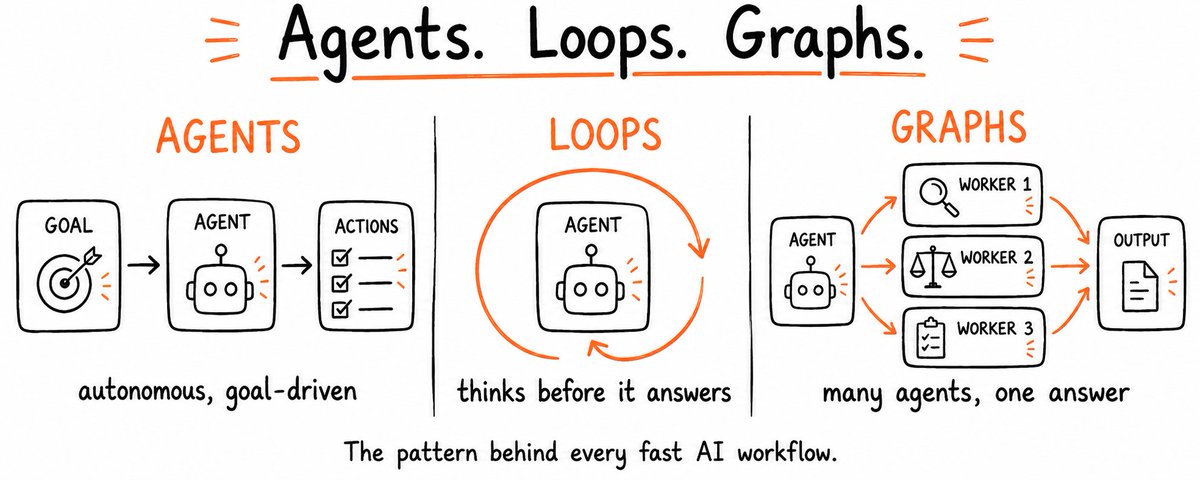
"Prompting will die in 6 months.
Loops and Graphs are what's replacing it."
In 2 hours, he shows exactly what the best engineers already build instead, and how to start building it yourself.
The missing piece most people skip: how to connect those loops into a graph that compounds every time it runs.
Watch it, then read the full guide on loops and graphs below.