
Smart Contract Developer at @OriginProtocol. Prev @swellnetworkio & @StakeDAOHQ Views are my own.
Joined August 2019
- Tweets179
- Following285
- Followers270
- Likes2.4K


Clément Moller 🦇 🔊 retweeted

Origin recently shared how it approaches protocol security. Here’s what that looks like in practice.
At @summit_defi Mumbai this week, @clement_moller showed how Origin’s invariant tests catch bugs that can block a withdrawal, even when every balance check passes.


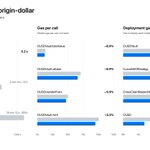
Solar on @OriginProtocol's OUSD repo: full build 37× faster than solc (383x faster against via-ir), deploys 35% cheaper, ~4% gas saved per call. Zero code changes. Wild.
Thank you so much @gakonst @DaniPopes @djtodoro 🔥


My first contributions to Foundry on formal verification are live! Very happy 🙌

Foundry v1.8.4 is out 🛠️
Native Base support, VS Code and Zed LSP clients, external compiler adapters, expanded BAL support, durable script recovery, and stability fixes for dynamic test linking and forge fmt.
Update with:
$ foundryup

2
104
Both talks got accepted! I’ll be at @summit_defi in Mumbai on November 1–2 🇮🇳
I’ll cover removing the staking oracle with Beacon Chain proofs, then DeFi liveness bugs with stateful invariants.
See you in Mumbai!

I applied to speak at @EFDevcon and @summit_defi in India! 🇮🇳
My proposals cover work we did at @OriginProtocol on Beacon Chain proofs and staking oracles, plus work I led there on invariant testing and Foundry's symbolic engine.
Really hope one gets accepted! 🍀
4
153
So long, Hardhat, and thanks for all the tests 👋
At @OriginProtocol, we've finally moved our core smart contract stack to Foundry.
Tests, deployments and ABI generation now all run through Forge.
The migration
github.com/OriginProtocol/or…
The final cleanup
github.com/OriginProtocol/or…

3
101
I applied to speak at @EFDevcon and @summit_defi in India! 🇮🇳
My proposals cover work we did at @OriginProtocol on Beacon Chain proofs and staking oracles, plus work I led there on invariant testing and Foundry's symbolic engine.
Really hope one gets accepted! 🍀
Update: I’ve upgraded this work with Foundry’s new mapping-aware SSTORE hooks.
The WETH invariant now tracks every balanceOf write in ghost state, "checking totalSupply == sum(all balances)" across symbolic users, not just a fixed holder set.
github.com/foundry-rs/foundr…

Played around with Foundry’s new symbolic testing on WETH9, it was fun!
I documented the properties checked, results, bounds, and current limitations. Definitely planning to integrate it more into my test suites!
If you’re curious: github.com/clement-ux/weth-s…

1
125
Played around with Foundry’s new symbolic testing on WETH9, it was fun!
I documented the properties checked, results, bounds, and current limitations. Definitely planning to integrate it more into my test suites!
If you’re curious: github.com/clement-ux/weth-s…
Symbolic Testing in Foundry - forge test --symbolic
Foundry has been used to secure >100B of value in deployed smart contracts. This is achieved through state of the art high performance fuzzing made available to every developer for free.
Going beyond fuzzing, AI empowers us to move towards formally verifying / proving security of our code by writing complete models of the behavior we want faster.
We have finally started to make progress towards symbolic / concolic execution in Foundry.
Try it out!
getfoundry.sh/forge/testing#…
Clément Moller 🦇 🔊 retweeted

In the era of AI-powered hacks, this is true more than ever before
medium.com/consensys-diligen…

Clément Moller 🦇 🔊 retweeted

Lido now has $1B+ in pending withdrawals.
Lido estimates ~15 days for withdrawals.
Current Lido validator exits cover just 58% — and take ~8 days to process.
Without a lot more validator exits, the real wait will be much longer.
@OriginProtocol's Lido ARM is helping users exit while generating strong yield for LPs.
analytics.originprotocol.com…


Clément Moller 🦇 🔊 retweeted
The End of Oracle Dependence: How Origin Ether Brings Trustless Validation to Liquid Staking
Ethereum’s liquid staking market keeps scaling, but most LSTs still rely on 3rd-party oracle committees to function.
That’s a structural weakness in a system built for self-verification.
These committees bridge execution → consensus, reporting validator balances and exits. The setup works, but it introduces delay, coordination overhead, and social trust into the a place that shouldn’t require it.
With the latest $OETH upgrade, that design gap is gone.
Origin Ether now verifies validator balances directly against the Beacon Chain using Merkle proofs via EIP-4788 — removing oracle dependencies entirely. This aligns LST accounting with Ethereum’s core principle: trust only the chain.
A quick breakdown:
• Execution-layer LSTs were historically blind to consensus-layer validator balances
• Most LSTs rely on committees to push updates every 24 hours
• This creates lag, trust assumptions, and offchain complexity
• Dencun’s EIP-4788 changed the model by exposing Beacon roots inside the EVM
• Smart contracts can now confirm validator state cryptographically, without intermediaries
OETH is among the first LSTs to fully adopt this architecture.
Validator balance increases, decreases, exits, and pending deposits are now verified entirely through Merkle proofs. Any state update failing validation is rejected onchain.
All contracts were audited by @OpenZeppelin, @sigp_io, and @Nethermind, ensuring the approach meets the same security bar as validator infrastructure itself.
Why this matters:
• Stronger resilience: no offchain actors needed
• Deterministic accounting: integrations can trust the numbers rather than oracles
• Full transparency: anyone can verify validator states using public Beacon data
OETH joins a small set of protocols — including EigenLayer and Stakefish — pushing proof-based validation forward.
Bringing this to the liquid staking layer gives users direct access to trust-minimized ETH staking rewards.
As Ethereum continues to evolve, proof-based accounting is set to replace oracle-driven systems.
Merkle proofs are emerging as a core primitive for the next stage of onchain finance, enabling things like:
• Restaking protocols with native validator state verification
• Institutional staking and fund products that require cryptographic solvency proofs
• Modular and cross-chain systems anchored to Ethereum’s consensus data
Origin Ether is taking this path early, setting a higher standard for verification in staking.
Full write-up in the comments. 👇

Ever wondered how to test an Ethereum staking strategy without a Beacon Chain?
That’s what we had to solve for @OriginProtocol’s latest OETH upgrade — so I built a mock Beacon Chain from scratch to fuzz test validator behavior and Merkle Proof logic.
Here’s how the invariant campaign worked 🧵

Origin’s new staking design verifies validator balances directly onchain using Merkle Proofs — no oracle, no multisig. To validate this, I built a full BeaconChain mock inside Foundry to replicate deposits, withdrawals, slashing, and consensus rewards.
After 9 hours and 7M fuzzed calls, zero invariants were broken.
Full write-up: medium.com/@clemmoller/invar…

I worked on the invariant testing campaign for this upgrade — definitely one of the most interesting challenges I’ve had lately.🚀
Using MerkleProofs instead of an oracle for an ETH LST is an extra step toward decentralization!
Article about it coming soon ⏳
OETH is getting a major upgrade. 🛡️
The upgrade has passed audits from @NethermindSec, @OpenZeppelin, and @sigp_io — three of the most respected firms in Ethereum security.
OETH staking is becoming more secure, transparent, and efficient than ever. (1/3)

1
2
128
Clément Moller 🦇 🔊 retweeted

why i dislike crypto founders so much
i got into crypto in 2016 and back then a large proportion of market participants cared about the core values like decentralisation, immutability, censorship resistance etc. today, hardly 2% still care about it, the rest of the "builders" just want to make money
there is NOTHING wrong with wanting to make money. it is a good thing. but if you want to make money, JUST SAY THAT and don't frame it like you are saving the world
jesse's words here are "we are gonna have this positive impact on the world (...) and figure out how these new tools can unlock new systems for ALL OF US and so (...) we are going to be exploring a network token"
shut your mouth
there is precisely one reason why base is launching a token and it is to max extract one last time for coinbase shareholders. and that by itself is not a bad thing, the bad thing is how jesse frames it like they want to save the world when indeed they just want to max extract
and this is true for ALL crypto companies
base worked great without a token for years, you don't need a token
polymarket, pumpfun, and all other dapps work perfectly fine without a token, yet, they all have one. for the sole reason that it is the easiest way to make more money for the team and vcs. and i would be ok with it if they were just honest about it instead of virtual signalling like a blue haired liberal
imagine that uber, spotify, airbnb and every single app had their own currency. makes 0 sense. they have company shares and it is the mandate of the board and management to maximise shareholder value, often against the common good. but i am ok with it, bc it is transparent and honest
only in our industry do we have people like sandy from scroll or cringe jesse pretending they are saving the world when indeed they are just enriching themselves
can't listen to these people talk...

Clément Moller 🦇 🔊 retweeted

Audits are really expensive, but you already knew that?
Yet you still do nothing to minimize the cost of your audits...
You're throwing money at the problem and hoping it'll magically solve everything...
A lot of elite teams do a simple trick that saves them thousands and it's called "internal reviews".
This is when the developers audit their code. This is not them casually looking around for anything interesting during development - this is a dedicated, structured process they schedule.
Here is how they do it:
Before the actual audit set a reasonable time frame (50% of what the auditors quote you for as the devs already know the code).
During that time only review the code, don't add new logic, don't add new mechanics, only focus on security and reducing complexity/unnecessary code.
This might seem trivial, but will actually save you a ton, especially if your code is littered with bugs.
Here are the benefits:
1. Your reports will look better, as they will have fewer bugs
2. You will catch most simple bugs allowing auditors to focus on the more complex parts
3. Audits will be faster as there will be fewer fixes, allowing you to launch sooner
4. You may only need 1 audit, whereas without this prep you might need multiple
Clément Moller 🦇 🔊 retweeted

Staking V2 now live on @CurveFinance: Fraxtal, @base, and @SonicLabs
Experience Stake DAO's upgraded infrastructure:
+ Instant boosted reward distribution
+ No reward dilution
+ Redesigned UI/UX (details coming 👀)
Try it before the mainnet release:


