

We are an interdisciplinary think-tank set-up to focus on the policy challenges at the intersection of technology and society.
- Tweets218
- Following20
- Followers158
- Likes10



ALT The Weight of the Tech World: A Comparative Dialogue Between Brazilian and Indian Tech Consultancy Worker Sebastian Antoine Maria Skłodowska-Curie Global Postdoctoral Fellow at the National University of Ireland Friday, 25th September, 2026 3 PM to 4.30 PM | R-110, IIIT-B Campus

ALT The global technology industry is characterized by a significant international division of labour, with thousands of workers from the Majority World being hired annually to serve clients and companies in the Minority World through a variety of BPOs, IT services or tech consultancy firms. This talk investigates the lived experiences of these workers: how do their specific working conditions shape their identities and imaginaries as technologists, as well as their relationship to the products of their labour and the broader society? Drawing on the experiences of two Millennial tech workers – one from Northeast Brazil and the other from Southern India – with extensive experience in such subcontracted consultancy environments, this talk will delve into their social and professional journeys by deploying a comparative dialogue inspired both by Bourdieu’s The Weight of the World and Burawoy’s Extended Case Method.

ALT Sébastien Antoine holds a PhD in Social and Political Sciences from UCLouvain and is currently a Marie Skłodowska-Curie Actions (MSCA) Global Postdoctoral Fellow at the National University of Ireland Maynooth. His research experience includes visiting positions at institutions in Brazil (USP, UFPE and UFRGS), India (IIIT-Bangalore) and the US (UC Berkeley and Penn), where he has engaged with different academic and research contexts. His work draws on these varied experiences to develop a comparative and interdisciplinary approach to his research.

ALT CITAPP SEMINAR SERIES “Time to shift lenses? – Indic Perspectives and Qualitative Studies in India” by Dr. Sarita Seshagiri, Consulting Ethnographer and User Researcher Date: Friday, 11 Sep 2026 from 3:00 PM – 4:30 PM Venue: R-109, IIIT-B (Ecity)

ALT The talk explores the possibilities of incorporating Indic perspectives into qualitative research in India. The first part examines pragmatic aspects of undertaking user studies in India, with attention to how the social, cultural, linguistic, and contextual specificities of the setting can inform research design, fieldwork and interpretation, rather than treating India merely as a site of data collection. The second, more exploratory part, considers the potential of Indic approaches, particularly Vendata tools, for qualitative data analysis. It examines how textual data generated through interviews, observations, and other primary studies might be interpreted through conceptual frameworks beyond established approaches such as thematic and content analysis. The discussion considers whether Indic ways of knowing can offer alternative interpretive lenses of qualitative inquiry.

ALT About the speaker Dr. Sarita Seshagiri holds a PhD in Political Science from the National University of Singapore and has extensive academic and industry experience in user experience research, ethnography, and interaction design. She has worked with leading mobile technology multinationals and conducted field research across rural, semi-urban, and urban India, with experience in diverse primary data collection and qualitative analysis. Her current work explores Indian Knowledge Systems and their possibilities for informing design and qualitative research. Drawing on her years of field engagement in India, Dr. Seshagiri brings a grounded perspective on understanding users, contexts, and the assumptions that shape research practice.

ALT Urbanization from Below: India and the Global Urban Question by Chetan Choithani (NIAS, Bengaluru) 📅 May 4, 2026 🕒 3:30–5:00 PM 📍 IIIT-B Campus, R-109

ALT This presentation will situate the processes of smalltown urbanization in India in current debates in the field of urban geography and urban studies on the ‘urban’ question. In 2008, for the first time in human history, more people lived in cities and towns than in rural areas, and demographic projections show that the humanity is ultimately headed towards an urban future. Much of the future urbanization will occur in the developing world, and away from big cities. This urban transition has prompted wide-ranging discussions on global urban conditions, particularly on urban futures in the developing world. These discussions have also inspired animated theoretical debates on what constitutes the ‘urban’. Drawing on primary, field-based evidence from the small urban(izing) geographies in India, this talk will look at the nature of urbanization unfolding at these places in India and reflect on the relevance of these emerging urban spaces for the urban theory.

ALT Chetan Choithani is an Assistant Professor at the National Institute of Advanced Studies (NIAS), Bengaluru. Prior to his present employment at NIAS, he was a Postdoctoral Research Associate at the Urban Studies Institute of Andrew Young School of Policy Studies, Georgia State University. Chetan obtained his PhD in Geography from the University of Sydney. The broad disciplinary domain of Chetan’s work is development studies. Within this area, his research and teaching interests include migration and urbanisation, food and nutrition, livelihoods, gender, and social policy and how they relate to development, particularly in the Indian context. He is the author of Migration, Food Security and Development: Insights from Rural India, published by Cambridge University Press, 2022.


ALT Balaji Parthasarathy presented select findings from the Fairwork India project in the paper "The spatial organization of digital platform work and algorithmic management: “Human in the loop” across hub-based and non-hub based platforms in India", at the session "Platform Labor: The Geographies, Economies and Inequalities under Algorithmic Management and Big data", during the American Association of Geographers Annual Conference in San Francisco, 17-21 March, 2026. Also presenting their papers at the session were former Fairwork India researchers Raktima Kalita and Kanikka Sersia. Their papers were titled, "Towards a spatial understanding of emotional labour in platform work", and "When the black box is open: Platform economy and everyday coding practices", respectively.

ALT Balaji Parthasarathy presented select findings from the Fairwork India project in the paper "The spatial organization of digital platform work and algorithmic management: “Human in the loop” across hub-based and non-hub based platforms in India", at the session "Platform Labor: The Geographies, Economies and Inequalities under Algorithmic Management and Big data", during the American Association of Geographers Annual Conference in San Francisco, 17-21 March, 2026. Also presenting their papers at the session were former Fairwork India researchers Raktima Kalita and Kanikka Sersia. Their papers were titled, "Towards a spatial understanding of emotional labour in platform work", and "When the black box is open: Platform economy and everyday coding practices", respectively.

ALT 'Data Rich - Knowledge Poornima: Building the Commons We Actually Deserve' Tanveer Hasan CIS Bangalore, IIIT Hyderabad Monday, 30 March 2026 3:45 - 5:15 | R-109, IIIT-B Campus

ALT About the talk: We are consistently told and informed that we live in the ‘Information Age’. Data is everywhere: harvested, stored, and processed at scales that would have seemed like science fiction a generation ago. If we are indeed drowning in data, why is it so hard to find reliable and nuanced knowledge in non-global, non-visible languages about something that actually matters to your community? What we find instead is often a digital wasteland: machine-translated gibberish, content optimised for clicks rather than truth, and datasets scraped without consent. Knowledge that should be deep, oral and contextual has been flattened into training data to be fed to a model. This ‘data rich, knowledge poor’ paradox is not a glitch in the software, it is unfortunately a feature of the system. The same volunteer labour that built the digital commons (in Indian languages as well) is now being extracted as raw material and repackaged and sold back to us as a service.

ALT Tanveer Hasan is currently with the Centre for Internet & Society, Bangalore, and the International Institute of Information Technology, Hyderabad. He previously worked with the Wikimedia Foundation, where he led global alliances for the Free and Open Knowledge Movement in South Asia. He has also served as an Assistant Professor at the Centre for Indian Languages in Higher Education at the Tata Institute of Social Sciences.

ALT Balaji Parthasarathy and V Sridhar have been awarded a grant for their proposal, Furthering Submarine Cable Supply Chains: An Australia-India Framework for Manufacturing, Installation, and Repair Security, under the Australia-India Cyber and Critical Technology Partnership. The Australian leadership will be provided by Dr Samuel Bashfield, of the Australia India Institute (University of Melbourne), and the La Trobe Centre for Global Security, La Trobe University. Submarine cable networks carry approximately 99% of global internet traffic and form the backbone of the Indo-Pacific's digital infrastructure. However, supply chains for cable manufacturing, laying, and repair face critical vulnerabilities: vendor concentration, limited manufacturing diversity, constrained repair capacity, and geopolitical risks. These vulnerabilities threaten network resilience and digital connectivity across the region, with direct impact on island nations and developing economies.

ALT Balaji Parthasarathy is Professor at the International Institute of Information Technology Bangalore, and the co-founder of the Institute’s Centre for Information Technology and Public Policy. His interests are rooted in economic geography and economic sociology, and explore the relationship between technological change and innovation, economic globalization, and social transformation, especially in underprivileged contexts. His publications have spanned the organisation of production in the global software industry, to the political economy of e-governance, e-waste and social innovation. As the principal investigator of Fairwork India, his current research examines the opportunities and constraints afforded by gig work in the digital platform economy.


ALT In this working paper, Claire Crawford considers the one-time password, a now ubiquitous security practice of entering an access code sent to an individual’s smartphone. Identifying logics of authentication but also of subjectification, she argues that OTPs have a traceable history of colonial and postcolonial data collection and bureaucracy. The talk seeks to provide context and nuance to the emerging body of work concerned with the politics and dangers of digital and algorithmic governance.

ALT Dr. Claire Crawford is a teacher and researcher at the University of Cambridge. She completed her PhD at King’s College London and a postdoctoral fellowship at the University of York. Her research focuses on transnational social movements, digital politics, and postcolonial theory.

ALT Balaji Parthasarathy was invited to the speak on Exploring Collaborative Research Opportunities between Universities from India and East Asia at the East Asian Summit Countries Conclave of Heads of Higher Education Institutions hosted by Nalanda University, Rajgir, Bihar, 17-19 September.

ALT Balaji Parthasarathy was invited to the speak on Exploring Collaborative Research Opportunities between Universities from India and East Asia at the East Asian Summit Countries Conclave of Heads of Higher Education Institutions hosted by Nalanda University, Rajgir, Bihar, 17-19 September.

ALT From skills to sustained livelihoods: Reimagining India’s labour market through training and technology Dr. Gayathri Vasudevan Chief Impact Officer, Sambhav Foundation, India Thursday, 9th October 2025 14:00 – 15:30 hours IST Room R110, IIITB Campus

ALT About the talk: India’s labour market stands at a pivotal moment. While the country adds millions to its working-age population every year, structural barriers—from informality and low productivity to gendered participation gaps—continue to limit economic mobility. The talk explores how integrated skilling, technology, and ecosystem partnerships can bridge these divides and move people from work to better work. Drawing on the Sambhav Foundation’s experience of impacting over 2.7 million lives across 20+ states, Dr Gayathri Vasudevan will illustrate how blended learning, digital tracking, and industry-linked training have transformed livelihoods for workers in construction, manufacturing, retail, green, and care sectors. She will also discuss emerging opportunities in green jobs, digital inclusion, and the circular economy, and the need to reframe “skilling” not as an end in itself but as an enabler of income growth, dignity, and resilience.

ALT Dr Gayathri Vasudevan is founder of the Sambhav Foundation, established with a vision to enable livelihoods and enhance the quality of life of vulnerable communities through Education, Employability, and Entrepreneurship. A development practitioner and social entrepreneur, she has dedicated her career to empowering youth, women, and men to earn a dignified living and build micro-enterprises. Under her leadership, the Sambhav Foundation has become one of India’s foremost non-profits in skilling and capacity building, with 100+ centres, 85+ vocational courses, and a presence across 12,000+ pin codes. Its holistic initiatives span education, health, environmental stewardship, and community development, impacting over 2.7 million lives and incubating 20,000+ micro-enterprises through a strong focus on micro-entrepreneurship and financial literacy.

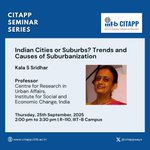
ALT CITAPP SEMINAR SERIES Indian Cities or Suburbs? Trends and Causes of Suburbanization by Kala S. Sridhar Professor Centre for Research in Urban Affairs, Institute for Social and Economic Change, India Thursday, 25th September 2025 14:00 – 15:30 hours IST Room R110, IIIT-B Campus

ALT This talk addresses questions regarding the suburbanization of persons, households, and jobs in India’s cities, their regional variations, the factors associated with this sprawl, and its consequences. We use granular data from the Global Human Settlements Layer at the sub-kilometre grid level for 100 Indian cities. We find that the downward-sloping population density function is appropriate for studying India’s cities. Further, we find that in 2015, India’s population was significantly more suburban (82%) than urban. Cities in southern and more urbanized states are more sprawling compared to cities across India overall, while those in slower-growing states are relatively more compact. We also find that employment is more decentralized than population suburbanization in 2015. On average, half of all jobs are concentrated within a 5-km radius of the core. For more on this talk, visit: https://citapp.iiitb.ac.in/events/upcoming-citapp-seminar-series-talk-by-kala-sridhar/

ALT Kala S. Sridhar is a Professor at the Centre for Research in Urban Affairs, Institute for Social and Economic Change, India. She was a Visiting Fellow at Stanford University’s Center for South Asia (CSA) from March to August 2025, and an Honorary Fellow at Stanford’s CSA from June to August 2024. A recipient of the Fulbright-Nehru Fellowship, she was hosted by UCLA’s Luskin School of Public Affairs, Department of Urban Planning, in 2021 and 2022, and was a Visiting Scholar at George Mason University during June–July 2023. She holds a Ph.D. from The Ohio State University and an M.S. from the University of Iowa. She has authored and edited books published by Routledge, Oxford University Press, Palgrave Macmillan, Springer, and Sage, and has published papers in leading journals including Regional Science and Urban Economics, Urban Studies, Cities, and many more. https://citapp.iiitb.ac.in/events/upcoming-citapp-seminar-series-talk-by-kala-sridhar/