

@mach1ai 🇺🇸 Former: @Traceup, @ReplicatedHQ, @Amplifyla, USC, Iowa.
Austin, Texas
Joined August 2007
- Tweets3.6K
- Following384
- Followers2K
- Likes1.4K






Pinned Tweet
The future of AI automation isn't just generating workflows. It's transferring operational knowledge.
When you introduce AI into a real workflow, the hard part is often not getting the first version working. It's identifying all the small production details that make the workflow reliable.
Mach 1's Tower doesn't just generate workflows. It can recommend patterns and operational considerations learned from workflows already built on the platform. The goal is to help operators benefit from knowledge that has already been discovered instead of repeatedly finding the same edge cases themselves.


The opportunity for Muse is that I can't connect both my work and personal Google accounts to Codex. So Codex gets work and Muse gets personal.
The risk to businesses is that a competitor changes the economics of your market before you change the economics of your business.
Chris Olson retweeted

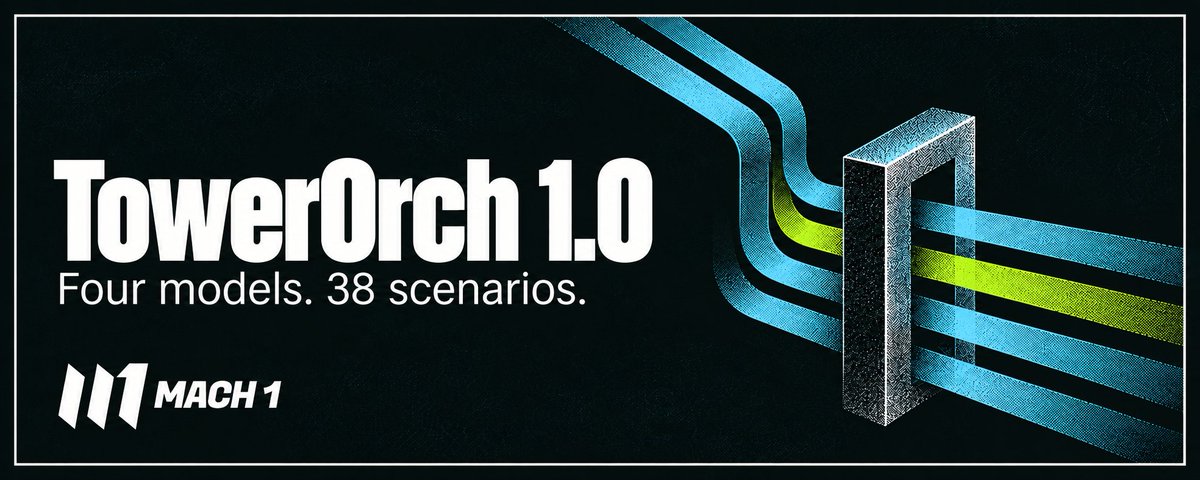
Our latest benchmark results are in.
We tested four models from OpenAI, Anthropic, DeepSeek, and Google across 38 orchestration scenarios ahead of a Mach 1 release coming in the next few weeks.
Full results below.


One of my favorite customer quotes:
"Since working with Mach 1, I've had to teach myself to stop asking, 'Can we do this?' and start asking, 'What's the best way to do this?' The possibilities feel endless."
Whether you're transforming an existing process or creating an entirely new experience, the possibilities are indeed endless.
One thing we’re learning at Mach 1:
Agents don’t just automate work. They create visibility.
Once an agent is inside a workflow, it can spot the patterns a dashboard misses: where customers are confused, where process breaks down, what language is resonating, and what the business should change next.

I used Codex a lot to ask questions about expected behavior in our app/api, and about half the time it answers the questions and then starts implementing assumed enhancements, which is weird.
"The idea that you will have an AI agent running around without nobody watching it is kind of insane." — Jensen Huang (via the Dwarkesh Patel podcast).
I couldn't agree more. At Mach 1, we believe operators are the conduit between the business and AI, so we build tools to power that connection.
Muse Spark not being publicly available via an API is strategically pretty telling of Meta's AI intentions.
Mach 1’s latest capabilities in helping operators build and deploy agents into their business.
In this demo, I recreate a sales agent for Trace, the same kind of agent we built three years ago. What once took months can now be built and deployed in under 10 minutes.
Mach 1 brings intelligence to your operations, helping teams build agents that can handle complex, real-world processes.
LGA tower frequency is 118.7. JFK has two tower frequencies, 119.1 and 123.9.
I don't think this was a turn of the dial mistake; I think the pilot used muscle memory and just hit the wrong muscle.
This quoted post is unavailable.


Operational AI has to move across systems, maintain context, and decide what happens next.
@mach1ai powers complex real-world processes with automation that doesn’t just run. It thinks.
During the holidays, Instagram should offer a feature where you can scroll nothing but ads for gift inspiration.
I'm a lifelong Democrat. But Gavin Newsom’s recent tactics remind me of a marketing quote: when you start copying your competitor, you end up looking like their asshole.
Isn’t this just like when FB rolled out a redesign? History shows it makes noise, but never stops more people from using it. That’s a pretty good place for OpenAI to be.

If you have been following the GPT-5 rollout, one thing you might be noticing is how much of an attachment some people have to specific AI models. It feels different and stronger than the kinds of attachment people have had to previous kinds of technology (and so suddenly deprecating old models that users depended on in their workflows was a mistake).
This is something we’ve been closely tracking for the past year or so but still hasn’t gotten much mainstream attention (other than when we released an update to GPT-4o that was too sycophantic).
(This is just my current thinking, and not yet an official OpenAI position.)
People have used technology including AI in self-destructive ways; if a user is in a mentally fragile state and prone to delusion, we do not want the AI to reinforce that. Most users can keep a clear line between reality and fiction or role-play, but a small percentage cannot. We value user freedom as a core principle, but we also feel responsible in how we introduce new technology with new risks.
Encouraging delusion in a user that is having trouble telling the difference between reality and fiction is an extreme case and it’s pretty clear what to do, but the concerns that worry me most are more subtle. There are going to be a lot of edge cases, and generally we plan to follow the principle of “treat adult users like adults”, which in some cases will include pushing back on users to ensure they are getting what they really want.
A lot of people effectively use ChatGPT as a sort of therapist or life coach, even if they wouldn’t describe it that way. This can be really good! A lot of people are getting value from it already today.
If people are getting good advice, leveling up toward their own goals, and their life satisfaction is increasing over years, we will be proud of making something genuinely helpful, even if they use and rely on ChatGPT a lot. If, on the other hand, users have a relationship with ChatGPT where they think they feel better after talking but they’re unknowingly nudged away from their longer term well-being (however they define it), that’s bad. It’s also bad, for example, if a user wants to use ChatGPT less and feels like they cannot.
I can imagine a future where a lot of people really trust ChatGPT’s advice for their most important decisions. Although that could be great, it makes me uneasy. But I expect that it is coming to some degree, and soon billions of people may be talking to an AI in this way. So we (we as in society, but also we as in OpenAI) have to figure out how to make it a big net positive.
There are several reasons I think we have a good shot at getting this right. We have much better tech to help us measure how we are doing than previous generations of technology had. For example, our product can talk to users to get a sense for how they are doing with their short- and long-term goals, we can explain sophisticated and nuanced issues to our models, and much more.