





Zheng Chen retweeted

🧠⚡ Excited to release EpiGraph! Led by PhD student Yuyang Dai, in collaboration with The University of Osaka (Dr. Zheng Chen, Dr. Yasuko Matsubara, Dr. Yasushi Sakurai) and University of Illinois Urbana-Champaign (Jathurshan Pradeepkumar, Dr. Jimeng Sun). 🎉


Zheng Chen retweeted
The takeaway: structured epilepsy knowledge substantially boosts evidence-grounded clinical reasoning!
🔌 Plug-and-play — run EpiBench with your own model, retriever & prompts
🌐 Interactive project page — explore the KG, click nodes, inspect evidence paths
🆓 Fully open-source
Excited to share two milestones in our EEG research 🏄♂️—TFM-Token and ODEBrain have been accepted to ICLR 2026!
Looking forward to pushing this direction further with the team and collaborators.
#ICLR2026


4
360
Meta reviewer: 🧐all reviewers keep their negative original scores. (Pic. 1)
All reviewers: 🤔Didn’t I raise my scores at all? (Pic. 2-4)
openreview.net/forum?id=gr8t…
@iclr_conf @BharathHarihar3 @LerrelPinto @Diyi_Yang
#ICLR26


1
341
Beyond models, data and AI infrastructure are equally important for understanding how far AI is from biomedical practice. This resonates with our MLOmics (Nature Scientific Data), a ML-ready multi-omics dataset to enable reproducible evaluation of AI models in cancer research.

1
46
Project Page: chenzrg.github.io/project/ml…
⚙️ Key Features:
• 🧬 8,314 multi-omics TCGA samples across 32 cancers
• 🧪 ML-ready datasets covering 20 learning tasks
• 🧠 Benchmarking reproducible baseline models
• 🔄 Multiple feature scales
• 📈 Diverse biological evaluation
21
Can we model brain activity as a time-evolving network, rather than a static graph?
EvoBrain answers this by grounding dynamic EEG graph modeling in theory and validating it on real intracranial EEG seizure prediction.
Spotlight @NeurIPS2025 🎉
Github: github.com/Kotoge/EvoBrain

59
Zheng Chen retweeted

Are you curious about how SE researchers apply Reinforcement Learning (RL) in their SE tasks? We recently conducted a survey of RL4SE, including the trends, research topics, used RL algorithms, model design and optimization, and more! Please check it! arxiv.org/abs/2507.12483
Welcome to our presentation and poster!
Oral Session 2E
Thu 24 Apr 3:42-3:54 pm
Poster Hall 3 + Hall 2B #16
Thu 24 Apr 10 - 12:30 am.

Can we integrate biological knowledge bases, experimental data, and AI models to unravel gene-disease associations?🤔
Excited to share that our paper “GeSubNet: Gene Interaction Inference for Disease Subtype Network Generation”has been accepted for an Oral at #ICLR2025 🚀🚀
237
🚀Thrilled to share that our work "SODor: Long-Term EEG Partitioning for Seizure Onset Detection" has been accepted at AAAI 2025!
arxiv.org/abs/2412.15598
1
1
161
Can we integrate biological knowledge bases, experimental data, and AI models to unravel gene-disease associations?🤔
Excited to share that our paper “GeSubNet: Gene Interaction Inference for Disease Subtype Network Generation”has been accepted for an Oral at #ICLR2025 🚀🚀

My Ph.D. student, Rikuto, will be at #ICDM2024 to present his first paper "SplitSEE: A Splittable Self-supervised Framework for Single-Channel EEG Representation Learning" on Day 2, December 10, at 14:45 (DM385).
Feel free to chat about anything!
1
124
arxiv.org/abs/2410.11200
This paper introduces a self-supervised learning method with a splittable architecture tailored for single-channel EEG, which holds potential for portable EEG monitoring and cross-channel/device deployment.
61
Zheng Chen retweeted

Rule-based rewards (RBRs) use model to provide RL signals based on a set of safety rubrics, making it easier to adapt to changing safety policies wo/ heavy dependency on human data. It also enables us to look at safety and capability in a more unified lens as a more capable grader model gives us higher quality RL signals.

We’ve developed Rule-Based Rewards (RBRs) to align AI behavior safely without needing extensive human data collection, making our systems safer and more reliable for everyday use. openai.com/index/improving-m…

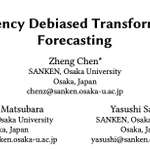
Congratulations to my first Ph.D. student, Xihao, for having his first paper, Fredformer, accepted by the #KDD2024 Research Track! We provide empirical analyses of frequency bias in Transformer-based time series forecasting and propose a feasible solution to solve this problem.

1
1
173
Zheng Chen retweeted

Checkout a new ICML paper from our group led by @ori_press! 🚨
We show why entropy minimization improves the accuracy of classifiers on input data, and how it could be used to estimate the accuracy of a classifier on an arbitrary dataset, without labels.
Detailed🧵👇

Entropy minimization is often used to increase the accuracy of models on unlabeled data, but it isn’t clear why it works. In our new ICML paper, we show that it clusters the embeddings of its inputs. With @ziv_ravid, @ylecun, @MatthiasBethge
arxiv.org/pdf/2405.05012
1/5 🧵👇
