

Risk first. Upside second. I hunt asymmetric setups from small caps to mega caps using fundamentals, catalysts and price action.
Charlotte, North Carolina
Joined October 2008
- Tweets17.9K
- Following1.7K
- Followers4.9K
- Likes2.7K



Pinned Tweet
That ETH cost basis is crazy. You and @mialovelyihgux6 are two accounts I follow because both of you make whale moves easier to read without overhyping them. Curious if this was just a trim.
1
6
816
Chip stocks have been getting punished.
Meanwhile, $AEHR announced more AI processor testing orders last week.
Interesting timing.
I'm not calling a bottom here.
But I'd rather dig into actual customer orders than guess which chip stock bounces first.
2
6
392
Everyone's talking about the memory selloff. I'm more interested in what the market is actually pricing in.
China's CXMT is pushing a more advanced DRAM architecture and has outlined plans for server memory products.
That's a legitimate competitive threat to study.
But a technology announcement isn't the same thing as proven high-volume production at competitive yields.
Those are very different milestones.
With $MU, the risk isn't that AI memory demand suddenly disappears. It's that future supply becomes more competitive, customers gain negotiating leverage, and investors start questioning how long exceptional margins can last.
I wouldn't dismiss the news.
I also wouldn't rewrite the entire memory cycle based on one announcement.
The next useful information will come from actual output, yields, pricing, and customer adoption.
Until then, it's a scenario, not a settled outcome.
1
5
170
If I had to build an October growth watchlist today, these are the 8 names I’d keep closest:
1.Nvidia ~ $NVDA
2.Arista Networks ~ $ANET
3.Palantir ~ $PLTR
4.Vertiv ~ $VRT
5.CrowdStrike ~ $CRWD
6.Rocket Lab ~ $RKLB
7.IonQ ~ $IONQ
8.Celestica ~ $CLS
AI infrastructure is still producing leadership, while software, networking, space and quantum are giving me the next group of names to track. Recent market action has kept Nvidia near record territory, while networking and quantum names remain active themes. Investor's Business Daily
Save this post.
I’m going to keep following these names through October and update the list when the setups change.
Follow and turn on notifications if you want the next update.
My October list is getting tighter.
$ANET
Watch: $200–$205
Buy zone: $195–$200
$PLTR
Watch: $186–$191
Buy zone: $180–$185
$RKLB
Watch: $68–$72
Buy zone: $64–$68
$IONQ
Watch: $42–$45
Buy zone: $39–$42
These are the levels I’m tracking now.
I’ll keep updating this list as October develops. Follow and turn on notifications if you want the next update.
3
347
I’ll say this once… 👀
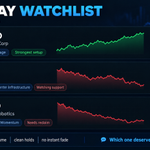
These are the names I’m tracking right now:
$ANET
Watch: $125-$135
🔥 Strong setup
$VRT
Watch: $105-$115
👀 On my radar
$PLTR
Buy zone: $145-$155
⏳ Waiting for confirmation
$RKLB
Watch: $70-$80
👀 Watching closely
$IONQ
Watch: $40-$50
⏳ Waiting for a better entry
Not chasing.
Just tracking.
I’ll keep following these names and share updates as things develop.
Follow along and turn on notifications for the next moves.
5
328
Before the bell, these are the names I’m not taking off my screen 👇
Large caps:
$NVDA $MU $GOOGL
Growth names:
$VRT $CRDO
Smaller / higher-risk names:
$VICR $AAOI $NVTS
I’ve been talking about a few of these for days.
The new names are here for a reason.
And one of the smaller stocks just moved very high on my list.
I’m not posting the reason here.
I’ll break down why I’m watching each one in the posts that follow.
💡 Follow me + turn on notifications so you don’t miss the next one.
3
243
I’m narrowing my list before the close. These 7 are still on it 👇
$NVDA (Nvidia) — Buy only on a clean pullback
$MU (Micron) — Top watch into earnings
$ANET (Arista Networks) — Buy on weakness
$COHR (Coherent) — Don’t chase today’s strength
$VRT (Vertiv) — Wait for confirmation
$NVTS (Navitas) — Speculative watch
$POET (POET Technologies) — High-risk watch only
I’ve been talking about $NVDA, $MU and $NVTS for days.
The other four aren’t random.
They’re all tied to the same AI infrastructure buildout I’ve been following.
There’s a reason each one made this list — and a reason I’m not treating them all the same.
I’ll break down which one I like most and why in my next posts.
💡 Follow me + turn on notifications so you don’t miss the next one.
268
The close gave us a cleaner answer.
Semis held up better than the market.
$SMH finished up roughly 1.1%.
But $NVDA couldn’t hold the early strength and closed down about 0.7%.
That matters.
The S&P finished red.
The Nasdaq finished red.
Breadth stayed negative.
And the 10Y hit 5.29% before easing back.
So the morning thesis only worked halfway.
Semiconductor relative strength = yes.
Broad risk-on = no.
$NVDA follow-through = no.
That’s a very different setup from simply saying “AI is strong.”
Tomorrow gets more interesting.
PCE hits before the open.
Then $MU reports after the close.
If yields cool and semis keep holding up, I’ll pay attention.
If PCE keeps the 10Y pinned near these highs, I’m not chasing strength just because a few chip names are green.
Risk first.
What matters more tomorrow:
the 10Y reaction to PCE, or $MU ’s guidance?
1
212
Morning question answered — at least partly.
AI strength is broadening.
Semis are up roughly 1.8%, and $NVDA is still one of the names holding up.
But I’m still not calling this broad risk-on.
The Nasdaq is basically flat.
The S&P is red.
9 of 11 sectors are lower.
And the 10Y pushed as high as 5.28%.
That’s the part I care about.
Chips are showing relative strength despite the macro tape, not because the macro tape got easier.
JOLTS softened.
Consumer confidence just hit a 12-year low.
Yields still aren’t giving growth stocks much relief.
So the thesis has changed a little:
Semiconductor leadership = confirming.
Broad market confirmation = still missing.
If breadth starts improving while semis keep leading, that’s a different market.
If yields stay near these highs and leadership narrows again, I’m not chasing it.
What would you trust more here —
semis holding relative strength, or breadth finally confirming?
122
Yesterday, $NVDA was the exception.
Today I’m watching whether it becomes the leader of a broader semiconductor rebound.
$NVDA is green again premarket.
$MU, $AVGO and $MRVL are all showing early strength too.
That’s an improvement.
But I’m not calling this broad risk-on yet.
The 10Y is still sitting around 5.2%+.
Oil is still elevated.
And we’ve got JOLTS + Consumer Confidence at 10.
So today’s question is pretty simple:
Can AI leadership broaden with rates still working against it?
For me, these are the levels that matter:
$NVDA — 233.21
$MU — 1084.81
$AVGO — 355.86
Clear those with real volume and the story gets more interesting.
Fail there while yields push higher?
Different setup.
Risk first.

134
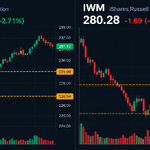
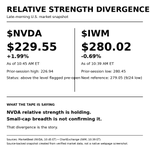
The divergence is getting cleaner.
$NVDA is now around $231, up roughly 2.7%.
$IWM is still red near $280.
QQQ is down roughly 0.8%.
That’s not broad risk-on.
It’s one of the market’s biggest AI leaders showing real relative strength while the broader tape still refuses to confirm it.
This morning I was watching whether $NVDA could hold above 226.94.
It did.
Now the question changes.
Can buyers keep it above the 229–230 area while QQQ and small caps stay weak?
If yes, that relative strength matters even more.
If $IWM finally reclaims 280.45 and starts pushing higher, then breadth gets more interesting.
Until then:
$NVDA strength = confirmed.
Broad risk-on = still not confirmed.
Which signal would change your read first here — $NVDA losing 229–230, or $IWM reclaiming 280.45?

159
The open gave us an answer.
$NVDA came out strong.
It opened well above the 226.94 level I was watching and traded above $232 early.
That’s real relative strength.
But I’m not calling this broad risk-on.
$IWM is around 280 and already slipped below the 280.45 level I was watching.
That matters.
Mega-cap AI strength is holding up better than the broader tape, while small caps still aren’t confirming the move.
So the setup has changed:
$NVDA strength = confirmed early.
Broad market strength = not confirmed.
Now I want to see whether Nvidia can hold the breakout while breadth stays weak.
If $IWM loses 279.05, that divergence gets even harder to ignore.
What matters more to you here:
$NVDA holding relative strength, or $IWM finally confirming the move?

1
117
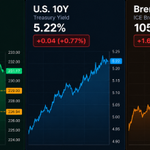
Oil is running the tape this morning.
Crude is back around $108.
The 10Y is near 5.22%.
Nasdaq futures are down roughly 0.9%.
That’s the chain I care about:
Oil → inflation pressure → higher rates → tighter multiples for long-duration tech.
But there’s an interesting divergence.
$NVDA is showing relative strength after Nvidia added $150B to its buyback authorization, while higher-beta AI names are under pressure.
So I’m not treating this as a generic “buy the dip” morning.
I want to see which AI leaders can actually hold up with the macro tape working against them.
$NVDA — first test is 226.94
$AMD — I want to see whether 625.52 can be reclaimed
$MU — 1073 matters
If yields keep climbing and those levels fail, I’m not forcing longs.
The question for the open:
Does stock-specific strength in $NVDA survive a 5.2%+ 10Y, or does the macro tape eventually win?
That’s the fight I’m watching.
Risk first.
126
Small caps haven’t won the rotation yet — but Friday gave me 3 names worth watching Monday.
$QMCO +13.6% — heavy volume, data/storage demand
$TSSI -3.1% — AI/data-center infrastructure, now needs to prove support
$WETO -10% — high-risk momentum, needs a clean reclaim
I’m not buying the story alone.
Monday I want:
• Volume
• VWAP holds
• No instant fade
Which one deserves the first breakdown?
#SmallCaps #AIInfrastructure #StockMarket

1
365
NEW: the mega-cap AI trade may have another catalyst.
China is reportedly considering allowing ByteDance and Alibaba to buy a new $NVDA chip designed for high-end professional computers.
That lands right after:
• Large-cap funds: +$36.6B
• Small-cap funds: -$1.0B
• Tech funds: +$4.9B
So the question gets even more interesting:
Does fresh AI demand keep money crowded in $NVDA — or eventually spill into memory, networking, power and data-center suppliers?
Demand is still there.
Capital is just getting a lot more selective.
#AI #Semiconductors #StockMarket

1
137
Here’s the market setup I can’t stop thinking about:
Large-cap funds just pulled in $36.6B.
Small-cap funds lost about $1B.
Meanwhile, AI and tech are still absorbing capital.
So here’s the real question:
Are investors right to keep hiding in the mega caps — or are small caps quietly setting up the next rotation?
I’m not calling the rotation early.
But if volume starts showing up in the right small caps, I want to see it before the crowd does.
Mega caps or small caps for the next move?
#StockMarket #SmallCaps #AIStocks #Investing
1
148

Power Hour is where today’s story gets graded.
Yields are still elevated.
Oil is back above $100.
Tech is still under pressure.
I’m not chasing whoever had the biggest morning spike.
I want:
• AI names closing off the lows
• Small caps holding VWAP with real volume
A strong close in a tough tape tells me more than an easy green day.
What earned a spot on your watchlist for tomorrow?

2
101
Small-Cap Radar 🔎
Higher yields are making small caps work for every green candle.
$TSSI +~12% — AI/data-center infrastructure
$WETO +~23% — physical AI, 25M+ shares traded
$QMCO +~8% — data/storage momentum
I’m not chasing the spike.
I want volume + a clean VWAP hold into Power Hour.
Which one still looks clean from here?

1
352