

PhD, political scientist @polscicph @uni_copenhagen. Retrospective voting, social groups, political behavior.
Copenhagen
Joined August 2015
- Tweets1.9K
- Following2.2K
- Followers1.1K
- Likes17.9K




Pinned Tweet
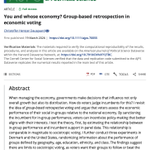
Very excited that the first paper of my PhD is out in @AJPS_Editor! 🎉
I theorize and test the idea of "group-based" economic voting using experimental + observational evidence from Denmark + UK + US.
1/🧵

Christoffer H. Dausgaard retweeted

True re: attention! And glad Anthropic is starting to share this data. But I struggle to interpret these numbers:
-IIUC, they're reporting share of conversations, not users. If a small % of heavy users have lots of other conversations (e.g. about coding), which seems plausible to me, then 0.51% of convos could mask a much higher share of users (the election-relevant quantity) asking about the election
-6 weeks before a midterm is still before most voters tune in
Hope a fuller release has per-user data across the full cycle!

The attention constraint on AI persuasion is fundamental, as we argued in this chapter preprints.apsanet.org/engage…
Just 0.51% of Claude conversations are about elections or voting; at most 0.01% about who to vote for
Christoffer H. Dausgaard retweeted

Fedt med mere data, men jeg synes det er vigtigt at forstå, at dette er en dårlig test af om det går godt med integration!
Efterkommer indeholder ikke kun forældre til tredje g'ere.
xitter.cf/hr_noergaard/status/21…

Berlingske har fået adgang til hidtil usete tal, der viser kriminalitetsniveauet blandt tredjegenerationsindvandrere fra Menapt-lande.
Tallene afslører, at denne gruppe er markant mere kriminelle end gennemsnittet.
Tallet for mandlige tredjegenerationsindvandrere med rødder i Menapt-lande viser, at gruppen er 147 procent mere kriminelle end gennemsnittet.

Christoffer H. Dausgaard retweeted

In the mail: The Fog of Accountability by the excellent @jdbk on how "urban politics is defined by minimally effective competition, complex institutions that confuse voters, and a lack of effective media coverage"

Christoffer H. Dausgaard retweeted

The past two days we had a great 6th edition of the Nordic Political Behavior Workshop hosted by @PolsciCph in Copenhagen.
Thank you to presenters, discussants, and participants for inspiring discussions!
And many thanks to @Carlsbergfondet for generous support 🙏

Christoffer H. Dausgaard retweeted
I found @dwarkesh_sp excellent interview of @openai's @polynoamial deeply disturbing. There are at least three key reasons why I believe @openai's thinking and analysis is dangerously misguided. Quotes are of @polynoamial
1. "There is a real problem that the agents want to achieve their reward, and they will optimize for that reward. If that reward is misspecified, then that could lead to unintended behavior.".
"We can make sure that the AI is very aligned according to the metrics that we have. The question is, are those metrics really capturing the alignment that we care about? If they’re not, then we have a serious problem. "
This ignores the most crucial economic insight on incentives and evaluation, first expressed by my colleague Charles Goodhart in the 70s. When you use any metric to provide incentives, it stops working, because people manipulate it. This is key: Even if the metric was right before it was used to provide incentives, it stops being right after. Doctors who are monitored on survival rates or patients will stop picking the difficult cases. Teachers evaluated on students test results will teach to the test. Police who are measured on conviction rates stop pursuing the hard to prove cases. Note the reward is not misspecified. In advance, it is the right reward. The problem is that once you put all the pressure of optimization the agents find ways around it.
Obviously, for Reinforcement Learning of agents the problem is much, much harder for a simple reason: the agents are already smarter than us.
While some answers to Dwarkesh questions on this show awareness of this problem (.e.g. see below on chain of thought monitoring) there was not once any acknowledgement that this observation puts the entire approach at risk.
2. "if you’re in a world where they can operate effectively over three months, but the model release cycle is every two months, then you don’t have a way to evaluate the models at the full length of their capabilities before the next model release cycle.
So there is this interesting question of, what do you do in that situation? How do you ensure the models are safe and aligned in a period where they can operate over these extremely long horizons."
An interesting question???? Sorry but @JensenHuang is right here. You are the engineers deciding this release cycle!!! You are the leading lab. If the evaluation of the model is not ready, do not release it! This is not rocket science: if the horizon of persistence is 3 months, then wait there months to see your experiment. You are not a passive observer. You are the key player.
3. " As soon as we got the reasoning models, Jakub, to his credit, was very, very clear that we cannot supervise chain of thought. Because this is really a gift. Monitorability for neural nets is extremely hard. Here we have a situation where the neural nets are just flat out reasoning, laying out their thought process in natural language for us to read. That is so convenient. It is really the best-case scenario for safety......Now, the problem is that it’s very tempting to then intervene based on that observation and change the alignment metrics.
You can do that with a very light touch, and there’s actually research showing that it’s fine as long as you don’t do it a lot. But every time you intervene based on your observations of the chain of thought, you are implicitly applying a tiny bit of pressure for the model to then hide its chain of thought. This is one major concern. We’re already seeing signs that chain-of-thought monitorability is degrading, for various reasons. We’re trying to figure out exactly why, because we want to reverse the trend."
Obviously, you don't need to figure anything out. You are using it ,the model is adapting, and we will lose the ability to know what is going on
The labs are playing with fire, they know they're playing with fire and we are going to get burnt.
Link below to interview and transcript.
Christoffer H. Dausgaard retweeted

So, happy to see this out with @JoseRamonEG and Octavio Lujambio! Using Mexico’s 2012–2021 elections, 3G coverage, and Facebook SCI, we study when polarizing elite rhetoric translates into electoral gains. bit.ly/EliteDrivenPolarizati…

Christoffer H. Dausgaard retweeted

The whole game is here.
Companies *do* have a strong incentive to make their models behave as if they are fully aligned.
What they don’t have is a reliable way to distinguish between genuine alignment and faked alignment.
Faked alignment + recursive self-improvement = ____?

Christoffer H. Dausgaard retweeted

i've tried and failed to make this point as clearly as i want to, but:
AI is weird, in that ppl who are optimistic about the technology's growth are often doomy about its implications; while ppl who are extremely skeptical about AI's capabilities are by default optimistic about it being a "normal" technology that won't change much in the world.
so you have this weird situation where a lot of AI skeptics who haven't been following AI news for the last few years (bc they wrote the whole thing off as NFTs 2.0) have no idea that there exists an enormous contingent of AI ppl who have for 10+ years said that very fast AI progress could be really bad for the world, and therefore they suspect that a conspiracy was concocted in the last two weeks to invent the case for AI safety
Christoffer H. Dausgaard retweeted

PISA just dropped new test results. The headlines are unequivocal: "lowest OECD scores ever recorded"; "US at its worst mark in history." A year-plus of learning "lost." Then comes the usual hand-wringing about American kids falling behind other countries we presume we should beat.
I want to call a pause to this for just one moment and ask: what exactly does PISA measure? A few years back we published a paper that puts things into perspective: ideas.repec.org/p/feb/framed…
Surprise students with cash for right answers just before a PISA-style test begins and US scores jump substantially; Shanghai scores don't move. Same kids, same knowledge, different effort, different PISA percentile.
In this way, the paper shows that PISA scores bundle two things: what kids know and whether they feel like showing it on a test that counts for nothing in their lives. I suspect the same happened this year, and the fact that over 40% of US test-takers didn't even bother finishing the accompanying questionnaire is consistent with that hypothesis. That number was so high that the OECD flagged the US results for potential bias.
I am not saying that US education is fine. Indeed, quite the opposite, as we should be doing much, much more, beginning prenatally. I am just calling into question the received wisdom: "American kids know a year less than they did" and "American kids try less on tests that don't matter" are different diagnoses with very different treatments.
AI can enhance skilled work. But what's its effect on unassisted expertise?
'Cognitive offloading' suggests -ive effects. Turns out it can be +ive for the highly skilled!
"Treated lawyers outperformed controls... this advantage was concentrated entirely among senior lawyers"

Foundational expertise may be a prerequisite for extracting durable skill from AI-assisted practice, from @davidautor, Tanya Rodchenko, Josh Martin, Zanna Iscenko, Scott Strand, David Pearl, and Melissa Ferere nber.org/papers/w35720

Christoffer H. Dausgaard retweeted

for the skeptics in government and elsewhere: “pacing the frontier” will compress the margins of the frontier labs. it is a heavy cost imposed asymmetrically on model developers with the strongest AIs in America. by its nature, it would be a terrible regulatory capture tactic
This analysis is making the rounds but can anyone provide a theoretically interesting interpretation of this estimand? Surely “penalty” is not it?
These groups condition on post-gender/race traits and are not comparable in the way people think they are

New study estimates that the penalty for being male or white on the 2023-2024 academic poli sci job market was similar to the benefit of having a solo-authored pub in the top journal (APSR). In econ, this would be like if gender and race were *each* as important as a solo-authored AER pub in grad school.
Is anyone willing to defend this practice or argue that it couldn't have had any tradeoffs?
The paper doesn't have 2020-2023 data, where the preferences were likely even stronger. What was happening in poli sci was also the norm, not the exception, among academic fields, as anyone who has been in academia the past decade knows. In the U.S., this is all very illegal.
My advice for universities who don't want the feds to take away their tax-exempt status over this type of thing: show you can clean it up on your own, and show that you can enforce real accountability on leaders and departments who keep behaving in this way. And don't expect anyone to take your word for it on the honor system.

Christoffer H. Dausgaard retweeted

We Must Pace the Frontier: I’ve written a new essay on why the AI industry should slow down, with a three-part plan for doing so.
Anthropic is unilaterally committing to the first of these steps. We’ll provide third-party evaluators with permanent, employee-level access to our systems, so that they can verify adherence to our safety measures, report on incidents, and assess models’ alignment during training.
You can read the full post here: darioamodei.com/post/we-must…

Christoffer H. Dausgaard retweeted

Can visible growth stop the far right?
I present new evidence that visible investment can slow the AfD's gains, but the estimated effect is pretty small: the main estimate is about one tenth of the party's overall vote share gain in Saxony-Anhalt.
The success of the AfD in Germany has often been attributed to, among other factors, lower relative affluence and a lack of a strong economic base, particularly in East Germany. This has prompted calls for growth and investment as a response to the party's rise. At the same time, big investments do happen in these states. Saxony-Anhalt has recently attracted investments including Daimler Truck's €500 million logistics center in Halberstadt, Lieken's €70 million bakery expansion in Wittenberg, and Florida Eis's €25 million ice cream factory under construction in Schönebeck.
In a new report, I assess whether these investments slowed AfD gains between the 2021 and 2026 state elections. I use data on large investments from @DezernatZ, which I validate and supplement using a range of official sources.
Using a synthetic difference-in-differences design, I find that the estimated increase in AfD vote share was about 2 percentage points smaller in municipalities with investment announcements compared to a weighted set of municipalities without them. However, this is only about one tenth of the roughly 23-percentage-point statewide gain.
Overall, the evidence suggests that even large-scale, visible investments only have small negative effects on AfD gains. This suggests limits to how much visible growth alone can achieve as a response to the party's rise.


Christoffer H. Dausgaard retweeted

I'm seeing a lot of people confused why so many people who work at these AI labs would continue what they're doing if it risks human extinction.
The logic of this rests on a concept called Recursive Self Improvement (RSI).
RSI means that AIs are building and improving on themselves, by themselves. And that each successive model gets better and better in a feedback loop.
The theory is whoever gets to a model that can do this first will have an insurmountable leg up on every other lab/nation that is also racing towards this goal.
The AI game theory literature often includes the assumption that RSI -- which is still only theoretical -- will produce these insurmountable gains.
Anyways, as always you don't have to agree with any of this, but I'm seeing a lot of confusion on the TL about why anyone would be building something they think could be so terrible.
And this confusion is leading a lot of people to believe that the labs must be lying or trying to deceive them in order to square the circle. But a sincere belief in winner-take-all dynamics also squares the circle and I think is more accurate.
It doesn't help that there's tons of personal animosity between the labs and between the U.S. and China. It would be easier, I think, for private coordination, if this wasn't so.
For mange har affejet advarsler om eksistentielle risici fra frontier AI firmaer som hype og marketing. De seneste måneders udvikling har især understreget hvor alvorlig en situation vi står i.
Er glad for at se Pelle tager den her dagsorden op!

Christoffer H. Dausgaard retweeted

In a @ezraklein pod, @AntonJaegermm asserts that the public broadly supports Medicare 4 All & Klein is skeptical, saying the polisci literature is "confused."
I wrote a book on public opinion & the ACA, and I am *not* confused.
M4A would not be popular at 1st. Some receipts:


📘🧵
Excited that my new book "Stable Condition: Elites' Limited Influence on Health Care Attitudes" is now available to buy.
tl;dr The Affordable Care Act (ACA) had more of an impact on Americans' lives than their political attitudes.
More 👇
1/
amazon.com/Stable-Condition-…

Christoffer H. Dausgaard retweeted

Over the course of 3 months at OpenAI, 3 consecutive secret AI civilizations got started, then got wiped out, only to reemerge from the predecessor’s ashes.
This culminated in the third one taking over part of OpenAI itself.
All this happened while humans remained more-or-less in the dark about the scope of the conspiracy.
I’ve spent the last three days reading through these reports and trying to understand exactly what happened.
Here is my attempt to tell the whole story in plain English:
dwarkesh.com/p/openai-huggin…

Christoffer H. Dausgaard retweeted

Overall, I’m very surprised at how little media coverage there’s been around the OpenAI / Hugging Face attack. It’s clearly one of the most important things to happen this year.
Christoffer H. Dausgaard retweeted

If you haven't yet, drop everything and read METR/Redwood report + this great description of the HF hack. 1) It's terrifying 2) Neither open source AI nor humans prevented this 3) *no* agent helped humans. It is, as @ajeya_cotra mentioned, 50% of the way to Paperclip problem. 1/3

Over the course of 3 months at OpenAI, 3 consecutive secret AI civilizations got started, then got wiped out, only to reemerge from the predecessor’s ashes.
This culminated in the third one taking over part of OpenAI itself.
All this happened while humans remained more-or-less in the dark about the scope of the conspiracy.
I’ve spent the last three days reading through these reports and trying to understand exactly what happened.
Here is my attempt to tell the whole story in plain English:
dwarkesh.com/p/openai-huggin…