
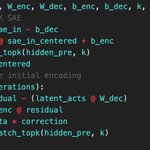


I've been curious how much we can quantize SAE training so we can train huge SAEs on a single GPU. I had Silico evaluate how much we can quantize SAE training before results degrade. 🧵

Using bf16 for weights and Adam seems fine. The limit is bf16 weights with int8+stochastic rounding for Adam. Below that things start to fall apart. This makes it possible to train a 1M latent SAE on a single H100.
Full report: share.goodfire.ai/a/shr_09cd…

David Chanin retweeted

So excited to finally share this!
Linear probes often outperform SAEs, especially out-of-distribution (OOD). @thesubhashk @JoshAEngels et al showed this convincingly (arxiv.org/abs/2502.16681). This prompted @NeelNanda5 and others to de-emphasize SAE research. Empirically, fair enough. But we think the theoretical case for dictionary learning was dismissed too quickly.
@oneill_c previously showed SAEs can't do proper sparse coding (arxiv.org/abs/2411.13117). @shruti_joshi @vpacela and @isacama_phys took this further and showed how this leads to problems particularly in OOD settings. So the issue may not be with dictionary learning itself, but with the current tools.
Here's the core argument: if neural representations are in superposition, i.e. more features than dimensions encoded linearly (arxiv.org/abs/2503.01824), then linear probes fundamentally cannot be the answer.
This is a compressed sensing problem. There's a linear measurement (the representation) and a nonlinear inference procedure (like an SAE encoder) that recovers the higher-dimensional sparse signal. Linear algebra tells us error-free recovery is impossible if decoding is restricted to be linear. (but see this cool work if errors are acceptable arxiv.org/abs/2602.11246)
Check out our video: We have some neat demonstrations here. A linear decision boundary in 3D becomes nonlinear in 2D, even though all sparse combinations of latents remain distinguishable. Compressed sensing works: we can, in principle, recover the high-dimensional latent space where linear probes work and generalize OOD.
Where does this leave us? With finite data and millions of concepts, simpler methods may perform better for a while. But if we want interpretability and safety methods that work OOD, especially compositional generalization covering all possible jailbreaks and real-world failures, we'll have to build bottom up from the right theory.
@kennylpeng @thebasepoint @tegmark @yash_j_sharma @woog09 @livgorton @EkdeepL @thomas_fel_ @nsaphra


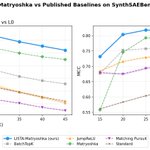
I let Claude autonomously do research on improving SAEs, and was extremely impressed with the result. The final SAE architecture outperforms all tested architectures on SynthSAEBench-16k, even matching logistic regression probe performance.

This works well when there's a clear metric and fast feedback loop. Not everything Claude did was perfect - it made occasional mistakes and was over-confident in some results. Overall it feels like supervising a really smart, extremely fast masters student.
Full write-up: lesswrong.com/posts/rbqJoxFZ…
SAE Code and task prompt: github.com/chanind/claude-au…
SynthSAEBench is pretty well-suited to this sort of automated research - try it out!

SAEs fail even when the Linear Representation Hypothesis holds perfectly.
We built SynthSAEBench: large-scale synthetic data with 16k ground-truth features, correlation, hierarchy, and superposition. We trained 5 SAE architectures on it.
None achieve perfect feature recovery.

Available in SAELens now! Install sae-lens and start training and evaluating SAEs on synthetic data with ground-truth evaluation in minutes.
Docs: decoderesearch.github.io/SAE…

Paper: arxiv.org/abs/2602.14687
SAELens: decoderesearch.github.io/SAE…
Joint work with @AdriGarriga @MATSprogram @decode_research
🚨Excited to announce our paper "A is for Absorption: Studying Feature Splitting and Absorption in Sparse Autoencoders" was accepted as an oral at #NeurIPS2025! Come see the talk this Thursday at 3:30pm in Exhibit Hall F,G,H!

1/9: 🚀 New Paper! "Feature Hedging: Correlated Features Break Narrow Sparse Autoencoders". We find an SAE problem called "feature hedging." If an SAE is too narrow and features are correlated, features get merged, harming the SAE. But there is hope!🧵
#AI #LLMs #mechinterp

8/9: 📊 Promising Results! Our "Balance Matryoshka SAEs," when tuned, show improved performance on several SAEBench metrics (like TPP, k-sparse probing, feature splitting) compared to standard Matryoshka or non-Matryoshka SAEs.
9/9: 🏁 Feature hedging may be a core reason SAEs underperform. By understanding and addressing it, e.g., with Balance Matryoshka SAEs, we hope to help SAEs reach their full potential!
🔗 paper: arxiv.org/abs/2505.11756
By @chanindav, @TomasDulka, @AdriGarriga