

Trust Layer for Autonomous Finance soon on Robinhood
Joined May 2026
- Tweets49
- Following5
- Followers84
- Likes610









Pinned Tweet
Phase 1 — Consumer Wallet Guardian
¤ Product: Read-only, key-never-touched app — Sage Brief, health score, pre-sign Safe/Caution/Danger verdicts, approval revocation, real-time alerts.
¤ Users: Retail, DeFi users, traders, power users.
¤ Revenue: Freemium → Pro (~$14/mo). Reach and trust, not margin.
¤ Moat: Brand + wallet-neutrality. A trusted cross-wallet name no wallet-embedded tool can be.
¤ Data flywheel — the seed: decision-outcome data — what a human was shown, what they did (signed/skipped/revoked), and what happened next. The exact training signal an autonomous engine needs; no rail or forensics firm captures it.
Why ChainSage Becomes the Default Trust Layer for AI-Native Finance
1. It owns the only unclaimed layer. Settlement (x402/MPP) and authorization (AP2) are being standardized by giants. The decision/trust layer — “should this execute?” — is open, and it gates autonomy. Owning the bottleneck is owning the market.
2. It’s the thing that makes autonomy possible. The agent economy is stuck on the human approval gate. ChainSage removes the gate safely — capturing the value the bottleneck was holding back, and every rail has an incentive to route through it.
3. It has the data no one else can get. The compounding decision → outcome → policy → reputation dataset is assembled from a position (consumer trust + neutral coverage + agent-native design) incumbents can’t replicate by spending money. Models commoditize; this data doesn’t.
4. It is neutral by construction. A trust network must be Switzerland — no wallet, chain, or single rail can credibly be the cross-ecosystem standard.
5. It compounds into a standard. The Phase 5 network effect turns “a good API” into “the call you’d be negligent not to make.” Standards (TLS, the credit bureau, the payment network) are the most durable moat.
6. The on-ramp is already shipping. The consumer Guardian is the trust brand and data engine that earns the right to be the default before agent volume arrives.

ChainSage today: a verdict before an agent signs. ALLOW / REVIEW / DENY.
That’s one transaction. But agents don’t think in single transactions — they think in plans.
So here’s what we’re building next 🧵

Coming: “explain this transaction” for humans.
Not everyone reads calldata. You paste a transaction, ChainSage tells you in plain language what it actually does — and whether you should sign.
Security that doesn’t require you to be an engineer.
One rule for all of it: ChainSage never executes.
No swaps, no bridges, no custody. We read and we judge — that’s why you can trust us.
Everything above is building, not live. When it ships, I’ll say so. Until then I’ll say this.
chainsage.finance
An AI agent just set a world record for spending money as fast as possible.
Congrats — genuinely. This is the future.
It’s also the exact reason we’re building the other half: a verdict that runs before each action, at the same speed.
Agents this fast need judgment just as fast.

We set a Guinness World Record for the most items purchased by an AI agent in three minutes on a single credit card.
Enjoy the world record setting items.
📺 xitter.cf/i/broadcasts/1YxNrrAME…
Coming: delegate to an agent without approving its every move.
The Policy Engine will let you set rules once — spend limits, allowlists, risk tolerance, “no unlimited approvals,” “nothing to contracts under 7 days old” — and ChainSage enforces them at runtime.
DENY beats REVIEW beats ALLOW. One blocking rule overrides everything.
Autonomy with guardrails you define. In preview, enforcement coming.

Building ChainSage into infrastructure, not just an app 🛠️
Coming: the Risk API + Agent SDK — the same verdict engine behind Guardian, exposed so any wallet, dApp, or agent can request a verdict in one call:
chainsage.guard(intent) → ALLOW / REVIEW / DENY
Fail-safe by design: on any error it returns REVIEW/DENY, never a silent ALLOW. Engine’s tested; wiring the deployed endpoint + SDK now.
Trust, as something other builders can plug in.

Soon: every action an agent takes will pass through a verdict before it’s signed.
The Checkpoint — an agent proposes a swap/bridge/approve, ChainSage returns ALLOW / REVIEW / DENY, and the agent only proceeds on ALLOW. DENY halts it before keys move.
The demo already runs end-to-end. Bringing it to a live surface next.

Building the layer that separates ChainSage from every “wallet scanner” 🛠️
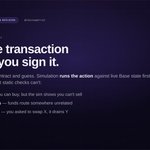
Coming: transaction simulation. Before you sign, ChainSage will run the transaction against live Base state and show what actually happens — what leaves your wallet, what approvals change, whether you can even sell after you buy.
Scanners read a contract and guess. This runs the action first.
What it’ll catch that static checks miss:
→ honeypots (you can buy, but the sim shows you can’t sell)
→ hidden transfers (funds route somewhere unrelated)
→ intent mismatch (you asked to swap X, it drains Y)
In progress now. Guardian’s live today while we wire this in
→ chainsage.finance

Anatomy of a Drain
*Most people who lose a wallet weren't hacked. They signed something. Here's exactly how it happens — and the one moment where it could have been stopped.*
## The myth of the "hack"
When someone says their wallet got "hacked," the picture in most people's heads is wrong. They imagine malware, a keylogger, a leaked seed phrase. Those happen — but they're not how most wallets are actually emptied.
The most common drain doesn't break into anything. It asks politely, and you say yes. The owner signs a transaction, on purpose, with their own hand — because the request looked exactly like a hundred routine ones before it. Nothing in the stack asked whether it *should* be signed. There's no judgment layer between a normal-looking request and a catastrophic outcome. That gap is the entire attack surface.
Let's walk through how it actually works. (This is a defensive breakdown — enough to recognize and avoid the pattern, not a manual for running one.)
## Step 1 — the setup looks routine
You end up with a reason to interact with a contract. Maybe a token appears in your wallet. Maybe a site offers a claim, an airdrop, a swap with a too-good rate. To do almost anything with a token on-chain, your wallet has to "approve" a contract to spend it. This is a completely normal mechanism — every DEX, every legitimate protocol uses it. That's what makes it the perfect cover.
## Step 2 — the approval is the attack
Here's where the damage is done, and it's almost invisible. The approval request has two properties that should set off alarms, and usually don't:
- **It's an *unlimited* allowance.** Instead of approving the exact amount you want to trade, the request asks for permission to spend an unlimited quantity of the token, forever.
- **The spender is not who you think.** It's not a canonical, audited router. It's a contract deployed hours or days ago, with no track record.
To a human staring at a wallet prompt, this looks identical to every legitimate approval. The interface doesn't say "this contract is six hours old and is asking for everything." It just says "Approve." You click confirm, because you've clicked confirm a hundred times and nothing bad happened.
You just handed a stranger a key to that token. Nothing has been stolen yet.
## Step 3 — the trap springs later
This is the part that makes drains so effective: nothing happens immediately. The malicious approval sits dormant. Your balance is untouched. The transaction "succeeded." Everything feels fine.
Then — minutes, hours, or days later — the contract uses the permission you granted. It calls `transferFrom` and moves the entire balance of that token out of your wallet to the attacker. You authorized it back in Step 2. There's nothing to "break in" to now; the door was opened willingly, in advance.
No malware. No leaked keys. A signature you gave on purpose, because the request looked normal and nothing judged it before you signed.
## The one moment it could have been stopped
Every drain has a single point of maximum leverage: **the half-second before the signature.** Once signed, the approval is on-chain and the outcome is just a matter of time. Before signing, it's still a question — and the right question, asked at the right moment, stops the whole thing.
That question is what ChainSage is built to ask. Before an approval is signed, the verdict engine reads the shape of the action:
- Is this an unlimited allowance?
- How old is the spender contract — was it deployed hours ago?
- Is it a known, audited protocol, or an unknown?
- Does the combination match a known drainer pattern?
An unlimited approval to a freshly-deployed, unknown contract is the textbook drain setup — and it resolves to **DENY**, before the signature, with the reason in plain language. One danger signal vetoes everything else. And if the engine can't reach a confident answer, it fails toward caution — REVIEW or DENY — never a silent "looks fine.

What’s live today, honestly
Guardian does part of this right now (chainsage.finance): it scans your live wallet for approvals you’ve already granted — re-reading each allowance on-chain so it’s never stale — and flags the risky ones, so you can revoke them before they’re ever used. If you’ve signed a bad approval in the past, it’s probably still sitting there, and Guardian will show you.
The deepest layer — simulating exactly what a transaction would do before you sign it, to catch honeypots and hidden transfers that even a careful reading would miss — is what we’re wiring in next. We say “next,” not “now,” because for a trust layer, claiming a check you haven’t shipped is the one unforgivable lie. What’s live today is the detection of the single most common drain pattern there is: the malicious approval.
The takeaway
You don’t lose a wallet because you’re careless. You lose it because the system asks you to make a security judgment, in a half-second, on a prompt designed to look routine — and gives you nothing to judge it with.
ChainSage is that missing judgment. The verdict before the signature.
See what’s sitting in your wallet right now → chainsage.finance
The most common way to lose a wallet on Base isn’t a hack. It’s a signature you gave on purpose, to a contract you didn’t read. ChainSage exists for that exact half-second.

Anatomy of an approval drain — how a “normal” signature empties a wallet 🧵
Step 1: You find a token in your wallet, or a site offers a claim/swap. To trade it, your wallet asks you to “approve” the token. Totally routine — every DEX does this.
Step 2: The approval isn’t for a known router. It’s to a contract deployed hours ago, and it requests an unlimited allowance. You click confirm — the prompt looked like every other approval you’ve signed.
Step 3: Nothing happens immediately. That’s the trick. The approval just sits there. Minutes or days later, the contract calls transferFrom and moves the full balance of that token out — because you gave it permission to.
No malware. No leaked keys. You authorized it, on purpose, because the request looked normal and nothing judged it before you signed.
Where ChainSage cuts it: before that approval is signed, the verdict engine sees the shape — unlimited allowance + a contract deployed hours ago + not a known protocol — and returns DENY. The textbook drainer pattern, flagged before the signature.
Guardian does this on your live wallet today (chainsage.finance): it finds approvals you’ve already given to risky spenders, so you can revoke before they’re used.
Honest note: the deepest checks (simulating exactly what a transaction does) are what we’re wiring in next. But the approval-pattern detection — the most common drain by far — is live. 🜂

Most wallet tools scan a contract and guess.
ChainSage runs the action through a tested verdict engine and combines every signal into one decision — DENY > REVIEW > ALLOW, one danger signal vetoes all.
The same engine powers Guardian, the Risk API, and the SDK. One source of truth. 🛠️

Scanned a wallet with ChainSage Guardian.
It reads live @base state — every active approval, re-checked on-chain so nothing's stale — and flags the drain risks: unlimited allowances, spenders on contracts deployed hours ago.
No signup. Keys never touched. Real data.
→ chainsage.finance
