

TMS founder (toncarton.con +10k deliveries a day) who also ships the hardware. ESP32, PCBs, 3D prints. Paris - Montreal - Builds, not slides.
Québec, Canada
Joined October 2010
- Tweets514
- Following795
- Followers129
- Likes905





Pinned Tweet
Experimented something super strange with the capacitive touch of an ESP32. I enrolled the wire like an inductor and now I have an amplified touch detection that does not need even a touch! It can detect my hand from 1 or 2 cm! Super cool discovery @realwillreil, you will like this one!

Chakib retweeted

1/16 Every half-bridge hides a tiny bell: copper plus FET capacitance. Switch too hard and it rings, hundreds of millions of times a second.
I simulated a real open-source motor controller at 48 V. Driver at full strength: its 80 V FET takes an 81 V hit. Turned down: clean. 🧵

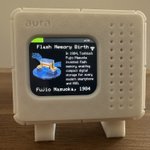
This air-quality sensor just taught me who invented flash memory !
Fujio Masuoka, Toshiba, 1984.
New card every day.
Text and illustration generated, then pushed to the ESP32.
@realwillreil the PnP ready, or do I keep placing these by hand?


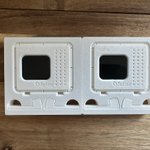
I want to show you this simple 3D-printed lock mechanism I use to mount the IPS screen from @waveshare00 to my enclosure. No complex mechanism or screws needed. The CAD from my @adskFusion shows how it’s inserted and can rotate with enough friction to stay in place.


Maximizing all available CPU on this little Hetzner server is always a joy. Let’s parse all OSM maps with Valhalla!

We have a linear correlation between temperature and battery voltage for a CR2033; each degree gained is 0.01 volts. At this stage we will be capable of measuring temperature just by looking at the battery voltage.
It's very important to choose the right battery cell for the right environment, but crazy to see how cold kills a battery. No surprise that the majority of electric vehicles heat up the battery pack when it's cold outside.

Playing with Golioth these past days and it’s an absolute joy to set up OTA firmware upgrades and RPC calls, so I can call methods to set params or reboot an ESP32 in another country.
Super helpful to go from prototype to production-ready hardware.


Some updates about the air quality monitor Aura! This version contains an adjustable lamp with a dedicated large pad to detect touch, useful when you try to reach it at night, a beautiful glowing effect, and a bigger screen!


The future will be drastically different from what we’ve imagined …

We’re sharing a solution to the Navier-Stokes Millennium Prize Problem, one of the deepest problems at the frontier of mathematics.
The proof was produced by a group of agents, using an OpenAI next-generation model significantly more capable than GPT-6 Astra.
The problem concerns whether the description of smooth three-dimensional fluid motion modeled by the Navier-Stokes equations can break down. It has remained unresolved for roughly 90 years.

This thing is amazing congrats @pollenrobotics

Chakib retweeted

Super happy to share our intention to join forces with NVIDIA in a $12,930,300,000 acquisition 💛💚
10 years after starting Hugging Face, open-source AI is at an inflection point. Thanks to the community, we’ve shown that it can be a complement, and even an alternative, to closed-source APIs. But for it to happen at larger scale, it needs more compute, more support, more collaboration and more visibility. That’s why we went to talk to Jensen, who offered to do exactly that with us.
In addition to doubling down on NVIDIA’s massive contributions to open-source AI (I called them the “King of American open-source AI” earlier this year), they’ve committed to strongly supporting Hugging Face and our mission while keeping the platform open, independent and compute agnostic. The founders and the team are all staying to keep pushing this mission forward.
Together, we think we can make open source the default way to build AI, with the goal of empowering 100 million AI builders to own their intelligence rather than rent it.
Excited about the next 10 years! 🤗🤗🤗
