

Building @clipra_app Turn a product description into pro motion graphics by chatting. Built for SaaS founders. Shipping daily.
internet
Joined October 2023
- Tweets2K
- Following1.1K
- Followers799
- Likes4.2K








Pinned Tweet
Still in internal testing, but Clipra is already creating motion graphics we're genuinely proud of.
This entire video was generated by chatting with an AI agent.
No timeline.
No keyframes.
Just describe what you want, and Clipra brings it to life.
More updates soon. 👀


OpenAI just showed us what the next generation of software might look like.
And the biggest announcement wasn't a model.
I went through the DevDay launches and there's a pattern hiding underneath them:
AI is moving from something you talk to → something you delegate work to.
Here's what OpenAI actually launched 🧵
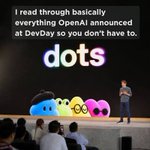
1. Dots
Always-on agents that can keep working toward goals.
The shift:
Chatbot → Agent → Persistent worker.
2. GPT-6.1 Sol
A new model optimized for agentic coding, computer use and professional work.
OpenAI says it delivers near-Astra intelligence at 1/5 of Astra's standard token prices.
Cheaper intelligence = agents can think, retry and work longer.
3. Ultrafast
Up to 6× faster API generation and up to 300 tokens/sec in Codex.
When AI is actually doing work, latency becomes part of the product.
4. Computer Use
Agents can operate software, not just call APIs.
Browsers.
Dashboards.
Internal tools.
Legacy software.
This is a huge difference.
5. Codex Cloud
Coding agents can work remotely while your computer is off.
Codex is becoming less like autocomplete and more like a remote engineering team.
6. Codex Security
Scan repositories, investigate vulnerabilities and prepare fixes.
Again:
Detection → execution.
7. Decisions API
Give the model a finite set of possible actions and let it make the decision.
AI becomes part of the control system, not just the chat interface.
8. MCP Events
Software events can trigger AI workflows.
Something happens → agent notices → agent acts.
That's how agents become asynchronous.
9. Plugins
Developers can build interactive experiences directly inside ChatGPT.
ChatGPT is becoming a platform and distribution layer.
10. ChatGPT Space
People + agents working together around shared projects.
Then OpenAI added Pages, Slides, Teams, shared tasks, meetings and integrations with Slack/Teams.
They're building the workspace around the intelligence.
11. Sign in with ChatGPT
OpenAI is also becoming an identity/distribution layer for third-party AI products.
12. Enterprise Marketplace
OpenAI is building the ecosystem around the models.
Models → agents → tools → workspace → marketplace.
And that's where the real story appears.
OpenAI isn't just building a smarter chatbot.
They're building something closer to an operating system for AI-powered work.
The old workflow:
Human → software → result
The emerging workflow:
Human → goal → agent → tools → execution → result
That changes how we should build startups.
Don't ask:
“Where can I add AI?”
Ask:
“What entire workflow can I give AI responsibility for?”
That's exactly why I'm thinking differently about Clipra.
The interesting product isn't:
“AI generates motion graphics.”
It's:
Give Clipra a product → understand the brand → develop the creative direction → build the animation → render → inspect → repair → deliver.
The model is only one component.
The product is the agentic production loop.
DevDay made one thing much clearer to me:
We're moving from AI that generates to AI that executes.
And I think the startups built around that shift are going to look very different from today's AI wrappers.

ALT OpenAI CEO Sam Altman stands on a stage at the DevDay 2026 conference, presenting in front of a large black screen. The screen displays the word "dots" in glowing, multicolored, rounded letters. Below the word is a row of five fuzzy, cartoonish blob characters with different faces and accessories, including a blue one with a beret, a green one with glasses, and a bright pink one.
Akorede Ogunsola retweeted

Aaaaaaand we're live!
stackfull.lol/
Find the full tech stack of any company.
Readers added context they thought people might want to know
stackfull.lol claims to find the full tech stack of any company but users report it often returns inaccurate or incomplete results including unused or nonexistent technologies. The creator described it as still a work in progress.
stackfull.lol
x.com/deesha_tech/st…
x.com/theadistar/sta…
x.com/ikyinusa/statu…
x.com/DeckardBuilds/…
x.com/__dev_himanshu…
Akorede Ogunsola retweeted

I’ve reached a point where I’m like not excited about new models. There are too many releases, too many people overhype those releases, and it feels like marginal gains.
I feel like the models from the last few months are good enough for my coding needs at least.
I’ve been teaching Clipra how to think like a motion designer, not a web designer.
This 30s video is one of the first results where I can actually see it clicking.
Good typography.
Good composition.
Intentional pacing.
Motion that follows the design instead of just decorating it.
There’s still a lot to improve, but this is exactly what I’ve been trying to build.

Here is list of 10 FREE hosting providers, to Host your Static Websites
- pages.cloudflare.com
- pages.github.com
- docs.gitlab.com/user/project…
- netlify.com
- vercel.com
- firebase.google.com/products…
- render.com
- surge.sh
- codeberg.page
- neocities.org

AI made building software so cheap that the hard part is becoming more obvious:
knowing what not to build.
I'm realizing that building in public isn't really about showing what you built.
It's showing what you tried, what failed, and what changed your mind
I'm not trying to teach AI how to make motion graphics.
I'm trying to teach it how a motion designer thinks before making them.
That's a much harder problem.
The scary part about AI coding isn't that it can write 1,000 lines in seconds.
It's that you can now build a bad idea before you've had enough time to realize it's a bad idea.
AI didn't kill the need for programmers.
It made programmers ridiculously cheap to multiply.
Now the scarce resource is taste.
