
Vibe Investing @AppWorks Ventures https://xitter.cf/t.co/ctGpscLkkD
Joined November 2023
- Tweets651
- Following401
- Followers392
- Likes1.4K




Pinned Tweet
Vibe VC #0: Becoming the VC who only talks
A lot of people think VCs just talk.
Meet a founder, ask why growth isn’t faster, or why margins are shrinking. But behind that is a ton of prep: digging into trends, screening deals, writing memos, compiling portfolio reports, keeping the founder community alive.
When I wrote my AppWorks 2-year reflection, I mentioned practicing “leverage.” With agents lowering the barrier to using software as leverage, the timing feels right.
After seeing Wei-Yu Lin’s piece on “Vibe PM,” I figured why not run my own experiment: Vibe VC.
Goal for the rest of the year: actually become a VC who runs just on mouth.
Principles are simple: if I can say it, I won’t do it with my hands. If it can be recorded, I’ll hand it to AI. If it can be automated, I won’t repeat it. If it can be an SOP, AI runs it.
Starting today, I’ll share takeaways each time I finish an automated workflow.
If you’ve got thoughts, any feedbacks is welcome!
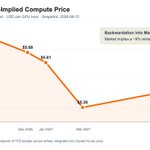
I think GPUs are more like aircraft and compute derivatives should look like shipping
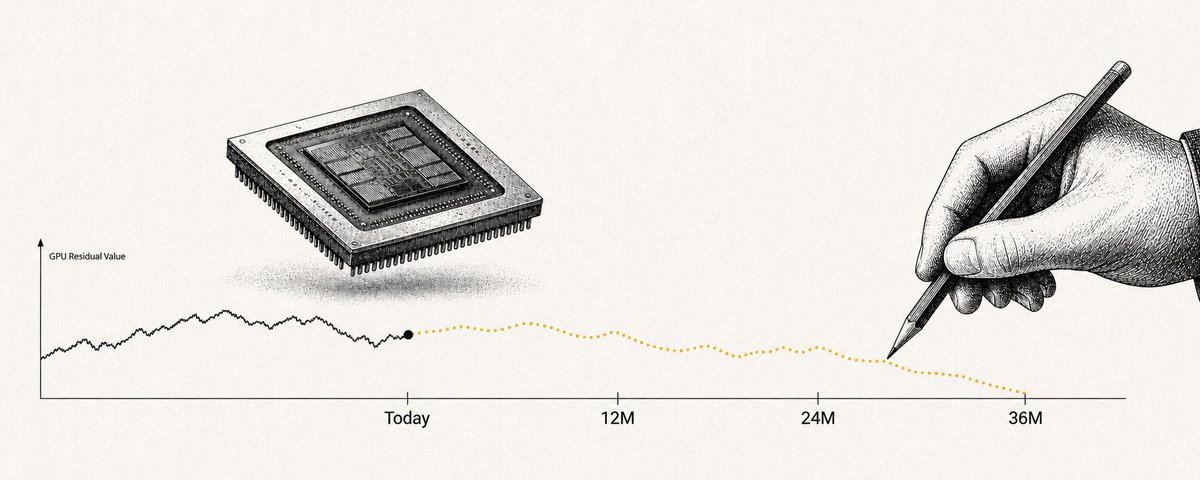
A cluster isn't really real estate. Buildings last fifty years; GPUs normally get superseded in 5-6 yrs (I know now much longer). The closer analogue is the aircraft: a standardized, high-value asset that loses value along a technology curve, rented out by type (H100 and B200 are the A320 and 737), with a global secondary market and real residual-value risk.
The financing already looks like aviation. Assets sit in SPVs, loans are sized to depreciation, and lenders underwrite the lessee's contract. They also charge for any gap between the contract and the loan. CoreWeave's DDTL 4.0, backed by a contract running to the loan's maturity, priced at SOFR+225. DDTL 5.5, a five-year loan against contracts averaging three years, paid SOFR+550 even with a full parent guarantee. Most of that 325bp is the price of re-leasing risk, the same risk aircraft lessors live with.
The derivatives should copy shipping. Shipping solved "trade the time-use of a standardized asset" decades ago: vessel classes, daily charter-rate indices, and cash-settled forward freight agreements. Compute can do the same: GPU-hour indices by generation, a benchmark chip with generation differentials, and cash-settled forwards against the index.
Once lessors can hedge years three to five of the GPU-hour curve, that spread should start to close.

Episode 5 of Where Capital Meets Compute is out, with Travis Cannell @traviscannell, COO of Vast AI @vast_ai.
Everyone assumes GPU marketplaces race to the bottom on price. Travis's answer: they don't, because no two GPUs are actually the same. Security, connectivity, location, it all changes what a GPU is genuinely worth, closer to real estate than a commodity.
We also got into how Vast's markup model works, and his honest take on whether this is a bubble.
Great piece!
“Operators’ delivery capability is part of the off-taker’s credit.”
I think more lenders will understand this.

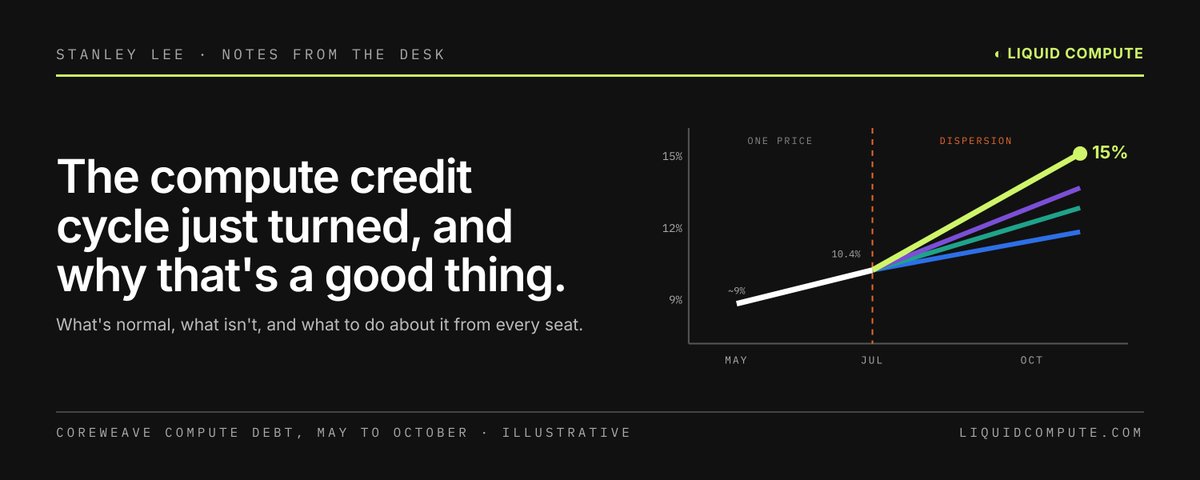





Heard now every AI startup after Series C is looking for “head of compute”, making sure the company can secure compute.
We’re going to see these people not just securing compute but also low cost funding to support their business.
Is your RWA real collateral, or just a receipt?
Anyone can wrap the same underlying, but real difference lies lean across 2 axes:
- Distance to on-chain cash
- Legal claim level
An RWA in the top right (close to cash with a claim that survives stress) beats an identical one sitting bottom left every time.
As collateral, this asset will have lower haircut, regulated capital can hold it, and and it will win.


Congrats @LawrenceGS !

NOBI Exchange kini menjadi Bybit Indonesia @Bybit_ID ! (1/2)
Sebagai bagian dari proses ini, seluruh akun dan aset pengguna NOBI Exchange akan dimigrasikan ke Bybit Indonesia di bawah pengawasan Otoritas Jasa Keuangan (OJK).


"Ramp spread is the market price of crossing monetary jurisdiction"

The stablecoin on/off-ramp must be understood as a dealer function situated at the boundary between two monetary hierarchies.
Stablecoins compress the transport of money: they reduce latency, intermediaries, reconciliation, and settlement frictions within the tokenized domain. However, they do not eliminate the scarcity of local convertibility. Instead, they displace it toward the edges.
Consequently, the ramp spread is the compressed price of an entire stack of constraints: fiat liquidity, banking access, inventory, compliance, fraud, regulation, FX scarcity, balance sheet capacity, and the cost of offloading positions into deeper layers of liquidity.
In the traditional system, these costs are distributed across correspondent banks, FX desks, domestic rails, payment intermediaries, and nostro/vostro structures. In the stablecoin model, many of these frictions condense into a single quote: the price at which local currency can be converted into tokenized dollars, or tokenized dollars into local currency, with size, speed, and certainty of execution.
This price is a form of jurisdictional basis. It does not merely measure the cost of moving money; it measures the difficulty of crossing a monetary border. In liquid, open jurisdictions, this basis will tend to compress due to competition. In jurisdictions with capital controls, dollar scarcity, inflation, banking fragility, or regulatory risk, the spread may persist because it essentially prices sovereignty, balance sheet capacity, and access.
Thus, stablecoins may commoditize global settlement, but they make local convertibility more valuable. They decentralize transport, yet they can recentralize economic rent at the points of entry and exit.
What this allows is that, provided the players operating these tolls are ultra-efficient, the aggregate cost of the overall structure could be driven down.
Therefore, the structural business is not simply moving stablecoins. It is market-making across incompatible monetary systems. The winner here will be whoever controls the scarce constraint within each respective corridor: licensing, banking access, local liquidity, distribution, compliance, or balance sheet capacity.
Stablecoins compress settlement. Ramps price convertibility. The spread is the market price of crossing monetary jurisdictions.

Bill Hsu retweeted

Big milestone 🚀
SignalPlus has officially closed our latest US$50M Series B1 funding round at a US$500M post-money valuation.
The round was led by our long-term supporters at HashKey Capital @HashKey_Capital, with strategic participation from BlockBooster @0xBlockBooster and AppWorks @AppWorks.
Deeply grateful to the Goldman Sachs team @GoldmanSachs for acting as our sole financial advisor.
We extend our deepest gratitude to our clients, partners, investors, and team members for their unwavering trust and support over the years.
The Next Chapter: TradFi Expansion & SignalPlus 2.0
Onwards and upwards!
prnewswire.com/news-releases…

Bill Hsu retweeted
AW#33 RFS: On-Chain Banking
The phrase "the future of finance is borderless" has been thrown around for a decade. But we are finally moving past speculation and into infrastructure. We believe the future of banking will be programmable, transparent, and natively on-chain.
It's not just about trading crypto; but modernizing the global financial infrastructure—from asset tokenization, decentralized clearing, and settlement, to borderless cross-border payments.
Building this layer of the digital economy requires massive stamina, localized regulatory intelligence, and deep institutional trust.
How AppWorks Backs On-Chain Builders
On-chain banking wins on real-world adoption. You need to plug into the real world. Here is how we bridge that gap for you:
Real-World Web2 & Web3 Bridges: Through our deep network of corporate partners, we connect Web3 startups with regional financial institutions, telecom operators, custodians, and exchanges to run compliant, real-world Proof of Concepts (PoCs).
The Web3 Legacy (and Present): You are joining one of Asia's largest Web3 ecosystems, featuring 152+ active teams and 313 founders. Our alumni and portfolio networks include Web3 titans like @pendle_fi (AW#20), @StraitsX (MAS-licensed stablecoin infrastructure, AW#21), @sanctumso, and @SignalPlus_Web3.
Regulatory & Scaling Navigation: Compliance is the ultimate boss fight in FinTech. Benefit from hands-on mentorship by compliance advisors, Web3 pioneers, and traditional finance veterans across 9 distinct Asian markets.
Capital Access: With a total fund size of $386M, our investment team is close by to guide you navigate the full fundraising stacks across different instruments when the time is right.
And the utmost principal: the accelerator is 100% free with zero equity, tokens, or fees taken.
If you are a founder moving the world’s value on-chain, AppWorks is your strategic launchpad to navigate and dominate the Asian market.
📅 First Round Application Deadline: June 21, 2026
📍 Apply here: lnkd.in/gzcs3Qj
Are you building the future of on-chain banking, or know a team that is? Let's talk in the comments or tag them below! 👇
