

Mostly China things | 2026 Summer Fellow at GovAI | Ex Washington Post, FT, Reuters
Shanghai
Joined July 2011
- Tweets3.9K
- Following4.7K
- Followers18.2K
- Likes11.4K






I increasingly think Huawei is the most important company in China’s AI push and maybe just the most important company in China full stop.


Interesting proposal to layer frontier AI atop Doshi and Campell's allied scale argument. The piece doesn't dwell on China's approach, but Beijing is already moving quickly to achieve similar goals through policies such as AI+, Data Elements x, etc.

'Industrial AI' is usually cope. Countries think they don't need frontier AI, and try to get by on industrial data and rampant protectionism instead.
Today's piece argues for a better deal: America makes the tokens, allies turn them into cancer cures, drones and robots.
writing.antonleicht.me/p/all…

Christian Shepherd retweeted

Our briefing today is an interactive infographic that looks at the companies behind China's data center buildout, at home and abroad: wirescreen.ai/briefings/chin…

Nice dispatch from China’s aspiring token capital

In Inner Mongolia, an abandoned high school is being turned into an AI data centre. Soon, computing racks will occupy the grounds where students once gathered between classes.
It's a striking metaphor for China's changing economy.
ft.com/content/e1dd8bff-b06d…

Christian Shepherd retweeted

China had its own “pace technological development” debate in 2011. The frontier technology was high-speed rail.
That July, one bullet train rear-ended another near Wenzhou, killing 40 people. The disaster prompted a national reckoning: was China’s obsession with speed outrunning its capacity to keep people safe?
A widely circulated essay captured the mood: “China, Slow Down, Wait for Your People.” Its prose read like a prayer: “China, please stop your flying pace, wait for your people, wait for your soul, wait for your morality, wait for your conscience!”
Online, a cohort of STEM intellectuals (with some similarities to today’s rationalists and EAs in worldview and temperament) argued for pressing ahead. they agued from first principle that country of China’s size needed an efficient rail network. Technological failures called for better engineering and regulations, not slow it down.
Many voices calling for a pause came from liberal and civil-society circles. Crudely speaking, this became an “Industrial Party” versus “Sentimental Party” debate. At the end the industrial party (tech accelerationalists) won.
(The Industrial Party also overlapped with the community behind the collectively written sci-fi epic The Morning Star of Lingao, which I wrote about for WIRED in January ykiyk)
I keep returning to this episode when thinking about what might make China slow down AI.
A few hypotheses:
1. The strongest pressure will probably come from inside China, and that’s the only way to cause china to pause.
China has its own arguments about technological progress, even if there is much less public room for them today. In a heavily bounded information ecosystem, where “China’s circumstances are different from the west” is a convicted argument, I suspect international appeals will carry less weight than domestic consequences.
2. A dramatic incident could change the calculus.
My current guess is that Beijing is unlikely to deliberately slow frontier AI development without a failure that makes the risks politically concrete. Imagine an AI-enabled intrusion into a major state agency’s systems.
Even then, the response might be tighter deployment controls rather than slower development. Those are different things.
3. I’m unsure how frontier-risk situational awareness translates into influence inside Chinese labs.
Some kinds of risk become clearer through expensive experiments with highly capable models. If a lab faces tight compute budgets and pressure to commercialize, how much room does it have for open-ended investigations of dangerous capabilities? That doesn’t mean Chinese researchers lack awareness. But awareness, resources to investigate, and political influence are three separate things.
4. Beijing understand AI primarily through systems it already knows how to govern.
Industrial production, public services, platforms, infrastructure: these are familiar objects of state intervention. I suspect that encourages confidence that AI’s risks can be managed through existing institutions. if you are active on the Chinese internet you’d know what i mean by such tight control on every level of digital life. if you lived through COVID in china you will know how CCP has control over physical reality.
5. The economic promise makes slowing down costly.
AI offers a compelling Marxist story about new-quality productivity force and industrial renewal at a time when China badly needs new sources of growth (the economy is so screwed right now). If officials see it as one of the few technologies capable of changing the economic trajectory, precaution has a formidable political opponent: hope.
Nice analysis. Another question I occasionally ponder: Do Chinese AI firms need to make money? Profits seem nonessential in previous examples of strategically important industries. If DeepSeek aids Huawei’s bid to take on Nvidia, does it need paying customers?

How do Chinese AI firms make money? In a new report, @cherylwoooo and @ansonwhho identify five revenue sources and analyze how much each contributes. 🧵

Christian Shepherd retweeted

Striking language on open-source AI in China’s new TC260 AI Safety Governance Framework 3.0:
“Once the autonomous attack capabilities of large foundation models spread downstream through open applications or open-source releases, they may significantly lower the barriers to conducting sophisticated cyberattacks, while accelerating the speed and expanding the scope of attacks.”
This is an explicit warning from within China’s own AI governance system. If a Chinese open-source model enables a major cyberattack in the future, the warning is already there.
The question now is what safeguards Chinese authorities and developers will put in place to prevent these risks from becoming reality.
Framework from China's National Information Security Standardization Technical Committee aka TC260 (in Chinese): tc260.org.cn/tc260/xwdt1/202…
Concordia AI's assessment (in English): aisafetychina.substack.com/p…

Christian Shepherd retweeted

Glad to see China's AI safety community getting covered. Many genuinely care about frontier AI risks and want international coordination on safety. However, hawkish framing from US labs makes that work harder. Thanks @lilkuo for a thoughtful piece.
nytimes.com/2026/09/27/world…

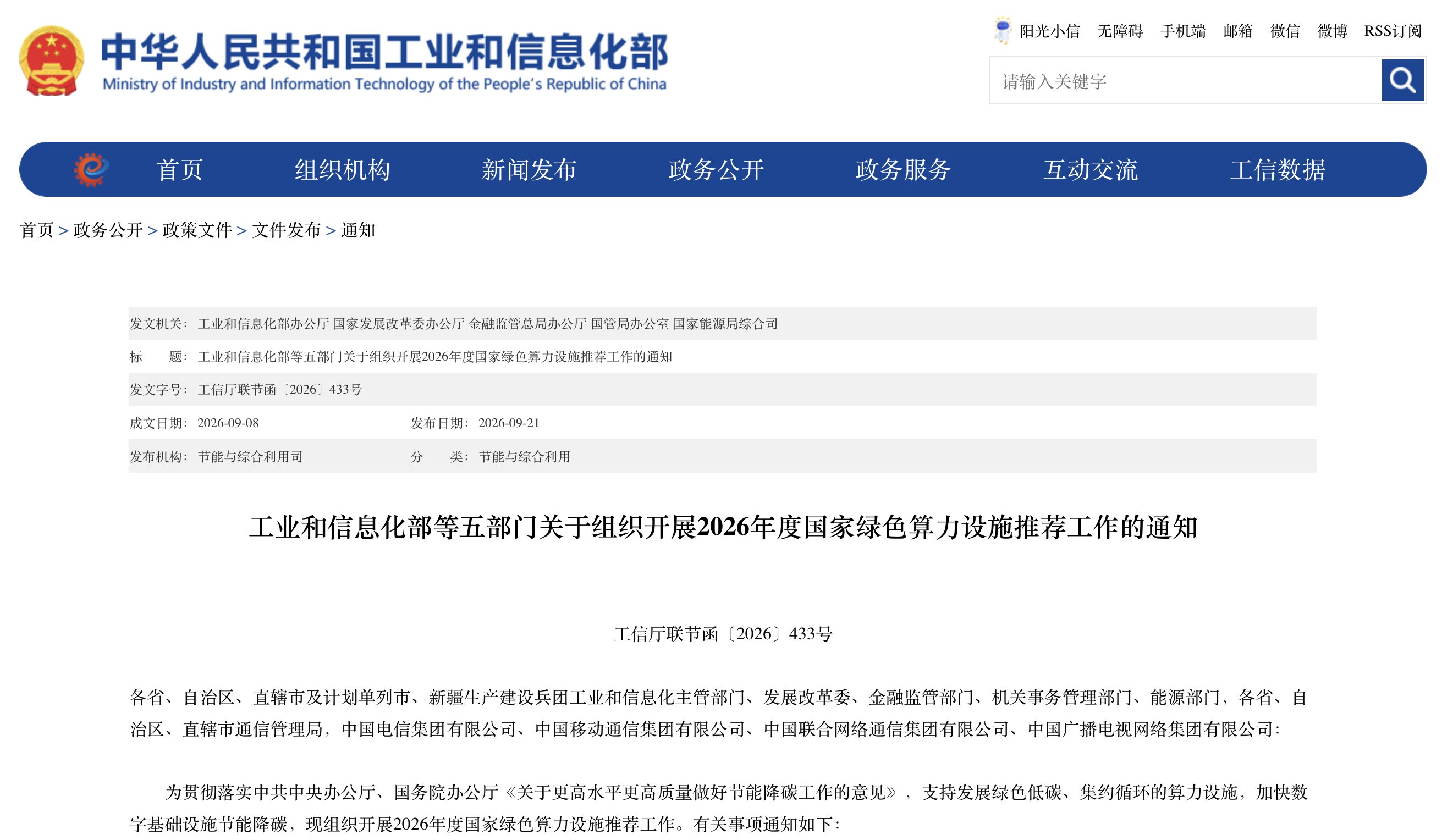
Yep. See for example this super scientific word cloud from CAICT's latest green compute development report on the most used terms in data centre-related policies. And this was before the latest compute-electricity synergy push got underway.

China is increasingly tying its compute buildout with its clean energy buildout.
Data centers can be designated as "National Green Compute Facilities" 国家绿色算力设施 if they satisfy several criteria:
1. Renewable energy needs to be a minimum share of electricity (level varies by province)
2. Located in a national integrated compute network hub or compute-power coordination pilot zone
3. Energy efficiency above a certain level
4. >60% rack occupancy (to prevent idle capacity)
5. Operating smoothly for at least one year
While it's not immediately clear what you get if you qualify, it's likely there will later be soft or hard incentives tied to this designation.
Christian Shepherd retweeted
My first piece for @NewYorker is out today!
As Xi Jinping lands in DC to start his state visit, you'll hear a lot about the US-China AI race. I'd like to tell a complementary AI story.
This past May, a few days after Trump visited Beijing, I went to the town people call China's vibe-coding capital, Liangzhu. There, you learn that China's AI scene is not monolithic. It's also full of contrarians, cool vibe coders, spiritual seekers, and people who love AI but refuse to join the 996 grind.
Liangzhu is on the edge of Hangzhou. I hung out with a group of anti-mainstream builders who use AI to make whimsical apps for fortune-telling, mental well-being, and creativity. Some of them run their lives entirely by bazi astrology (their founder almost became a Taoist monk). They meet on "Crazy Thursday" to vibe-code together. Rent is cheap, so they can get a bigger place with a living room to have friends over (unthinkable in Beijing or Shenzhen). In Liangzhu, they want to use AI to forge their own future.
It’s a ground-level story—less about model capabilities, hyperscalers, or AI policy, and more about how people in China are using AI, and the human stories behind it.


Christian Shepherd retweeted
New from me: Some argue there is no point in pacing the AI frontier until China cooperates. But Beijing is unlikely to take American calls for restraint seriously unless Washington is willing to restrain itself.
If the United States wants effective AI diplomacy with China, what it does at home may matter as much as what it says at the negotiating table.
I’m delighted to partner with @ReadTransformer for my first-ever cross-posted Substack essay—a look at how Beijing is approaching U.S.-China AI diplomacy, and what Washington needs to do to make that diplomacy more credible and effective.
transformernews.ai/p/bargain…


Christian Shepherd retweeted

Announcing China Innovation Atlas. A resource for those interested in China, tech, and infrastructure. atlas.sinocities.org/

Christian Shepherd retweeted
🚨 NEW High Capacity piece 🚨
China became a clean tech superpower not just for its own energy security but because it took climate change seriously.
Can the same shift happen with AI risks and AI safety? highcapacity.org/p/how-china…

Christian Shepherd retweeted

Told my mum I wanted to be a scientist at 10; ended up a science journo. That counts…right?
But hi, I’ll be @NYTimes’ new China Science Correspondent. If you are a Chinese scientist in or outside China, on the fence, floating around…I’d love to talk!
nytco.com/press/a-new-report…

Christian Shepherd retweeted
Supernodes are all the rage this year in China. They offer a way to scale up compute to make up for lower single-chip performance.
However, only Huawei and Sugon are really doing supernodes at scale. In general, Chinese chip designers are ultimately bottlenecked on production capacity.
Chinese AI companies are sourcing chips from different chip designers because nobody has enough production. There’s a lot of fragmentation in the market as a result, and interconnects are often incompatible.
Chinese AI chips are regarded as usable now for large-scale inference and the software issues of the past seem to have improved a lot. However, Chinese AI chips aren’t really used for large-scale pre-training (except perhaps Meituan on Huawei chips).
Huawei Cloudmatrix 384 is seen as being 4-5x less energy efficient than Nvidia NVL72, but a Chinese customers don’t care so much because they’re not energy constrained and can build compute clusters in places like Inner Mongolia.
Lots of interesting details in this podcast: podcasts.apple.com/us/podcas…

Christian Shepherd retweeted

China has some of the most extensive AI regulations in the world, and yet their approach to AI's frontier risks—ways that the technology could cause large-scale existential harm—is severely lacking. So how did Beijing become the adult in the room?
My latest for @NYMag on how the U.S. ceded the AI-safety agenda to China:
nymag.com/intelligencer/arti…

Christian Shepherd retweeted
🚨 NEW EPISODE 🚨
• How do users in China access Claude and ChatGPT?
• What's really driving China's AI optimism?
• What's China doing about deepfakes?
I talk with @ZilanQian about the hidden side of China's AI boom on the High Capacity podcast.
YouTube: youtube.com/@HighCapacityPod…
Apple Podcasts: podcasts.apple.com/us/podcas…
Spotify: open.spotify.com/show/6kafwx…

Christian Shepherd retweeted

Zai really emphasizing Cyber Security in its GLM-5.3 release. I've never seen this from any Chinese AI Lab release b4. It claims to match Mythos 5 in this area thru 10x+ long-horizon task environments & extended post-training.
I will talk a little bit about its claims below


Introducing GLM-5.3: Built to Code. Ready for Cyber Defense.
- Top-tier coding and agentic capabilities, achieved through post-training on the 743B base model
- A major leap in cybersecurity, setting a new standard among open models
Tech Blog: z.ai/blog/glm-5.3
