

Postdoc at @NASAGISS studying climate extremes and humid heat 🌎 previously @Columbia PhD '24 and @Princeton BA '17 | she/her
New York, NY
Joined November 2017
- Tweets145
- Following339
- Followers508
- Likes683






Pinned Tweet
It's official! Last month I successfully defended my dissertation and this week I turned in my final written thesis 🥲
I couldn't be more grateful to everyone who made this journey possible, and I'm thrilled to start this next chapter as an NPP Fellow at @NASAGISS!


Incredibly honored to have received this year’s Wagner Memorial Award for my paper deriving “stickiness” (linked below) and very grateful to all those who made my visit to @DRIScience so special!
journals.ametsoc.org/view/jo…


Today we celebrated the 26th Anniversary of the #WagnerAward by awarding this honor to Catherine (Casey) Ivanovich from the Department of Earth & Environmental Sciences at @Columbia University. Read the full story on our website: bit.ly/wagneraward2024. #ScienceThatMattersNow
Casey Ivanovich retweeted

Climate science PhD student @ccivanovich of @Columbia @columbiaclimate @LamontEarth explains how extreme heat affects big cities and some possible solutions. Via Now, Let's Talk: iheart.com/podcast/269-now-l…

Casey Ivanovich retweeted

This week on #TheClimateDivide, we explore new ways to warn about extreme heat in D.C. 🌡️
Discover the “stickiness” weather variable and NWS’s HeatRisk tool. With record 90° days, staying informed is crucial. Tune in wherever you get your podcasts.
🔗holacultura.com/extreme-heat…

Very exciting and comprehensive coverage of our new variable “stickiness” from @AGU_Eos! Thanks so much for the interview 🌡️

It's hot and sticky across much of the US today. But just how sticky? A new "stickiness variable" quantifies how we experience humid, hot days. eos.org/articles/how-sticky-…

Had the opportunity to speak with Austyn about our new variable “stickiness” for today’s @nytclimate Climate Forward newsletter! Thanks so much for the feature on how stickiness could be used in both physical science and impacts applications!

Day 2 as a reporting fellow on the @nytclimate desk and first day writing the Climate Forward newsletter!
Everything's heating up; send tips/pitches/ideas/etc to austyn.gaffney [at] nytimes.com
nytimes.com/2024/06/11/clima…
In what is likely the peak of my scientific career, we created a new variable!
If you’ve ever struggled to quantify the different drivers of extreme humid heat, take a look at our new article on “stickiness” in @AMS_atmos 🧵1/9
journals.ametsoc.org/view/jo…
Our primary derivation is based on wet bulb temperature, but we also derive versions using moist static energy and Humidex. Additionally, we provide the code necessary for readers to apply these methods to any humid heat metric of choice. 8/9
github.com/ccivanovich/Stick…

Many thanks to @profadamsobel @radleyhorton and @regclimo for their contributions to this quirky project! 9/9
These results may help to identify additional times of year with high risk of heat stress and provide a framework for understanding how precipitation can influence local humid heat based on background moisture availability. 5/6
Many thanks to @radleyhorton, @profadamsobel, and @climatechirper for their thoughtful collaboration on this work! 6/6
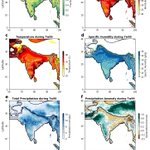
Baseline moisture availability also influences whether early or delayed monsoon onset increases wet bulb temperature anomalies. 4/6

However, the relationship between precipitation and heat stress is distinct across subregions. Background specific humidity determines whether wet bulb temperatures are intensified by enhanced or suppressed precipitation. 3/6

In contrast to dry heat, most extreme wet bulb temperature events in South Asia take place on rainy days during the monsoon season. 2/6

We typically think of rain as bringing cooling relief from extreme heat.
But in our new article, we find that the relationship between precipitation variability during the South Asian summer monsoon and local humid heat is a bit more complex...🧵1/6
doi.org/10.1029/2023GL107382
