

CEO and Founder at @sceniumapp, NYU Stern EMBA A25, passionate about DeFi, serial entrepreneur in Fintech and Asset Management.
Joined October 2024
- Tweets421
- Following102
- Followers205
- Likes419






If all your savings are in your local currency, you're already making an investment decision.
You're betting your central bank will protect the value of your money better than any other asset in the world.
In some countries, that bet has worked. In many, it has quietly cost families a decade of savings, one devaluation at a time.
Diversifying into hard currency used to require a foreign bank account, paperwork and a big ticket. That's changing.
Holding only local currency isn't "playing it safe." It's a concentrated position. Most people just never chose it.
A few more sleeps, and @sceniumapp v2 will arrive.

Here’s an uncomfortable truth about private markets:
We decide who can invest based on how much money they have, not on how much they understand.
In the US, you generally need $1M+ in net worth or a high income to access most private deals. Many funds require $5M+ in investments.
But wealth has never been a good proxy for judgment. Plenty of people with money make terrible investment decisions. Plenty of people without it would make excellent ones.
The rules exist to protect investors, and that goal is right. The filter is what’s outdated.
Tokenization gives us a chance to rethink it: cheaper compliance, embedded rules, better disclosure, real investor education.
Protection should come from understanding, not from exclusion.
Same asset. Same structure. Fair access.
Most people think private markets were "only for the rich" because the assets were too complex.
They weren't.
The door was locked by the structure around them: fixed costs, $250K minimums, and rules that let only ~2% of US households into many funds.
Fair Access, part 1 👇
xitter.cf/cbscenium/status/21100…

People ask me why I'm betting my career on tokenization.
I spent years managing funds. I saw the same pattern over and over: the best opportunities were decided by the size of your check, not by the quality of your judgment.
A family in São Paulo or Lagos could understand an asset perfectly and still never get in. Minimums, paperwork, jurisdictions, structure costs. The door was built for someone else.
Tokenization is the first technology I've seen that attacks that problem at the root. Not by lowering standards, but by sharing the structure.
I'm not interested in hype. I'm interested in a world where the quality of your decisions matters more than the size of your balance.
Same asset. Same structure. Fair access.
The best investments in the world were never hidden. They were just expensive to reach.
Institutions spread the cost of structure over millions. You'd pay it alone.
Tokenization builds the structure once and shares it with every holder.
Same asset. Same vehicle. Same cost of structure. That's not crypto. That's fair access.
Billions of digital dollars are sitting in wallets across LATAM and Africa earning exactly 0%.
Not by accident. By law.
I wrote about how investors outside the US can earn dollar yield without a US bank account, and the 6 questions to ask first 👇
xitter.cf/cbscenium/status/21085…

Tokenization doesn’t remove risk.
It moves it: from the asset to the wrapper, the custodian, the stablecoin and the code.
The investors who win the next decade won’t be the ones with the most access. They’ll be the ones who know what they own.
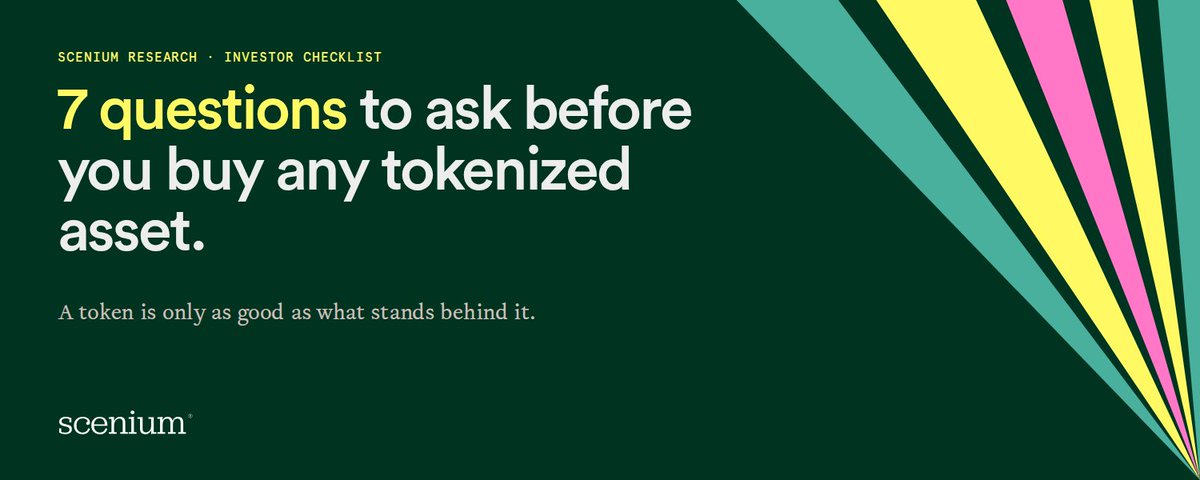

A token is only as good as what stands behind it.
Two tokens can look identical in your wallet and carry completely different rights, risks and protections.
I wrote the 7 questions I'd ask before buying any tokenized stock, fund, Treasury or credit product 👇
xitter.cf/cbscenium/status/21074…