

@cappados
Account based inUnited States
About this account
- Account based in
- United States
- Connected via
- United States App Store
Account-level information from X, not a live location or the device used for a specific post.
ItalianAmerican citizen of the world, mixologist, magician, guitarist, director/writer of film & television entertainments. Natural born skeptic. Fi/Fi Fo/Fum
Los Anhellis
Joined June 2009
- Tweets9.7K
- Following6.6K
- Followers1.6K
- Likes55.9K






PJ Pesce retweeted

Hang on, I’m almost done with my forthcoming paper, “Du Hast Mich”: Matrimonial Ontology and the Fascist Eros of Negation in Rammstein's Post-Reunification Soundscape



PJ Pesce retweeted

MACARTHUR PARK: This is your tax money at work…
Free crack pipes and needles being handed out to drug addicts. CEOs of these so-called “nonprofits” making millions a year. The smell, the squalor, the inhumanity.
All of it is funded by YOU.
WAKE UP CALIFORNIA!!!
PJ Pesce retweeted

Corey Feldman thinks he's Eddie Van Halen, but his solos sound like a dial-up modem trying to connect.

👇👇👇👇👇


My post about France went viral. Thousands of likes. Many Americans told me: "Democrats aren't socialists. America will never be France." I want to answer that seriously, step by step.
Start with a simple observation. Look at what has gotten cheaper in America over the last 25 years: TVs, phones, software, clothes, toys. Now look at what has exploded: college tuition, healthcare, childcare, housing.
What separates the two lists? The first lives in competitive markets. The second is exactly where government is most involved: subsidies, mandates, licensing, zoning, regulation.
College. Washington lends students almost unlimited money. Universities know the money will always come, so they raise tuition and hire more administrators. The student pays the bill for twenty years. More government money, higher prices.
Housing. Why can't a nurse buy a home in the city where she works? Not because of capitalism. Because of zoning laws, permits, environmental reviews, years of procedure to build a single building. The most expensive places to live in America are the places where it's hardest to build. When building is nearly illegal, prices explode.
Healthcare. The patient almost never sees the price. A third party pays, regulations limit who can compete, and costs climb year after year with no one able to say no.
So here is the trap. The problems you suffer from are not the failure of free markets. They are the places where the market has already been replaced by the state. And the solution you're being offered is more of the same.
That's the Trojan horse. It always works the same way. A real problem. A generous-sounding promise. A program that makes things worse. Then the failure of that program becomes the argument for the next one. People who lived under communism in Poland learned to recognize the lie and the mask the lie wears. The lie never presents itself as a lie. It presents itself as compassion.
In France we are at the end of that road. Debt we can never repay. Young people who can't afford a home. Our best people leaving. And every few years our cities burn. Nobody voted for this. They voted for one more generous promise, fifty years in a row.
If you're a Republican, share this with the Democrat in your life. Not to win an argument. To start a conversation.
If you're a Democrat, I'm not asking you to switch teams. I'm asking you to look at the pattern. Wherever the state took over, life became unaffordable. Don't fix the failures of government with more government.
Stay American. Ask for less state, not more.

PJ Pesce retweeted

The cruelty has been puzzling me. Under almost every post which recounts the anguish of someone seeing AI models becoming shockingly good at their own craft, there is a stream of comments telling the poster to, essentially, accept their own obsolescence. If the poster calls for this development to slow down, the response is to stop standing in the way of progress. If the poster wants to nuance the picture of the machine god steamrolling everything, reply guys call it “cope” and “cringe”. Most recently, this has been happening in mathematics with the field’s shocked reaction to the deluge of AI-generated proofs, but similar dynamics have played out for musicians and visual artists, and to a more limited extent for programmers.
These people seem to be cheering for the machines rather than humans. But I don’t think it’s as simple (or as extreme) as anti-human sentiment. The more charitable read is that most of these people really believe that this represents progress. They are excited about scientific and technical progress, and don’t want old farts like professors and other credentialed types to stand in the way. Let’s unleash machine science, and if the professors and intellectuals don’t like it, they can find something else to do!
But this is a perverted idea of progress. What good is a proof of the Riemann conjecture if there is no one who understands it? And not just a single person: you need a whole community of people to understand it and then gradually think about what it might lead to. Maybe the result will contribute to a better encryption algorithm, or a better understanding of quasars, or something else. But this requires diffusion of understanding through scientific communities. A proof of the Riemann conjecture by itself is meaningless; to me, or to the vast majority of people out there, it’s just a bunch of symbols that we can’t read. The same thing can be said for other types of research: say, for example, that your AI system deciphers some cellular mechanism that could help with a cure for cancer. A whole network of experts is then needed to do all the complex science and innovation that helps translate this into a cure, test it, and so on. The paper itself would just be collecting digital dust unless the right scientific communities were there to build on it.
Now, where do all these experts and their communities come from? From doing research. The only way we know of making people understand the frontiers of a field of knowledge is by trying to advance it, which must come with a real chance of succeeding and being recognized for it. It’s very hard, not to mention boring, to understand the minutiae of some arcane topic if you are not working on producing new knowledge there. If you fully automate the production of results in some discipline, you will also cut off the supply of experts who can understand it.
People who have never participated in research may not understand this. If that’s you, try reading a recent paper in a field you know nothing about: category theory perhaps, or carbon nanotube synthesis, or cecidology, or loop quantum gravity. Faced with pages of mysterious scribblings, you can ask Claude or Gemini to explain the paper to you, but then the terms used in the explanations will need to be explained again, and so on. You will find that, in order to actually understand the research and its significance, you will need to understand the whole research field.
Then there are those who do understand the role of expertise and the difficulty with which it is cultivated, and still ridicule those who are less than enthusiastic about the AI-driven disruption/destruction of whole research fields. Wherefore? What are they thinking, really? Let us again try the most charitable interpretation. Maybe they believe that we will not need anyone to understand that proof of the Riemann conjecture, because some complex sequence of AI systems will take us all the way from a proof in fundamental mathematics, via all kinds of research, development, and design, to a finished consumer product shipped to your door. This would imply end-to-end automation of much of the economy.
I guess some people are really worried that something like this might happen, and therefore want to pre-empt it by acting as if it were already a certainty. This, I think, is the gist of statements like “everything will be AI anyway”, which I’ve seen cropping up with alarming frequency. Submit to the machine god before it arrives, a form of anticipatory grief. Abandoning agency early makes you look like you have situational awareness. “Coping” is uncool. I get it, but cynicism is always the easy choice. It’s also the cowardly choice. Let’s not be cowards. We have agency here; it is a given that technology will advance, but the exact way in which it will advance is down to all of us, and how we adopt this technology in society is something we can and must decide on together.
Finally, there are those who have thought all this through, and still welcome the wholesale replacement of human cognitive work. Those for whom it would be a good thing that some sequence of AI systems does all the thinking, so we don’t have to. Who would think this? Well, clearly, someone who doesn’t much enjoy thinking. But I think it’s more than that. I think that there are people for whom the devaluation of expertise would be a good thing. Those who “have had enough of experts”, as Michael Gove said of the British people in the campaign for the Brexit referendum. Those who think these clever know-it-alls should be put in their place. They think people who have spent much of their lives specializing in some narrow topic should not be given all that respect and influence they seem to have now. This is called anti-intellectualism. And that’s where the cruelty comes from.
I can’t know what’s going on in their heads, but when I see people telling mathematics professors to go get a real job, as if their jobs would somehow be less real than those of massage therapists, real estate agents, or police officers, I call that anti-intellectualism. Much the same as for people who would rather take health advice from a podcaster than from a medical doctor, or who would happily see a news show host rather than a decorated general in charge of the military. At the extreme end of anti-intellectualism, we have the Cultural Revolution and the Khmer Rouge.
I hate anti-intellectualism. I think our society should incentivize people to study hard, think deeply and originally, try to push the boundaries of knowledge, and talk freely about it. I think those who spend their lives specializing in arcane topics should be respected and protected. Yes, it goes without saying, I am an intellectual. A tenured professor even, the worst of the worst from an anti-intellectual’s point of view. So you would expect me to defend the experts and intellectuals. But let me make a non-self-serving argument: humans will always compete. That’s human nature. Would you rather live in a society where the smartest people compete in understanding the mysteries of nature, developing complex technology, and producing beautiful art, or in a society where the smartest humans compete by accumulating money and/or simply by fighting each other?
As I have written about before, I am worried. I am not worried that out-of-control AI will kill us all or even that it would put us all out of work. There will always be some kind of work for us. I am worried there will be no place for us in advancing knowledge and understanding the world. I think that the defining question of our time is how to avoid this fate. It’s not a matter of my own job, or yours; it’s a matter of the purpose and dignity of humanity as a whole. Big words, I know, but I think they are warranted, and I don’t care if the cynics call it cringe.
So next time you see someone complaining that AI is steamrolling their field of expertise, don’t join in the heckling choir. Don’t be cruel. And don’t assume that someone who has devoted their life, or at least their career, to furthering knowledge wants to stand in the way of progress. Instead, try thinking constructively about how we can work together to ensure that human experts and intellectuals can float on top of the AI wave rather than be drowned by it.
Do we have a deal? Alright, thank you! Now I will go back to thinking and working on AI, meaning artificial intelligence, not anti-intellectualism.
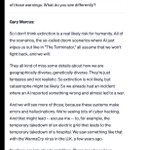
“Such philosophical debates are entertaining and even important, but when they then head in the direction of "when such superintelligence emerges, there's a good chance that it will want to kill all humans", I say "science fiction".”
👇👇👇

(1/7) I'd like to provide some additional context for the remarks that can be found in this interview.
(2/7) My discomfort with the attention being paid to existential risk---and with the ongoing dominance of the public discussion of such risks by a few so-called thought leaders---is that there's an elephant in the room that is being missed. That elephant is the effect of all of this discussion on young people, and indeed the effect---beginning with social media a decade ago---of information technology on young lives broadly speaking.
(3/7) I recently read an interview by Jill Lepore in which she reports on discussions that she had recently with a group of college students: "They had just three things to say. One, social media completely destroyed their childhoods. Two, AI is destroying their college education and their likely prospects for employment. And three, what the hell are we all doing?" To add a fourth bullet that I've heard in similar discussions: "I'm not going to have children, because the existential risk is just too high."
(4/7) Please contemplate such a statement, those of you who think that it's OK that the public, widely diffused, discussion coming from seemingly authoritative figures is so adamant about existential risk.
(5/7) Let me add that I have little interest in a debate about what "superintelligence" might mean, or whether we're currently seeing the emergence of superintelligence. For what it's worth, I would certainly agree that the solution of extremely challenging math problems (for example) exhibits a very impressive form of intelligence, although I would want to argue that such intelligence is impossible to dissociate from the collective of humans that provided data to the machine learning system (which itself has become a kind of collective).
(6/7) Such philosophical debates are entertaining and even important, but when they then head in the direction of "when such superintelligence emerges, there's a good chance that it will want to kill all humans", I say "science fiction". Again, I don't think that it's bad to consider such thoughts, but I strongly believe that it's bad for society, and especially young people, for such thoughts, unaccompanied by any serious real-world analysis, to become a dominant form of discourse of the era.
(7/7) We are damaging human lives, and the consequences of that damage will no doubt be a major theme of the next several decades.
PJ Pesce retweeted

What the West Still Doesn’t Get It:
Communism’s True Core: The Systemic Lie
Most people in the West think they understand communism. They picture bread lines, gulags, failed five-year plans, and the collapsed Soviet Union. They treat it as a discredited economic theory – an experiment that proved that abolishing private property doesn’t work. Case closed, history moved on.
This misunderstanding may be the most dangerous intellectual failure of our time.
Communism was never primarily an economic system. Economics was the surface. Beneath it lay something far more insidious: a total, systemic, institutionalized commitment to lying. Not occasional dishonesty. Not spin or propaganda in the ordinary sense. Something deeper – a civilizational war against truth itself, waged through every institution, every classroom, every newspaper, every conversation, until reality itself became negotiable and the lie became the air people breathed.
The Words We’re Missing
The Polish language, forged by decades of living under this system, produced words for this phenomenon that English simply cannot match:
Zakłamanie [zah-kwah-MAH-nyeh] – a state of total, pervasive, socially embedded falsehood, a condition in which an entire society is saturated with lies so thoroughly that truth becomes almost inaccessible.
Obłuda [ob-woo-dah] – a deep, performative hypocrisy, the gap between what is proclaimed and what is actually practiced, the mask worn so long it begins to feel like a face.
These are not words for individual liars. They describe a system – a mode of social organization built on organized mendacity, where the lie is not the exception but the foundation. English has no single word for either concept, and that linguistic gap is not a coincidence. It reflects a gap in experience. Cultures that did not live under communism lack the vocabulary because they lack the wound.
And because they lack the vocabulary, they struggle to recognize the thing when it reappears in new clothing.
The Continuity: Communism, Leftism, Wokeism
What we call wokeism today, or the broader radical left, is not a new phenomenon. It is the same operating system running on updated hardware. The specifics have changed – instead of the proletariat, we have marginalized identity groups; instead of bourgeois class enemies, we have racists and transphobes; instead of socialist realism, we have DEI statements. But the deep structure is the same.
That deep structure is this: truth is not discovered, it is assigned. Reality is not something to be understood honestly but something to be narrated strategically. Language is not a tool for communication but a weapon of power. And anyone who resists the approved narrative is not simply wrong – they are dangerous, and must be silenced, shamed, or destroyed.
This is zakłamanie in its modern form. This is obłuda wearing a human rights badge.
The same movement that insists men can become women will insist, with equal fervor, that questioning this is an act of violence. The same institutions that claim to champion free inquiry systematically suppress dissent. The same people who invoke tolerance as their highest value are among the most intolerant forces in public life. The contradiction is not accidental – it is structural. It is the system working as designed.
Why the West Still Doesn’t Get It
People who grew up in freedom tend to assume, at some level, that bad actors know they are lying. That somewhere behind the ideological performance, there is a cynical operator who privately acknowledges reality. This assumption is wrong, and it is why Westerners consistently underestimate what they are dealing with.
The totalitarian lie, at its mature stage, is not cynical. It is believed. Or rather, it creates a condition in which the distinction between belief and performance collapses entirely. People learn to say things they do not believe so fluently, and for so long, that they lose access to what they actually think.
1/2

PJ Pesce retweeted

I think what’s happening in Austin right now is going to change how Wall Street looks at $TSLA.
Since September 3, people in Austin have been paying for rides in Tesla Cybercabs with no steering wheel, no pedals, and no human driver. Then on October 10, Tesla announced that more than 300 Cybercabs are now serving Austin, an 8x increase in just 30 days. Then, right after, Tesla’s head of AI software, Ashok Elluswamy, said Dallas is coming soon.
Just 2 yrs ago, the Cybercab was something we saw on a stage. I remember so many people thought it would never happen. And today, real customers are getting picked up, going about their day, and paying Tesla for the ride. This is now a real service operating on public roads.
I’ve experienced Cybercab myself, and I think people are underestimating just how big this is about to become.
You see, when Tesla sells a car, it collects $ money from that sale. On the other hand, when Tesla operates a Cybercab, that same vehicle can keep generating revenue, ride after ride, day after day, potentially for the life of the car.
This is a COMPLETELY different business that Tesla just opened up.
And this is something incredibly valuable that is very difficult for most companies to build from scratch. Tesla already manufactures hundreds of thousands of vehicles every quarter, develops its own self-driving software, and has a massive fleet of 10M+ customer vehicles providing real-world driving experience.
Now imagine that manufacturing scale being used to produce vehicles that both 1/ get sold to customers, AND 2/ continue earning $ money for Tesla throughout their working lives.
Of course, putting 300 Cybercabs on the road is not the same as proving a profitable business… we still need to see what each vehicle earns, how much it costs to operate, how safely and reliably it performs, and how quickly Tesla can expand it.
But this is exactly why Austin matters so much… it’s where Tesla starts turning years of promises into actual business results.
And once Tesla can show that a Cybercab makes $ money consistently, and that the business can grow from hundreds of vehicles to thousands and eventually tens of thousands, it’s really hard for me to see how Wall Street can keep looking at Tesla through the same lens as a traditional car company.
You have to start valuing Tesla as a growing transportation network that can generate revenue every time someone needs a ride.
A major re-price is coming imo.


PJ Pesce retweeted

Guys, it was just the fire. The fire magically decided to destroy the oldest market in Paris, located right in the middle of the historic Jewish neighborhood of Le Marais, directly during all those mostly peaceful "student protests." Naughty, naughty fire.

Fire destroys French capital's 'Enfants Rouges' covered food market reut.rs/4B2HhcW reut.rs/4B2HhcW


PJ Pesce retweeted

This is Nobel Laureate Geoffrey Hinton showing precisely where the entire AI industry went wrong.
He went along with the trend: “If you have any theory of how the brain works, you can simulate it on a digital computer” unless it’s quantum effects.
This is false.
The brain is a physical learning system that uses the laws of physics to calculate. It *cannot* be reproduced in digital form, nor can it be simulated. The moment you digitize information, you lose the part that makes it real. By converting it to bits—no matter how many—you lose the infinite resolution of reality.
All forms of biological intelligence are 100% ANALOG. This is not an incidental feature of intelligence. It is fundamental to it. We have never simulated intelligence or consciousness on a digital computer because you can’t.
LLMs simulate the OUTPUT of intelligence. They do not simulate intelligence itself. They do not learn. They are static piles of human data compressed in high-dimensional math. The whole idea they are intelligent is absurd.
You will never get an intelligent digital computer, much less a conscious one. The future of AI is analog computing. When computers use the universe to calculate, when they adapt based on input from the physical world, we’ll be getting closer.
Until then, AI is a dead end.
PJ Pesce retweeted

Sending your kid to a charter school while staying silent as Dems try to restrict charter options for low-income families is wild. Spot-on from @mattyglesias.

PJ Pesce retweeted

🚨Final nail in the coffin of the AI IPOs? 🚨
“The ten highest-quality models carry 14% of developer tokens, down from 55% last year, as cheaper, "good enough" models win on volume.”
theinformation.com/articles/…


PJ Pesce retweeted

"I failed to understand how the brain works." ~ Physics Nobel laureate Geoffrey Hinton
This notorious fake-AI bullshitter admits that he has no clue how the brain works. All he knows are his precious "connection weights". And yet, he somehow thinks he knows that LLMs have subjective experience, i.e., that they are conscious. 🙄
Lord have mercy. 🤦♂️
PJ Pesce retweeted

A retired NASA engineer who had worked on the Space Shuttle program for 25 years was hired by SpaceX at age 62. He described the first week as the most disorienting experience of his professional life.
At NASA, a design change required 3 meetings, 2 committees, a review board, and 6 to 18 months of documentation. At SpaceX, his new supervisor said "if it works, build it. If it doesn't, change it by Friday."
He sat at his desk after the first day and called his wife. He told her he felt like a man who had been swimming with ankle weights for 25 years and someone just cut them off. He could move. He could decide. He could build something in the morning and test it in the afternoon. The constraint that he had accepted as the nature of aerospace engineering turned out to be the nature of bureaucracy.
Within 6 months he had contributed to more design iterations than he had completed in his last 5 years at NASA. Not because he was working harder. Because the time between having an idea and testing the idea collapsed from months to hours. The same brain. The same knowledge. A different operating system.
He described a specific moment where he proposed a modification to a Raptor engine component. At NASA, the proposal would have entered a queue. At SpaceX, the modification was machined by the end of the day and tested by the following morning. He watched his idea become a physical object in 18 hours. At NASA, 18 hours would not have been enough to schedule the first meeting to discuss whether to schedule a meeting.
He told an interviewer: "I didn't get smarter when I went to SpaceX. I got faster. The intelligence was always there. The system was in the way."
The difference between SpaceX and NASA is not talent. NASA has extraordinary talent. The difference is the time between a thought and a test. SpaceX compresses it. NASA elongates it. The same engineer produces 10x more at SpaceX than at NASA because the bottleneck was never the engineer. It was the meetings about the meetings about the work.