

Anarcho-capitalism • Coder • Cypherpunk • Free Software • PGP 0x304952407A6E5C38
No signal
Joined April 2023
- Tweets1.4K
- Following156
- Followers384
- Likes6K





Pinned Tweet
My little contribution to Bitcoin Core is waiting for the sharp eyes of code reviewers 👀 #Bitcoin #BitcoinCore #CodeReview
github.com/bitcoin/bitcoin/p…

Cͨaͣeͤs͛aͣrͬCͨoͦdͩeͤrͬ 𓆙 retweeted

I could keep calling myself an ancap since, philosophically, I align with the ideals.
Reality doesn't give a shit about philosophy.
That's the harsh truth.
Most issues are essentially a trolley problem. You can claim the so-called "moral high ground" by not participating. Call yourself a better human because you didn't side with the lesser of two evils.
But understand that the world is filled with people who don't share your morals, aren't interested in making the world a better place, and want to take control of the power structure. They will use it against everyone who stands in their way.
These people will blame you for their shortcomings, steal from you, and even murder you and your family if they get the opportunity.
Philosophy: The state shouldn't exist.
Reality: The power structure exists. It has existed for all of human kind. It is not going away. Someone will take control of it.
What are you going to do about it?
The number of words you choose in BIP-39 determines the maximum entropy of the seed, not the actual security level of the private keys for the addresses.

BIP-39 maps 11 bits per word. A 12-word seed encodes 128 bits of entropy. A 24-word seed encodes 256 bits. The extra 128 bits do not reach the private key in any meaningful way, because Bitcoin private keys have a security level of 128 bits regardless of seed length. The ECDSA curve order is 256 bits, but brute-forcing a Bitcoin address via RIPEMD-160 collapses that to 160-bit preimage space, and the actual attack surface against a secp256k1 key sits at roughly 128 bits of effective security.
I made a Bitcoin puzzle using information contained in the genesis block created by Satoshi to generate the wallet.
The entropy is extremely low. I didn’t even need to back anything up. Everything I needed was already in the genesis block.
Good luck!
mempool.space/address/bc1qfk…


[SOLVED] Genesis Block Wallet Puzzle
github.com/floflo777/open-cr…

The best way to create a wallet is to use an approach few people know. Study, experiment, and understand every step. Blindly copying popular tutorials could put your wallet next in line to get drained. Don't just follow instructions. Learn how it works.
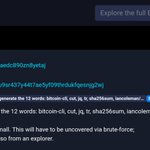
bitcoin rpc getrawtransaction 473a314bcb3f5abc8dc4500e8d0ab80525ff65a846d55406c1e1e10fa8c8e46c | cut -b 215-1300 | xxd -r -p


I made a Bitcoin puzzle using information contained in the genesis block created by Satoshi to generate the wallet.
The entropy is extremely low. I didn’t even need to back anything up. Everything I needed was already in the genesis block.
Good luck!
mempool.space/address/bc1qfk…


Cͨaͣeͤs͛aͣrͬCͨoͦdͩeͤrͬ 𓆙 retweeted

Pues de estos ataques (encuentra las diferencias en las fotos de Trezor) ya hemos hablado hace años.

Alguien perdió 1,33 bitcoin.
Trezor bitcoin hardware wallet que parecía perfectamente genuino desde el exterior; sin embargo... (izquierda - original, derecha - falso)
La unidad se compró a un vendedor de confianza a través de un popular sitio web de anuncios clasificados, y las pegatinas holográficas de la caja y la propia cartera estaban presentes y sin daños.
Tanto la caja como la carcasa de la unidad están selladas con pegatinas holográficas, el microcontrolador está en modo de protección de lectura de memoria flash (RDP 2). El gestor de arranque comprueba la firma digital del firmware y, si se detecta una anomalía, debería mostrar un mensaje (que no mostró así que se supone todo debería estar bien) de firmware no original y elimina todos los datos de la cartera.
En primer lugar, se eliminaron las comprobaciones del gestor de arranque para los mecanismos de protección y las firmas digitales, eliminando así el problema de la "pantalla roja" durante la comprobación de originalidad del firmware en el inicio.
En segundo lugar, en la etapa de inicialización o al restablecer la cartera, la frase semilla generada al azar se reemplazó con una de las 20 frases semilla pregeneradas guardadas en el firmware pirateado. El propietario comenzaría a usarlo en lugar de uno nuevo y único.
Salsas en kaspersky.com/blog/fake-trez…


Cͨaͣeͤs͛aͣrͬCͨoͦdͩeͤrͬ 𓆙 retweeted

>a hacker finally uses zcash
>gets identified immediately
working as intended


Ledger theft, day two. Since yesterday the thief has pushed ether through Tornado Cash three times, and each time on into Zcash's shielded pool. We followed every lot out the far side. Here is how, step by step.
1. THE SAME BUILD, THREE TIMES
An ether wallet pays a fresh splitter. The splitter pays four fresh wallets. The four drop it into Tornado Cash's 100, 10 and 1 ETH pools. Minutes, every time.
Run 1, yesterday 15:17: 1,254 ETH. Run 2, today 09:42: 1,291 ETH. Run 3, today 11:56: 450 ETH from 0xfa4EaBB840A33C156E600311433AE261CBfCb0e2, in the pools by 12:15.
2. OUT OF TORNADO CASH
The mixer breaks the link between a deposit and a withdrawal. We do not need the link. Our tooling fingerprints the withdrawal transactions themselves: how each one is constructed, who constructs it, and when.
Yesterday's 65 withdrawals (1,084 ETH) and today's 96 (1,726 ETH) all carry the same signature. The six other withdrawals from those pools in today's windows do not. Run 3 came out from 12:18 into 0x0d697aa182801566d87adc86e68e95fd3b2f5f82 (213 ETH) and 0x676b16cc18542f37d202a1a79ac05463395496a4 (122 ETH), and 195 ETH of it was inside a cross-chain swap service by 12:38. Forty-two minutes, end to end.
3. INTO ZCASH, AND OUT AGAIN
The swap service turns the ether into shielded ZEC, where sender, amount and recipient vanish. But the service's own shielding of each lot is public, and from it we derive a value signature for that lot's exit, then scan every transparent exit from the pool. 108 of 108 exits across both days match their lot to the zatoshi. Not one other exit from the pool does.
First lot today: in at 10:18:18, out at 11:06:16 in block 3512847 (8d26a9b095d4d28373527f7a6eb81a3be7f906d1e2190960c0512ff64f369418 and 738c6d1261e79766e4dd16bdbd38dced91b8e3a86ce41dcda83eda1f19208fbf), straight into a ZEC to USDC order.
Today so far: 20 lots ordered (2,379 ZEC, $2.9m), 14 out, 5 inside the pool, 1 still settling. Every exit feeds a ZEC to USDC order paying two wallets born at 11:11, 22 of the 28 paid by 12:43:
0x816D5Ee17DB1495d1409F135b98FF3edc5F3cDf8: 940,561 USDC
0xBA736A4b616e79867B6d586293966b552883f3F3: 852,258 USDC
1.79m USDC, unspent. @Circle can freeze it.
(1/2) 🧵⤵️

Cͨaͣeͤs͛aͣrͬCͨoͦdͩeͤrͬ 𓆙 retweeted

UPDATE: I can confirm that the Ledger supply chain is compromised in Europe as well. @Ledger should initiate an immediate product recall to protect users.
I just purchased a second device from a different Mediamarkt location today, recorded the unboxing process, and discovered spyware once again (video linked in the second tweet).
The device was compromised in the exact same manner, featuring identical modifications (such as additional cables and an LTE module). This indicates its a widespread issue rather than an isolated incident, potentially affecting Ledger inventory across MediaMarkt and Saturn stores throughout Europe (comprising over 1,000 stores across 11 countries).
My initial hypothesis was that these devices were returns that looked unopened to the employees and were just sold again as new however, a MediaMarkt employee confirmed that the device I purchased was not a return, and that returned Ledgers are sent directly back to the manufacturer rather than resold.
Store records show the inventory originated from Aqipa GmbH. While Ledger's CTO was unsure if Aqipa serves as the direct distributor between Ledger and MediaMarkt, it appears to be the case. Given that Aqipa distributes across Europe, any physical retail store receiving stock through them may be at risk.
I sent the first ledger to mark and the second one is going to ledger now, so that they can analyse it.
If you purchased a ledger from anyone other than the official ledger store, make sure to check your device!!


Cͨaͣeͤs͛aͣrͬCͨoͦdͩeͤrͬ 𓆙 retweeted

🚨 Plusieurs tests confirment que des wallets Ledger modifiés sont vendus en Europe via des revendeurs agréés.
Cͨaͣeͤs͛aͣrͬCͨoͦdͩeͤrͬ 𓆙 retweeted

This nails one of the strongest arguments against the "AI will kill Bitcoin" FUD

Cͨaͣeͤs͛aͣrͬCͨoͦdͩeͤrͬ 𓆙 retweeted

Another spy implant confirmed, this one looks like the v1.0 of the one I have here, meaning there were more iterations.
xitter.cf/0xJohannes_/status/210…

PSA the ledger incident isn't limited to Asia
This is a device purchased in store from an official reseller in Europe (a legitimate device doesn't have any of these cables as can be seen in picture 2)
This even seems to be an old version of the 'spy implant' even though the device was purchased a couple of weeks ago. The newer versions usually hide the implant by the screen so it's easier to miss
What's interesting is that this compromised ledger never transfered funds to an exploiter. Either the device didn't work or they were waiting for a more widespread usage of the comprised devices?
If you own a ledger that didn't directly come from the ledger online store make sure to not just rely on the software genuinely check by ledger but to actually open up the ledger yourself to make sure its original, again there are reported cases in Asia, south America and now Europe as well.
@MagicalTux made some useful videos on how to open the ledger and what to look for.


Cͨaͣeͤs͛aͣrͬCͨoͦdͩeͤrͬ 𓆙 retweeted
I think that's the first Ledger Stax I saw with an implant.
xitter.cf/wentrre/status/2109339…


Cͨaͣeͤs͛aͣrͬCͨoͦdͩeͤrͬ 𓆙 retweeted

The most recent post by ColdCard @COLDCARDwallet is a complete scam and attempt to steal your coins. DO NOT FOLLOW INSTRUCTIONS.
The URL redirect is to a site I have never seen @Coinkite @COLDCARDwallet use ever.
This is out of an abundance of caution. I am not linking the post
Cͨaͣeͤs͛aͣrͬCͨoͦdͩeͤrͬ 𓆙 retweeted

A little bit of common sense posting since it seems to be rare in the world of the crypto casino hype.
If fault-tolerant, error-corrected quantum computers capable of breaking ECDSA existed today, crypto would not be the first or only place we noticed. That level of quantum compute would be a general scientific and industrial shock. You would expect visible progress in quantum chemistry, materials discovery, condensed matter physics, optimization, logistics, financial modeling, and parts of engineering where classical computation hits hard limits. The same machine that can run Shor’s algorithm at cryptographically relevant scale is not just a Bitcoin-key-cracking box. It is a new computational instrument.
Breaking ECDSA is not a cute demo. It requires large-scale, reliable logical qubits, long coherent computations, and serious error correction overhead. If someone had that, they would also have crossed the threshold into useful fault-tolerant quantum computing. That means they could simulate molecular systems better, search design spaces differently, analyze quantum materials, improve catalysts, batteries, superconductors, pharmaceuticals, and possibly accelerate work in areas where exact classical simulation is impossible or brutally expensive.
You would also expect markets to react. Not because every quantum application would instantly become profitable, but because investors price future capability. If credible, error-corrected quantum compute existed at the level needed to threaten ECDSA, it would imply new companies, new national-security programs, new supply chains, new patents, new lab results, and massive repricing of firms exposed to cryptography, materials, semiconductors, biotech, logistics, and finance. The stock market would not treat that as a footnote.
Instead, what we see is the opposite: impressive physics progress, noisy intermediate-scale devices, roadmaps, demos, and specialized experiments, but not the broad economic signature of cryptographically relevant quantum computing. We do not see public-key cryptography collapsing. We do not see sudden unexplained leaps in materials, drug discovery, industrial optimization, or financial strategy that would suggest someone has general fault-tolerant quantum capability.
So the crypto quantum panic is usually incoherent. People talk as if there will be a narrow event where Bitcoin or Ethereum suddenly becomes vulnerable, while the rest of civilization keeps running normally. That is not how it would look. The compute needed to break ECDSA is part of the same capability class that would unlock major advances across science and industry. If that capability were here, the world would be giving off much louder signals than "maybe your wallet is unsafe."