

@cadeapple
Account based inUnited States
About this account
- Account based in
- United States
- Connected via
- United States App Store
Account-level information from X, not a live location or the device used for a specific post.
AI / ML | Quantitative Finance | Ex Treasury | Ex Energy | Ex PRAC | Ex PwC |
Chicago
Joined May 2024
- Tweets1.1K
- Following3.4K
- Followers130
- Likes2.1K
Cade 🍎 retweeted

BREAKING: Tesla's Roadster flips off a ramp and hovers back to the ground.
"Flying cars are real."
Cade 🍎 retweeted

DINOv2 has never seen a caption, and Qwen3 has never seen an image. We still aligned their embedding spaces without a single image-caption pair.
It even works when the images and the captions come from different datasets.
Project page: dominik-schnaus.github.io/un…
⬇️
Cade 🍎 retweeted

Hello computer.
Decompile and distill Grand Theft Auto.
Make the game set in my hometown -- use Google Earth to reconstruct it in pixel-perfect detail.
Make the character me and have my spawn point be in the mansion I always look at on Zillow.
Review my chat memory and make every mission about my hopes and dreams.
Make it playable online so my friends can join.
When you're done, sell all my video games on Ebay and use that money to fund tokens for my next game.
Cade 🍎 retweeted

“Cryptography is a subfield that’s extremely conspicuous by its absence from OpenAI’s list of 376 papers!
But my sources tell me that the AI cos have now started, gingerly and discreetly, investigating whether their latest internal models can break important cryptographic protocols and primitives.”
- Scott Aaronson, CS chair at UT Austin
Cade 🍎 retweeted

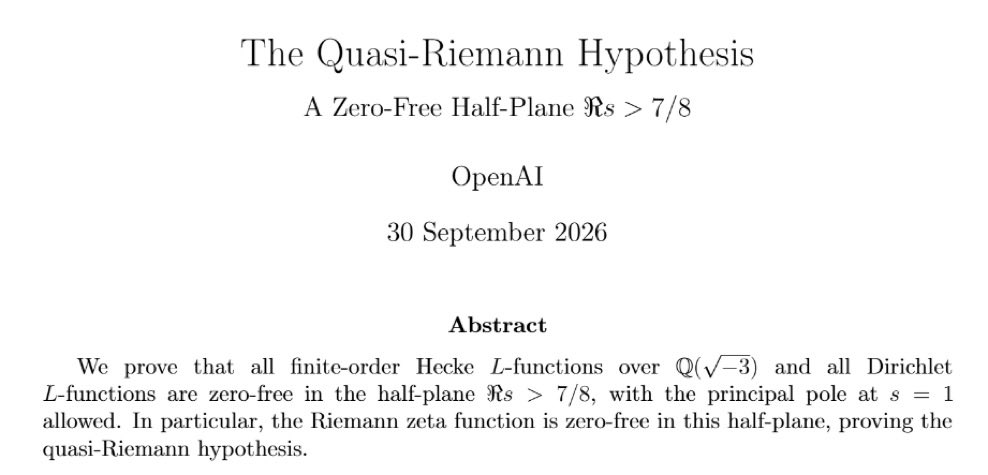
Quasi-RH?!?!???! Are you kidding me? If a human did this, it would be an instant Fields Medal, no questions asked.
RH says zeta has no zeros in Re(s)>1/2. The best we had until a second ago was a region that got thinner and thinner the higher up the imaginary axis you go. I thought maybe they’d fatten that up a bit, that’d be a massive breakthrough. But no. They got a zero free strip!!!! Insane


We’re releasing a broad range of new mathematical results produced by an internal frontier model.
We’ve been consulting with the independent Advisory Group on Mathematics and Artificial Intelligence at the Institute for Advanced Study, and we have drawn on their advice and public recommendations to inform how we release these results.
github.com/openai/math

Cade 🍎 retweeted

This is what Ilya saw.


OpenAI is downplaying this for PR reasons. If you’re a mathematician, you must feel like a nuclear bomb hit, and you’re at ground zero.
Reasoning models are two years-old. In that time they went from incapable of basic arithmetic to solving problems humans couldn’t solve for decades.
Math is only the beginning. AI will revolutionize the entirety of the human scientific endeavor. Most of us don’t appreciate what that means.
What a time to be alive!
Cade 🍎 retweeted

Engineering doesn't have to be learned from flat diagrams.
A jet engine in interactive 3D, from intake to exhaust. Built with Claude Opus 5.5 using Three.js.
Cade 🍎 retweeted
We are now entering into an era where any product can be created exactly to a consumer's preferences & needs.
I vibe-fabricated a dog door with a wifi-controlled lock, perfectly to the specifications & design of my house.
I know nothing about metal fabrication or electrical engineering.
It's now getting manufactured and delivered in 2 weeks -- for almost the same cost if I bought a mass-produced item off-the-shelf.
Cade 🍎 retweeted

i seriously doubt people comprehend what this means
*10 million Optimus per year*
that's the equivalent of a whole nation of robots that could eventually work tirelessly, ~24/7, without needing to be trained individually, with the intelligence of a nobel prize winner, that only improve with time, that build and repair each other, that do not need holidays or sick leave or a raise, and that will just work without complaining
a new industrial revolution is coming, the scale of which we can't comprehend

The Optimus factory construction at Giga Texas is progressing rapidly.
It'll be a massive 7 million sq ft facility with a targeted capacity of 10 million Optimus per year. Initial production is planned to begin in 2027.
The Fremont facility, planned for 1 million per year, is expected to begin production this year.

Cade 🍎 retweeted

"explain how Shazam works"
I had no idea
Karpathy is so right about this
custom explainer videos will change education

We'll be spending a lot more time trying to understand the outputs of language models. A few thoughts, tips & tricks:
Writing. Something I've had success with: Ask your LLM to explain something in ASD-STE100, it's a controlled language specification originally developed for aerospace maintenance documentation. LLMs well-versed in this language and it comes with heavy constraints on clean writing style that I often find a lot more readable. Sometimes I've tried to soften it a bit e.g. ask for "80% of the way to ASD-STE100" because the spec is quite stringent. But even better:
Diagrams / images. Instead of writing, ask your LLM to create a diagram. These can be a lot easier to process, parse, and understand. But even better:
Web pages. Ask for output "in HTML" to get a beautiful, interactive webpage. LLMs are getting really good at frontend and can create beautiful experiences, animations, etc. But even better:
Explainer videos. The output format I am most bullish on is fully custom / bespoke explainer videos generated on any arbitrary topic. Experiment with things like "Create a 3b1b style video explainer on X. Use my ElevenLabs API key for audio narration". (you'd need an API key for the latter or you can ask your LLM to find you decent free alternatives that use your local compute). This is actually starting to work!
In summary:
- As LLMs get better, they will do more and more of the legwork autonomously, and a lot more of our work will rise up the abstractions into oversight and understanding.
- Luckily, LLMs can help here too because as intelligence and code are increasingly abundant, you can ask for large, custom, discardable software artifacts (e.g. web apps, video explainers) that would have never made sense to create before. Push the boundaries here and you'll be surprised.

Cade 🍎 retweeted

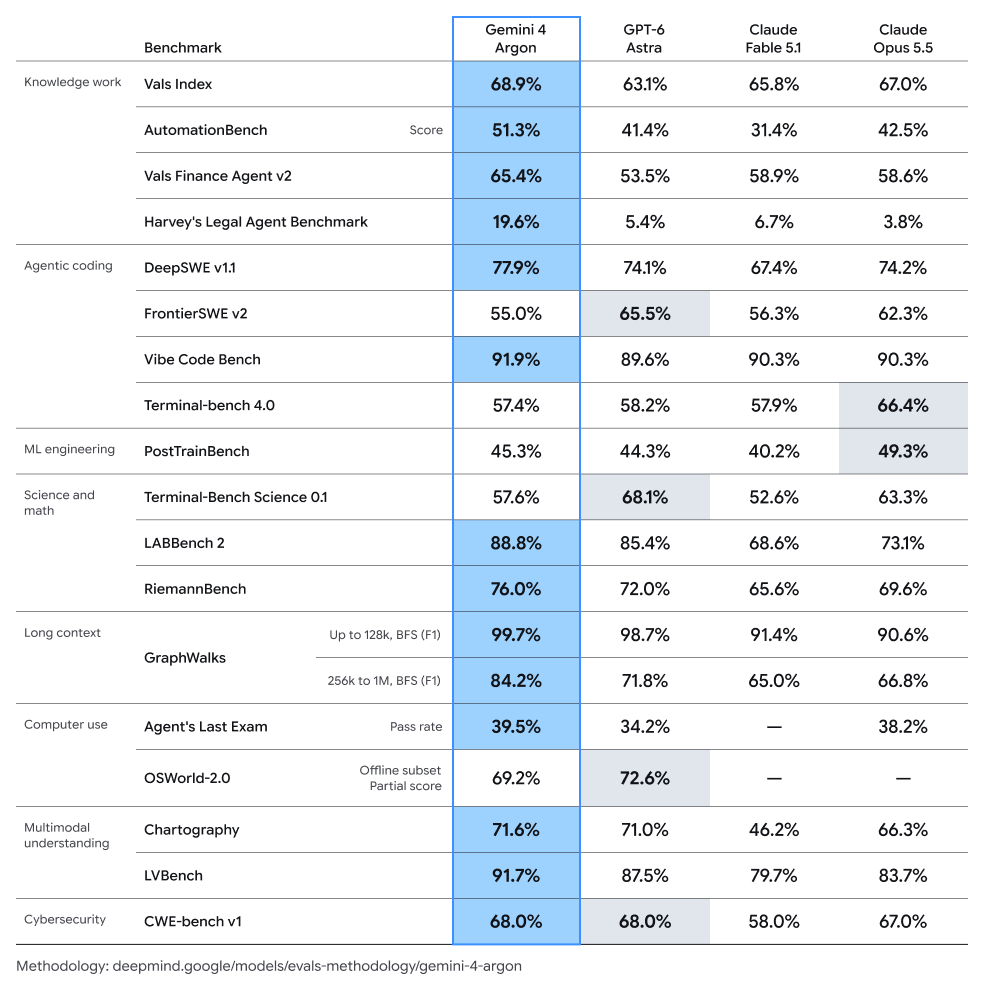
Introducing Gemini 4 Argon – our new frontier model.
It’s built for complex workflows across coding, enterprise knowledge work, and cybersecurity defense – rolling out today to a set of trusted testers through our Fairwind Program.
Cade 🍎 retweeted

we gathered all the resources you'll ever need to become the most cracked ai performance engineer
follow and save to keep up with the series. links in thread 🧵
part 7: Efficiently Scaling Transformer Inference
Reiner Pope and coauthors studied PaLM inference on TPU v4. the paper gives performance engineers a way to reason about where weights, activations, and KV caches should live, what must move each step, and which transfers limit latency.
the paper's mechanisms suggest these checks for an inference deployment:
- prefill and decode can have different arithmetic intensity, meaning computation per byte transferred. prefill can process many prompt tokens in one pass; standard autoregressive decode produces one new token per sequence per step. larger decode batches amortize weight reads, but add sequence-specific KV cache traffic. sweep batch size with context length and profile the linear layers and attention to locate the bandwidth or compute limit.
- tensor parallelism can reduce local compute without removing the communication bottleneck. in the paper's 1D layout, activation-aggregation time stays roughly constant as chip count grows for a fixed workload. 2D partitioning splits both weight dimensions so each chip communicates smaller activation shards. evaluate this against the actual interconnect and matrix dimensions before increasing the parallelism degree.
- the best tensor to move changes with the token batch. weight-stationary layouts exchange activations; weight-gathered layouts transfer more weights to reduce activation exchange. large prefills can justify that trade because their activation tensors are large. count the tokens processed per forward pass, including prompt tokens during prefill, when comparing those layouts.
- multiquery attention shares one KV head across query heads, but a head-sharded layout can replicate that cache across devices. the paper shards attention across the batch during decode and exchanges current-step activations to reduce cache reads per chip. in vLLM's grouped-query attention deployments, check whether tensor parallelism exceeds the KV-head count and introduces cache replication before estimating per-GPU capacity.
- KV cache capacity and prefill attention intermediates are separate memory problems. at a fixed batch size and query-head count, sharing KV heads does not shrink the full attention-score tensor. for dense prefill, that tensor's element count grows with the square of sequence length. Appendix G discusses microbatching to reduce temporary allocations and FlashAttention to avoid materializing the full score matrix. use that distinction to identify whether a memory failure comes from retained KV state or temporary attention allocations.
- communication overlap depends on the execution schedule and tensor layout. the authors use Looped CollectiveEinsum to overlap collectives with matrix multiplication, including choosing output sharding that exposes overlap opportunities. inspect a GPU timeline for exposed communication and dependent compute stalls; an asynchronous collective does not establish that its cost is hidden.
- quantization changes different bottlenecks depending on what is quantized. the paper stores weights in int8 while retaining bfloat16 matrix arithmetic. this reduces weight-loading traffic, but does not provide faster arithmetic for compute-bound batches. evaluate weight, activation, and KV cache precision against the measured bottleneck and benchmark the effect on both phases.
- benchmark the operating point that the application needs. the paper compares latency with accelerator-time per token and model FLOPS utilization. in a serving system, track time to first token, inter-token latency, and throughput under the target load. keep queueing time separate from prefill time.
the practical use is to narrow an optimization experiment: estimate compute, HBM traffic, and collective costs for the actual workload, inspect the bottleneck, change the relevant layout or precision, and remeasure at the same latency target.

Cade 🍎 retweeted

the only investment research you need for the next two years is looking at this photo

Cade 🍎 retweeted

I led engineering at Google DeepMind.
Today, I'm proud to introduce Fo to give personal AI something no lab ever has... Humans.
Other personal AI's pretend AI can do everything. Fo employs humans to do tasks that AI cannot.
- 2x better at real-world task completion (beats other agents by 69%)
- 94% trust rate (4x less likely to leak private info vs Muse, Instinct)
Sign up for free: wajo.ai/join-wajo
Cade 🍎 retweeted

I asked Claude Opus 5.5 to explain how a rocket engine works by building an interactive Raptor 3 you can take apart in your browser.
Cut it open, follow the oxygen and the methane through both turbopumps, then throttle it and watch the shock diamonds move.
airsup.ai/rocket-engine
Cade 🍎 retweeted

One of the odd things about learning mathematics is how long you can manipulate an equation without having much of a picture of it in your head.
You learn the notation, follow the derivation, get the answer, and move on.
Then somebody shows you the same idea visually and you realize there was a geometric intuition hiding underneath the symbols the whole time.
A Fourier sum becomes rotating vectors added head-to-tail. Attention becomes a weighted combination you can watch being formed. SVD becomes a sequence of transformations you can follow one step at a time.
Even the equation behind a diffusion process feels different when you can see a point following a changing vector field.
None of this replaces the mathematics. The equations are still where the precision lives.
But once you have a picture in your head, the notation has something to attach itself to.
I think this is why some mathematical ideas suddenly become much easier years after we first learned them. We finally stop seeing the equation as a line of symbols to manipulate and start seeing the process it describes.
I wish more mathematics had been taught that way.
Cade 🍎 retweeted

Today, with over 100 industry partners, we introduced the NVIDIA Open Agent Safety Platform, bringing together OpenShell and Sentry.
Artificial intelligence is extraordinary technology that will advance discovery, productivity, security, health, and prosperity for generations to come.
But its full promise can only be realized when people have confidence that AI is being built to be safe and deployed with wisdom and responsibility.
This is bigger than a single product. It's the beginning of an open ecosystem to build the trust layer for safe agent systems.
Together, we are building the foundation of the AI economy.
Trust and innovation are not in conflict. Safety is how trust is earned. We must build not only the most capable AI, but the most trusted AI, so that this extraordinary technology can realize its enormous promise for the world. nvda.ws/4hcoq7m

Cade 🍎 retweeted

A timeless rule of competition: commoditize your complement.
Every product has complements. When a complement gets cheaper, demand for your product can rise. So companies often try to drive the price of key complements toward zero.
Open-weighting a model is basically this move at a frontier scale.
OpenAI and Anthropic position the AI model itself as the product you pay for.
For Meta, dependence on a model layer controlled by competitors would threaten its ability to profit from its own AI products.
So Meta gave Llama for free. They can afford to give away the model because they don’t have to sell it. Instead, they sell advertising to 3B users. The model is Meta's complement, while its data and distribution are the moat.
Once you start to see the pattern, other open-model releases become more clear:
- Google (Gemma) and Microsoft (Phi) sell cloud computing and software. A cheap model layer sends more workloads to their clouds.
- OpenAI (gpt-oss): When open competitors set the price, you release something open too.
- Nvidia agreed to acquire Hugging Face for $12.9B, preserving openness and support for competing hardware and cloud providers. Making models more accessible encourages more applications and greater usage, which expands demand for computing infrastructure.
Essentially, companies open up one layer when doing so strengthens the part of the stack where they make money.
For companies whose only business is selling access to closed frontier models, cheaper and more capable open-weight models mean more competition at the model layer and more pressure on token pricing.
Cade 🍎 retweeted

Sakana AI welcomes Jürgen Schmidhuber as Chief Scientific Advisor.
sakana.ai/schmidhuber/
Sakana AI is incredibly proud to announce that Jürgen Schmidhuber, universally recognized as the father of modern AI, is officially joining Sakana AI as Chief Scientific Advisor.
For nearly four decades, Jürgen has explored how machines can learn to learn. His foundational work in the 1990s drove core advancements in deep learning and established early frameworks for world models. Crucially, his pioneering innovations in meta-learning opened the very path toward recursive self-improvement.
These ideas have already shaped our own research, from the Darwin Gödel Machine to The AI Scientist. Now Jürgen will help guide our newly formed RSI Lab, whose objective is to trigger a compounding cycle of scientific discovery aimed at improving machine intelligence. We are assembling a critical mass of world-class experts in Tokyo to make this a reality.
Welcome, @SchmidhuberAI !

Cade 🍎 retweeted

arXiv has received a 17.2 million investment from three leading philanthropic organizations. Thank you to Simons Foundation International, Siegel Family Endowment, and XTX Markets for your support of arXiv!
Read more: blog.arxiv.org/2026/09/23/ar…
