

Curious | Investments at Accel | ex-Apna, BCG
Joined November 2023
- Tweets116
- Following202
- Followers87
- Likes631


Vidhya Ananthakrishnan retweeted

At seed, an investor's conviction is sometimes just your confidence reflected back. Aggression gets you the meeting, sometimes even the cheque. It doesn't get you the company. On hollow aggression, why a round isn't validation, and the 6 questions:

Vidhya Ananthakrishnan retweeted

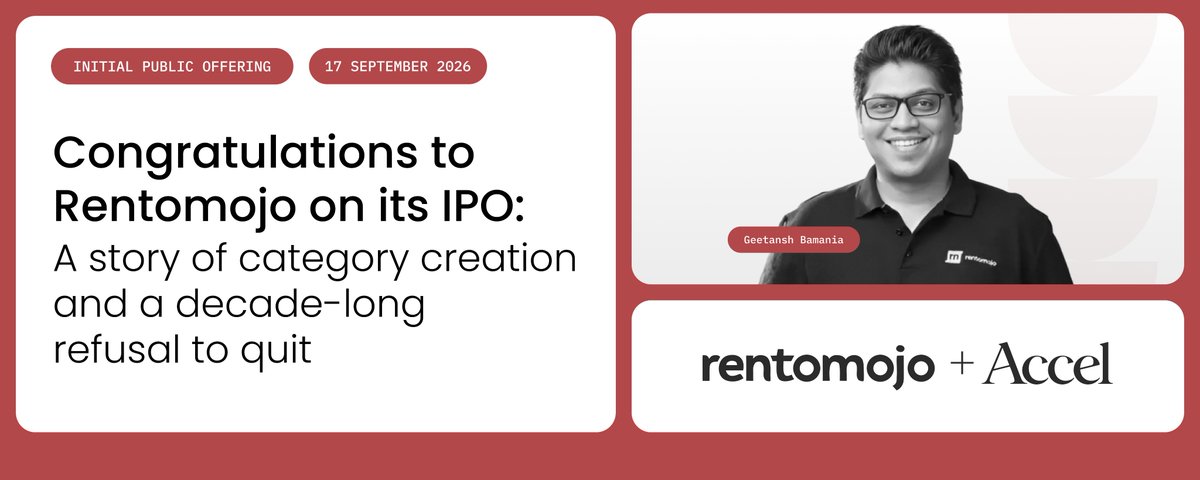
A decade ago, @GeetanshBamania asked something none of us had heard before: what if people rented furniture instead of buying it? He saw a shift the rest of us hadn't, cities changing, ownership starting to feel like a burden.
Glad to have witnessed this special journey from day one.

Today, @Rentomojo goes public.
An idea about renting became a business that helped India feel at home. We look back at what it took to get here.
Congratulations to the entire team on your IPO and your own new beginning.
#AccelFamily • @prashanthp
Vidhya Ananthakrishnan retweeted

The GTM playbook for AI companies is still being written. Last week, we got in a room with some of the people helping define it.
Shekhar Kirani (@skirani), Partner at @Accel, sat down with Barathram A, Partner at @McKinsey, who advises frontier labs, hyperscalers, and AI-native companies on building commercial motions, and Varun Anand, Co-founder of Clay, who built one of the defining GTM platforms for AI-native sales teams and had to develop the methodology while shipping the product.
(1/3)


Vidhya Ananthakrishnan retweeted
GTM is among the hardest unsolved problems for AI-native companies.
Most playbooks were built for a different era. AI-native products need AI-native commercial motions — and very few people have figured out what that actually looks like in practice.
At our next Accel Founder Connect, Shekhar Kirani (@skirani), Partner at @Accel, sits down with two people who have cracked different parts of this problem:
• Barathram A, Partner at McKinsey, leads Go-to-market work for AI and software companies, advising and partnering with frontier labs, hyperscalers, tech and AI-natives on how to build and scale commercial motions.
• Varun Anand co-founded Clay, the GTM platform of choice for AI-native sales teams. He didn't just theorise about AI-native GTM. He had to figure it out while building the product itself.
Together, they'll get into first-principles playbooks, org structures, and what global go-to-market actually looks like when you're building AI-native.
Sign up to attend in person in Bengaluru: luma.com/AccelAIGTMStrategie…
Sign up to attend virtually: luma.com/AccelAIGTMStrategie…

Vidhya Ananthakrishnan retweeted

In honor of 50 years of Apple, we're sharing - for the first time ever - Don Valentine's original 1977 memo for Sequoia's investment into Apple Computer. #Apple50

Vidhya Ananthakrishnan retweeted

Last one on this topic, and I have been holding this in myself for a while.
For centuries, class divides kept the labor of the poor invisible to the rich. Factory workers toiled behind walls, farmers in distant fields, domestic help in backrooms. The wealthy consumed the fruits of that labor without ever seeing the faces or the fatigue behind it. No direct encounter, no personal guilt.
The gig economy shattered that invisibility, at unprecedented scale.
Suddenly, the poor aren't hidden away. They're at your doorstep: the delivery partner handing over your ₹1000+ biryani, late-night groceries, or quick-commerce essentials. You see them in the rain, heat, traffic, often on borrowed bikes, working 8–10 hours for earnings that give them sustenance. You see their exhaustion, their polite smile masking frustration with life in general.
This is the first time in history at this scale that the working class and consuming class interact face-to-face, transaction after transaction. And that discomfort with our own selves is why we are uncomfortable about the gig economy. We want these people to look our part, so that the guilt we feel while taking orders from them feels less.
We aren't just debating economics. We are confronting guilt. That ₹800 order might equal their entire day's earnings after fuel, bike rent, and app cuts. We tip awkwardly, or avoid eye contact, because the inequality is no longer abstract. It's personal.
Pre-gig era, the rich could enjoy luxury without moral discomfort. Labor was out of sight. Now, every doorbell ring is a reminder of systemic inequality. That's why debates explode. It's not just policy. It's emotional reckoning. Some defend the system (“they choose it”), others demand change (“this isn't progress, its exploitation”).
And here’s the uncomfortable twist: the unsaid ask of clumsy ‘solutions’ isn’t dignity. It is about returning to invisibility.
Ban gig work and you don’t solve inequality. You remove livelihoods. These jobs don’t magically reappear as formal, protected employment the next day. They disappear, or they get pushed back into the informal economy where there are even fewer protections and even less accountability. Over-regulate it until the model breaks, and you achieve the same outcome through paperwork instead of slogans: the work evaporates, prices rise, demand collapses, and the people we claim to protect are the first to lose income.
And then what happens?
The rich get their old comfort back. Convenience returns without faces. Guilt dissolves. We go back to clean abstractions and moral posturing from a distance. The poor don’t become safer, they become invisible again: back in cash economies, back in backrooms, back in shadows where regulation rarely reaches and dignity isn’t even debated.
The gig economy just exposed the reality of inequality to the people who previously had the luxury of not seeing it. The doorbell is not the problem. The question is what we do after opening the door.
Visibility is the price of progress. We can either use this discomfort to build something better (which we keep doing continuously as delivery partners are our backbone), or we can ban and over-regulate our way back into ignorance. One of those choices improves lives. The other simply helps the consuming class feel virtuous in the dark.
Vidhya Ananthakrishnan retweeted

Henry Kravis on VC firms trying to attempt the private equity rollup strategy using AI
"The problem today is that [multiple] arbitrage is closing. Small companies are waking up and saying I wont sell my company at 6x when I look at comparables and they are selling at 15x"
Vidhya Ananthakrishnan retweeted
When we launched Accel Atoms (@AccelAtoms) in 2021, the intent was clear: help Indian founders build better and be a real catalyst in their 0 to 1 journey.
Today, that mission expands with our largest and most ambitious cohort yet: Atoms AI Cohort 2026, built with Google’s AI Futures Fund (@AIFuturesFund).

Vidhya Ananthakrishnan retweeted

BREAKING: Europe is facing a historic birth collapse.
• Finland down a third since 2010.
• Switzerland, England, Scotland, Wales at record lows.
• Poland lowest in 200 years.
• Greece lowest in Europe.
• Spain, Italy, Austria, Germany in over 35 years of very low fertility.
