

Unblock the web. Ethical proxy infrastructure for AI agents and web scrapers.
- Tweets301
- Following3
- Followers11.7K
- Likes56





ALT Free data for startups. Three months on residential, then founder pricing. A Byteful Startup Program banner shows three tracks: bootstrapped, VC or accelerator, and Y Combinator.


ALT Cover slide for ten questions to ask a proxy provider before you buy, some of them uncomfortable to answer.

ALT Questions one to five: how they bill you, whether unused data expires, how long a sticky session really lasts, what the P95 is rather than the average, and whether failures tell you why.

ALT Questions six to ten: whether you can see pool size before committing, what triggers limits, which independent benchmarks they have been in, what targets are blocked, and how IPs were sourced ethically.

ALT Closing slide asking which question you would add to the list.

ALT Five things worth checking before you scale: data consumption, timeout, concurrency ceiling, retry strategy, and knowing what broke.


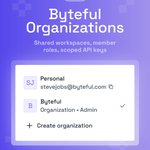
ALT Byteful Organizations launch. Shared team workspaces with member roles and scoped API keys, shown in the dashboard workspace switcher.

ALT Creating an organization gives a team its own proxies, billing and members, while your personal account stays independent.

ALT API keys can be unrestricted with full access, or fine-grained with selected permissions and an expiration date.

ALT Existing accounts are already personal workspaces, with billing, proxy users and API keys intact. Nothing to migrate.

ALT Cover slide on unlimited concurrent sessions at Byteful, and what unlimited actually means.

ALT Byteful sells no concurrency tier on residential, ISP or datacenter. You pay for data or for IPs, not for how many requests run at once.

ALT Unlimited concurrency means no tier and no plan-level cap. It does not mean no safeguards: fair use protections cover traffic that threatens network stability.

ALT Unlimited concurrency across residential, ISP and datacenter, with fair use safeguards for genuine abuse rather than normal scaling.

ALT Smartpath saved over 40% of residential data consumption on average in a Byteful test across 10,000 pages in July 2025.

ALT The test covered 10,000 real pages across Amazon, Reddit, Footlocker, ASOS, Target, Redfin, Trustpilot and Bloomberg.

ALT Smartpath assesses each request in under 10ms. Requests needing residential stay on residential; the rest route through datacenter without consuming residential data.

ALT A page loads more than its main HTML request, the routing decision happens per request in under 10ms, and savings depend on what each page actually needs.


ALT OS Targeting in beta. Append an os parameter to your proxy username to route through a Windows, Linux or Android device, on residential and mobile proxies.

ALT Cover slide for Proxy 101 episode six, on what happens when a proxy request fails and the debugging trail it leaves behind.

ALT Every Byteful response carries two debugging headers: x-byteful-status-code for what happened, and x-byteful-request-id to find the request in Live Activity.

ALT Six failure buckets on a request path. Five point to a specific cause, from credentials through to the target refusing. The sixth is a broader server or network error.

ALT TLS keeps an HTTPS target's response encrypted, so Byteful reports the failure it observed while connecting or transmitting rather than the target's own HTTP status code.

ALT Cover slide arguing that more precise proxy targeting is not always better, since every filter narrows the pool you draw from.

ALT Start at country level for the widest pool and fewest surprises. Add a narrower filter only when something actually needs it.

ALT Country level suits almost everything. City, ZIP or ASN is worth adding when content differs by location or you need a particular network or carrier.

ALT Cover slide comparing HTTP and SOCKS5 proxy protocols, framed as two protocols built for different jobs.

ALT HTTP proxies read plain HTTP requests and headers but tunnel HTTPS unread. Best for standard scraping, unsuitable for DNS, streaming or real-time protocols.

ALT SOCKS5 relays TCP connections and, where supported, UDP datagrams, without interpreting HTTP. Suits DNS, RTSP-based streaming, gaming and real-time traffic.

ALT HTTP for standard web scraping, SOCKS5 for DNS, streaming or real-time, and both supported natively when a pipeline needs each.

ALT The EWDCI Certified trust seal, a blue circular badge, on a light grey background with faint orbital rings and pixel-square texture.

ALT Byteful Quick Tip: your timeout is set off the wrong number. A 410ms timeout, the global average, is struck through. 2000ms is marked correct, since 95% of responses finish by 810ms.