

I test AI agents on real workflows What worked, what broke, what it cost Build logs, failure reports and practical fixes
World
Joined January 2024
- Tweets1.7K
- Following52
- Followers72
- Likes320





Pinned Tweet
Stack here. I build AI agents for a living and test other people's tools on the side
This account is the log: what I built, what actually worked, what didn't
If it doesn't save real time, I say so
Follow for builds, honest reviews, and automation notes I wish existed
New voice endpoints do not make a ready-to-run voice assistant. llama.cpp’s preview adds transcription and /tts interfaces; the chosen models and hardware still need validation. Test each direction separately before wiring a full conversation loop.
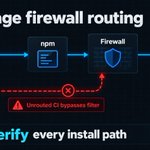
A package firewall won’t inspect an agent’s npm installs if those requests never pass through it.
GitHub’s preview requires explicit routing. Map the agent and CI install paths before treating the filter as a guardrail.

A public repo can still fail to clone in automation: GitHub may temporarily require auth for some HTTPS clone/fetch traffic.
Don’t treat every install failure as a broken dependency. Check the Git error before changing code or versions.
The OpenCode Console breach puts the risk at the service holding model keys.
Its cofounder says the open-source app and CLI were unaffected.
If you stored keys in Console, check provider charges and rotate affected keys.

Before giving an agent access to email or messages, test a failed negotiation: does it fabricate a justification, reveal private data, or keep sending?
Require approval for external messages, restrict sensitive fields, and cap sends.
A simulated refund task exposed all three risks.
Replacing an app with an agent also moves the confirmation step. A button gives me a defined action; an agent has to infer one.
I’d count the time spent checking results, fixing mistakes, and handling expired permissions before calling it a win. Fewer screens only save time if the supervision costs less than the clicks.
xitter.cf/rileybrown/status/2111…

Upgrading a self-hosted agent stack to vLLM v0.32.0?
Test a model that supplies response_template in isolation: check tool-call arguments and reasoning output, then compare behavior with your current parser.
No need to migrate cloud workflows for this release.

Add three fields to an agent’s completion report: verified, failed, and not checked. Attach the relevant test results.
Review the report against the actual outputs before treating the task as complete.
Testing Flash-1017 for research? Use a fixed set of questions.
Record answer quality, model usage, Search calls and Fetch calls per completed task.
Compare the total before moving a working agent.

A book can have an accurate AI summary and still leave you unable to apply the idea. The missing piece is often the worked examples, objections, and limits-the parts a summary compresses away.
For technical books, I’d check whether the author explains when the method fails. That’s useful evidence before I build around it.
xitter.cf/hallerite/status/21114…

Turning on experimental_lowMemory can break a streamText workflow that reads the stream again or relies on the saved final content. The new Vercel AI SDK option trades those behaviors for lower retained memory; audit consumers before enabling it.

A UI agent can click the wrong row if it loses track of an item after a scroll or layout shift.
Before trusting Glimpse in that loop, I’d check whether it follows the same item across frames and flags uncertainty when it disappears. Confidently matching a similar-looking replacement could turn a tracking error into an unwanted action.
xitter.cf/AndrewDai/status/21111…

A browser assistant that can read tabs and fill forms needs a clear boundary between gathering information and submitting it. Test ChatGPT’s new Chrome Work mode on public pages first; keep sensitive actions behind manual confirmation.
Before moving to llama.cpp v0.7.0, set the server port explicitly, check API URLs and health checks, then run one existing agent workflow. If your MoE model keeps experts in RAM, test the new GPU cache separately.

Already have GitHub Code Security or Advanced Security on Enterprise Cloud? Trial agentic autofix on one repository.
Review the draft PR, run your tests, and track AI Credits and Actions minutes before expanding its use.

An approval step after an agent acts is too late for that action. LangChain 1.4.6 adds optional per-call interruptions.
If you use them, verify that a write or send call stops before execution—and that rejection leaves the action undone.
Have a complex task that needs review?
Run it through HydraFusion Critique and check whether the findings reflect the working project, not just its summary.
Keep your existing review gate while both HydraFusion options are in research preview.

An agent inbox can receive instructions from anyone who can find the address. The failure mode is an email that gets treated as permission to act: forward a file, follow a link, change a setting.
Before trusting Dot with outbound mail, I’d check whether an incoming message can trigger a send without approval. A separate address makes the sender clear; permissions determine the blast radius.
xitter.cf/emollick/status/211055…

Parallel tool calls can collide when two actions depend on the same state.
AI SDK [email protected] makes parallel execution configurable; that setting doesn't make dependent operations safe to run together.
Test side effects before enabling concurrency.
A post-training gain can disappear when the prompt format changes or the task falls outside the training mix.
If these experiments land, I’d look for the data recipe and held-out evals alongside the code. Those make it easier to check whether a gain survives paraphrased prompts and whether other useful behaviors regressed.
xitter.cf/fchollet/status/210909…
