

23yo cs grad · pi optimization addict · building in public
Joined November 2025
- Tweets512
- Following97
- Followers141
- Likes1.5K







cagan retweeted

Analytics that sees everything but your visitors' names.
Introducing invisit. No cookies, no fingerprinting, no consent banner. And you still get the full picture:
- Realtime visitors on a live globe
- Traffic from ChatGPT, Claude, Gemini
- Which crawlers are reading your site
- Revenue next to the traffic that earned it
- Funnels, heatmaps, web vitals
- Short links with routing rules and custom domains
- Search Console queries, alerts, API and MCP
Free forever with 20,000 events a month, 10 short links. Your data is kept forever, on every plan. No card required.





made an openrouter-compatible fork of fast-jev-compaction (made by @tamarajtran), the claude code plugin that drops stale tool calls with jev instead of summarizing
no need to top up $5 on typesafe separately, works with your existing openrouter key 👇🏻
github.com/cgngtr/fast-jev-c…


found the perfect use case for @typesafeai Jev:
instant compaction
in 2026, why is compaction still a summarization prompt?
Jev can make it instant by scoring every tool call and dropping what’s irrelevant
4
361
cagan retweeted

You should be able to use smarter models in your agent.
You should be able to use cheaper models in your agent.
You should be able to use local models in your agent.
You should be able to use a different model for every job.
You should be able to switch models in the middle of a conversation.
You should be able to choose what data your agent has.
You should be able to choose what it remembers and what it forgets.
You should be able to choose what computer your agent runs on.
You should be able to run it on a machine that never touches the internet.
You should be able to run it while your laptop is closed.
You should be able to reach it from the apps you already use.
You should be able to choose how your agent thinks.
You should be able to read the prompt it runs on.
You should be able to see every tool it has, and turn off the ones you don't want.
You should be able to teach it something once and never explain it again.
You should be able to know what it did, and when, and why.
You should be able to export your agent.
You should be able to read the code.
You should be able to change the code.
Your agent should be yours.
WHY?
why are we doing this? why are we LYING CONSTANTLY?

Announcing dots. Dots work 24/7 for you, learn from your feedback, have their own computer, browser and can be connected to over 4k apps in our ecosystem.
They’re powered by Astra our best model yet. Included in your Pro plan, without drawing down on any of your usage. You can even call a dot while it’s working.
We’re getting you started with your primary dot today and soon you’ll be able to create entire teams of them.
1
1
76
same prompt, four models, one shot each: animated pixel art wizard, single html file, no libraries.
sonnet 5.5: 12.8 min, $1.71
opus 5.5: 11.4 min, $2.17
gpt 6.1 sol: 6.9 min, $0.45
gpt 6 astra: 5.9 min, $2.31

gave sonnet 5.5 and opus 5.5 the exact same detailed prompt: animated pixel art wizard, canvas 2d, 128x96, fixed palette, particle pool, no libraries.
sonnet 5.5 → ~12.8 min, 105k output tokens, ~$1.71 est.
opus 5.5 → ~11.4 min, 68k output tokens, ~$2.17 est.
prompt below.
1
302
anthropic hasn’t even solved token efficiency yet. imagine opus with openai-level token efficiency… it would be over.

32
gave sonnet 5.5 and opus 5.5 the exact same detailed prompt: animated pixel art wizard, canvas 2d, 128x96, fixed palette, particle pool, no libraries.
sonnet 5.5 → ~12.8 min, 105k output tokens, ~$1.71 est.
opus 5.5 → ~11.4 min, 68k output tokens, ~$2.17 est.
prompt below.
Create a single self-contained HTML file that renders an animated pixel art wizard casting a spell, using vanilla JavaScript and Canvas 2D. No external assets, libraries, or network requests.
RENDERING
- Draw everything to an offscreen canvas at a fixed logical resolution of 128x96, then blit to a fullscreen display canvas scaled by the largest integer factor that fits the window, centered, with imageSmoothingEnabled = false and CSS image-rendering: pixelated.
- All drawing snaps to integer coordinates on the logical canvas. No sub-pixel positions, anti-aliasing, gradients, or shadowBlur.
- Fixed palette of ~24 hex colors: deep blues/purples for night sky, warm robe tones, 3-4 bright magic colors. Every pixel comes from this palette.
CHARACTER
- Build the wizard procedurally from filled rects and pixel runs, ~24x32 logical pixels: pointed hat with a bend, long beard, two-shade robe with darker outline, staff with a gem at the tip.
- Parameterize the pose (staff angle, arm raise, head tilt, robe sway). Animate parameters smoothly, then quantize to the pixel grid each frame so motion reads at an 8-12 fps pixel animation feel even though the loop runs at 60fps.
ANIMATION
- Looping state machine: IDLE (2-frame bob, beard sway) -> CHARGE (staff raises, gem flickers, sparks spiral inward) -> CAST (bright burst, projectile fires across the scene, 1-2 pixel screen shake) -> RECOVER (settle back). Ease pose parameters between keyframes.
- Pooled allocation-free particle system: preallocate and reuse. Sparks orbit the gem during CHARGE, explode outward on CAST, each particle stepping its palette index from white to magic color to dark before despawn. Snap particle positions to the grid when drawing.
- Fixed 60hz timestep update with rAF rendering. Zero object allocation inside the loop.
SCENE
- Minimal background: dark sky, a few twinkling 1px stars, moon, stone floor line. Character silhouette must read clearly.
- Subtle 1px rim light on the wizard from the gem, brightening during CHARGE and CAST.
QUALITY BAR
- Crisp pixels at any window size, seamless loop, stable 60fps, readable silhouette. Should look like a polished 16-bit sprite animation, not vector shapes scaled down.
207
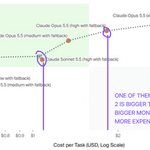
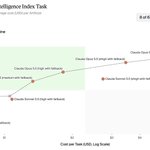
here's the worst part: pareto efficiency is completely broken for sonnet.
intelligence differs by A LOT.
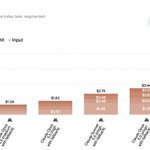
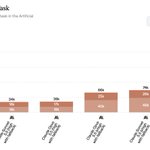
to achieve the same ~56 intelligence index score of opus 5.5 (xhigh):
- opus 5.5 (xhigh) costs you $3.46
- sonnet 5.5 (max) costs you $7.60
you have to push sonnet to max effort just to match opus at xhigh, and it ends up costing ~120% more.

1
70