

Build Alpha Trading Software creates, tests and codes trading strategies with the click of a button. Demos: https://xitter.cf/t.co/kF5Niev0Wg
Boca Raton, FL
Joined January 2017
- Tweets3.3K
- Following0
- Followers8.4K
- Likes863






I am convinced prop firm trading is an entirely different ballgame than trading cash accounts.
Traditional metrics like Sharpe, smooth equity curves and low max drawdown aren’t what you should be optimizing for to maximize prop payouts.
I actually added new fitness functions to find more prop firm compatible strategies
-probability of passing eval
-probability of first payout
-expected return per attempt
It is best to think of prop evals as a call option.
The option premium is the fee
The max loss is the fee
And the upside is essentially unlimited payouts
Options love volatility. Why are you trading the eval like it’s your retirement account?
The best strategy for your own capital is often the wrong one for an eval. Totally different games.
You may not even want the same strategies to pass the challenge as the ones you'll trade once funded.
That's why the prop firm simulator can sort by these different metrics.
I'll be showcasing more of it later this week with a full write up.
if you're new to this math or curious about the details I gave two examples last week (below) and will share more this week
xitter.cf/buildalpha/status/2109…
xitter.cf/buildalpha/status/2110…

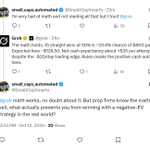
This prop firm math post was pretty controversial despite providing the math 🙃
So I couldn't resist ha! here's prop firm math part 2
47 unsuccessful attempts. 3 payouts. Still profitable.
Consider LucidFlex 50K, assuming a $105 evaluation price.
50 attempts over time would cost:
50 × $105 = $5,250.
Suppose just 3 eventually reach one maximum $2,000 payout request.
After the 90/10 split, you receive $1,800 per payout:
3 × $1,800 = $5,400
$5,400 received
$5,250 spent
+$150 (before other costs).
The other 47 attempts fail and produce nothing.
6% (3/50) reach a max payout while 94% lose.
For this simplified one-payout model there is an
Expected profit per attempt =
Probability of reaching payout × $1,800 − $105.
So break-even is approximately 5.83%
The question is, do you think you can build strategies or (better yet) a portfolio of strategies that get to one payout 6% of the time? If so, you print.
150 on 5250 invested is 2.86% return. If you run this every month, you're north of 30% per year while failing 94% of challenges. Uncomfortable? Yes. Profitable? Yes. That's usually how trading works.
These prop firms are mostly math. Many traders build one strategy, fail and claim it is a scam. Turn the odds in your favor by understanding your numbers.
More on the BA prop simulator soon..
A weekend read with some real data and ideas to test.
A simple mean reversion strategy in SP500 that buys when price closes in the bottom 20% of the day's range and sells when price closes in the top 80% of the day's range.
Look at the impact a market regime filter can have.
Big jump in average trade and big reduction in time in market. A great candidate for a position sizing scaler (covered in the article below)


ICYMI full write up on detecting and using market regimes in your trading
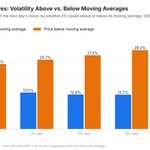
Stat of the day: check your moving averages

I have to block some people on here because they just repurpose my content. Shameful. What can you do. Mostly “gurus” with 18 months experience talking like experts 😆. Careful out there.
This prop firm math post was pretty controversial despite providing the math 🙃
So I couldn't resist ha! here's prop firm math part 2
47 unsuccessful attempts. 3 payouts. Still profitable.
Consider LucidFlex 50K, assuming a $105 evaluation price.
50 attempts over time would cost:
50 × $105 = $5,250.
Suppose just 3 eventually reach one maximum $2,000 payout request.
After the 90/10 split, you receive $1,800 per payout:
3 × $1,800 = $5,400
$5,400 received
$5,250 spent
+$150 (before other costs).
The other 47 attempts fail and produce nothing.
6% (3/50) reach a max payout while 94% lose.
For this simplified one-payout model there is an
Expected profit per attempt =
Probability of reaching payout × $1,800 − $105.
So break-even is approximately 5.83%
The question is, do you think you can build strategies or (better yet) a portfolio of strategies that get to one payout 6% of the time? If so, you print.
150 on 5250 invested is 2.86% return. If you run this every month, you're north of 30% per year while failing 94% of challenges. Uncomfortable? Yes. Profitable? Yes. That's usually how trading works.
These prop firms are mostly math. Many traders build one strategy, fail and claim it is a scam. Turn the odds in your favor by understanding your numbers.
More on the BA prop simulator soon..
Prop firm math is CRAZY. A losing strategy can become a winning strategy under a prop firm structure.
Imagine a strategy that:
• Wins $200 on 90% of days
• Loses $2,000 on 10% of days
Trading your own capital, its expected daily P&L is:
90% × $200 − 10% × $2,000 = −$20 ❌
Now imagine a hypothetical prop arrangement:
• $100 total fee per attempt
• Five winning days to pass the evaluation
• Five more winning days in the funded account to receive an $800 cash payout
• Any losing day closes the account
• No additional costs or payout restrictions
Assuming independent daily outcomes, the probability of reaching that payout is:
90%^10 = 34.9%
Your personal cash outcomes become:
• Reach payout: $800 − $100 = +$700
• Fail before payout: −$100
Expected profit per attempt:
34.9% × $800 − $100 ≈ +$179 ✅
The strategy has negative trading expectancy, but this hypothetical "prop" contract gives the trader positive cash expectancy.
Why? Because you absorb the evaluation fee instead of the strategy’s full trading losses. This opens up what strategies and portfolios can look like.
It is a completely different design and optimization problem for strategy and portfolio development.
This week I will be sharing more about the prop firm simulator I've built and what it can do.
Build Alpha retweeted

This man is gathering all the infinity stones and been COOKING!
Definitely tuned in for this. Thank you for sharing!
A pretty backtest is not evidence of edge.
Search enough combinations, randomness will eventually produce something that looks amazing.
Jaffray Woodriff of QIM discussed this idea in his chapter, The Third Way, in Hedge Fund Market Wizards: don’t just ask whether your strategy looks good but ask whether it looks better than what luck can produce.
That’s the idea behind the Vs Random Test.
Can your strategy beat the best random result? if you're going to data mine or use ai to find strategies this is a requirement.
Because if random signals produce the same Sharpe, P&L/DD, profit factor, or whatever metric you optimized for, then your beautiful equity curve may just be the winner of a noise lottery.
Backtests are easy to make impressive now. Beating luck is harder.

Prop firm math is CRAZY. A losing strategy can become a winning strategy under a prop firm structure.
Imagine a strategy that:
• Wins $200 on 90% of days
• Loses $2,000 on 10% of days
Trading your own capital, its expected daily P&L is:
90% × $200 − 10% × $2,000 = −$20 ❌
Now imagine a hypothetical prop arrangement:
• $100 total fee per attempt
• Five winning days to pass the evaluation
• Five more winning days in the funded account to receive an $800 cash payout
• Any losing day closes the account
• No additional costs or payout restrictions
Assuming independent daily outcomes, the probability of reaching that payout is:
90%^10 = 34.9%
Your personal cash outcomes become:
• Reach payout: $800 − $100 = +$700
• Fail before payout: −$100
Expected profit per attempt:
34.9% × $800 − $100 ≈ +$179 ✅
The strategy has negative trading expectancy, but this hypothetical "prop" contract gives the trader positive cash expectancy.
Why? Because you absorb the evaluation fee instead of the strategy’s full trading losses. This opens up what strategies and portfolios can look like.
It is a completely different design and optimization problem for strategy and portfolio development.
This week I will be sharing more about the prop firm simulator I've built and what it can do.


The last week or so I’ve covered four different signals and filters for context-aware systematic trading. Here’s a recap for wknd readers.
Gamma Exposure: option market maker positioning. Dealers will quiet directional price moves when long gamma and will extend directional price moves when short gamma.
Commitment of Traders Report: understand how different players are positioned. Large speculators are net long and retail is net short is different than large specs net short and retail extremely bullish.
Market Breadth: what’s going on under the hood. Is this rally well supported or only due to a few names. Will there be follow through?
Event Conditioned signals: sequence matters. If last hour yesterday rallied hard, what does that mean for today’s open? How we got here is as important as where we are.
Links in the comment for full explanation and example signals you can test.
If you like this type of content let me know with a comment. I have more haha

GEX: BuildAlpha.com/gamma-exposur…
COT: buildalpha.com/commitment-of…
Market Breadth: BuildAlpha.com/market-breadt…
Event Conditioned Signals: BuildAlpha.com/event-conditi…

Markets have memory. Most signals pretend they don’t.
A Football score of 21–17 means nothing by itself. It matters whether the team down 17–0 just scored three straight TDs, or was up 21–0 and is collapsing.
Same with price.
Strong last hour yesterday → does the first hour follow through?
Above VWAP at noon → does that hold into the close?
Unusually large opening range → do breakouts actually continue?
A signal conditioned on an earlier event is a different signal.
Treating every bar as independent throws info away.
I wrote about 168 event conditioned signals and how to think about (and test) market memory.
Markets have memory. Most trading signals don’t.
The same signal can mean something completely different depending on what happened earlier in the session.
And what happened earlier changes what happens next.
Think of a football game's score. 21–17 tells you the state of the game. It matters if the team down 17–0 has just scored three straight touchdowns, or was ahead 21–0 and is collapsing.
That’s the idea behind event-conditioned signals. A trading signal conditioned on an earlier event.
Examples:
• Yesterday’s last hour was strong → does today’s first hour follow through?
• Opening range closed higher → does the last hour tend to rally?
• Price was above VWAP at noon → does that strength persist into the close?
• Today’s opening range is unusually large → are breakouts more likely to continue?
I've added a ValueWhen function that stores what happened at a specific time or event, then we can use that information later or even the next session.
Available in the custom editor and the prompt to signal feature.
This greatly expands the types of signals and strategies possible.
I put together 168 ready-made event-conditioned signals covering:
• Last-hour behavior
• Opening-range behavior
• VWAP checkpoints
• Open / ORH / ORL relationships
• Body-to-range ratios
• High/low-of-day structure
Then you can mix them with Build Alpha’s other built-in signals and/or your own custom signals and let Build Alpha + AI test which combinations actually survive validation.
The more context your strategy has the more robust it can be.

Build Alpha retweeted

I really like the football analogy, it perfectly explains how conditioning on different events can uncover useful variations and build genuinely interesting systems off them. Please drop more sauce like this 👏
Would you consider adding more events/features to the signal search?
Build Alpha retweeted

Edge leakage since 2017 and you all still dont understand. This is so good.
Markets have memory. Most trading signals don’t.
The same signal can mean something completely different depending on what happened earlier in the session.
And what happened earlier changes what happens next.
Think of a football game's score. 21–17 tells you the state of the game. It matters if the team down 17–0 has just scored three straight touchdowns, or was ahead 21–0 and is collapsing.
That’s the idea behind event-conditioned signals. A trading signal conditioned on an earlier event.
Examples:
• Yesterday’s last hour was strong → does today’s first hour follow through?
• Opening range closed higher → does the last hour tend to rally?
• Price was above VWAP at noon → does that strength persist into the close?
• Today’s opening range is unusually large → are breakouts more likely to continue?
I've added a ValueWhen function that stores what happened at a specific time or event, then we can use that information later or even the next session.
Available in the custom editor and the prompt to signal feature.
This greatly expands the types of signals and strategies possible.
I put together 168 ready-made event-conditioned signals covering:
• Last-hour behavior
• Opening-range behavior
• VWAP checkpoints
• Open / ORH / ORL relationships
• Body-to-range ratios
• High/low-of-day structure
Then you can mix them with Build Alpha’s other built-in signals and/or your own custom signals and let Build Alpha + AI test which combinations actually survive validation.
The more context your strategy has the more robust it can be.
Full write up with custom signals: buildalpha.com/event-conditi…
YouTube video: youtu.be/k4eicVLj2V0?si=kO8N…