

The Committee for a Responsible Federal Budget is a nonpartisan group of budget experts concerned about this nation's fiscal future. https://xitter.cf/t.co/e8R4vf8v9S
Washington, DC
Joined January 2010
- Tweets34.1K
- Following4.5K
- Followers21.2K
- Likes5.4K




Pinned Tweet
☑️Objective. ☑️Nonpartisan. ☑️Committed to Fiscal Responsibility.
Follow the Committee for a Responsible Federal Budget for our latest analysis of what's shaping the fiscal conversation in Washington.
🔗crfb.org/ | 📲@BudgetHawks
💡How do we solve the affordability crisis?
In a new series by @POLITICOMag on 26 ideas for solving the affordability crisis, Victoria Guida (@vtg2) points to controlling the deficit as a way to bring down costs.
As this piece notes, focusing on fiscal responsibility is key to improving affordability. Our recent analysis breaks down how reducing the deficit can help tackle affordability issues and make life less expensive for Americans. Click here to learn more 👉 crfb.org/papers/deficit-redu….


From @POLITICOMag: 26 Ideas for solving the affordability crisis
Some smart. Some practical. Some far-fetched or utterly implausible. All on the table.
Read the full list: politi.co/4jtk25A
+ A few ideas from the special issue🧵👇
🎨 Darya Semenova

🚨Charitable Deduction Reform Could Raise Revenues and Increase Giving
We estimate reforms to charitable tax deductions could generate $20 billion while increasing giving, or $115 billion with little impact on giving, based on a new study from the @TaxPolicyCenter.
As a result of the OBBBA, there are currently three major charitable tax deductions with different sets of rules. These include:
1️⃣an itemized charitable deduction, with a 0.5% of AGI floor on what giving is deductible
2️⃣an above-the-line deduction, capped at $1,000 per year ($2,000 for married) with no floor
3️⃣a corporate charitable deduction with a 1.0% of AGI floor.
CRFB board member @EugeneSteuerle, @Rob_McClelland, and Nikhita Airi of the @TaxPolicyCenter propose merging the two individual deductions into a single Universal Charitable Incentive (UCI) – an uncapped above-the-line deduction with a single percent-of-AGI floor.
Using TPC’s estimates as a starting point and applying the same floors to corporations, we estimate a UCI with a 1.5% of AGI floor could generate $20 billion over a decade while substantially increasing individual charitable giving by improving the marginal incentive to give, and a 2% of AGI floor would generate $115 billion with little net impact on individual giving.

🚨 Between FY 2001 and FY 2025, the country went from running a 1.2% of GDP surplus to a 5.8% of GDP deficit. #DebtFacts
🎙️ ICYMI: The Committee’s SVP and Senior Policy Director @MarcGoldwein joined the We’ve Got to Talk Podcast with hosts Nicole Fonarow and Jolene Conway to discuss the current fiscal outlook of the nation. Throughout the interview, Marc covered a variety of issues including the state of our debt and deficits, effects of rising interest, looming trust fund insolvency, and potential options for reform.
The bottom line: the US is in the worst financial shape it's ever been...
Click here to watch the full interview 👉 youtube.com/watch?v=PH8naCqa….

🚨NEW: High Inflation Drives 3.6% Social Security COLA
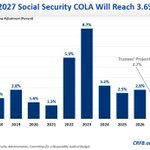
Social Security beneficiaries will receive a 3.6% cost-of-living adjustment (COLA) in 2027, based on today’s inflation data. This COLA will be 0.8 percentage points higher than last year’s 2.8% COLA and 0.9 percentage points above what the Social Security Trustees recently projected.
With Social Security’s retirement fund less than six years away from insolvency, action will be needed soon to prevent a 22% benefit cut that could wipe out the previous nine years’ worth of COLAs all at once in 2032.

🚨GAO: Up to $304 Billion in Tax Fraud Annually
Tax fraud costs the federal government between $116 billion and $304 billion each year, according to a recent analysis by the @USGAO using data from 2018 through 2024. Those amounts constitute 2% to 6% of all tax revenue owed to the federal government if applied to tax year 2022.
Assuming the higher end of GAO’s estimate, this means annual revenue loss due to tax fraud is larger than all tax expenditures except for the exclusion for retirement savings and pension contributions. Even assuming the lower end of GAO’s estimate, revenue loss due to tax fraud would be larger than all but four tax expenditures.
Click here to learn more ➡️ crfb.org/blogs/gao-304-billi….

🚨 If interest rates average 50 basis points above CBO projections through 2036, deficits would grow by nearly $2 trillion. #DebtFacts
🚨BREAKING: CBO Estimates $2.0 Trillion Deficit for Fiscal Year 2026
The United States borrowed $2.0 trillion in FY 2026, including $28 billion in the month of September, according to the latest Monthly Budget Review from the @USCBO. We expect to hear more details on FY 2026 from CBO next month.
The following is a statement from CRFB President @MayaMacGuineas⤵️

🚨CBO Estimates Golden Dome Could Cost More than $1 Trillion
Earlier this year, the @USCBO released an analysis estimating the 20-year cost of a National Missile Defense (NMD) system based on President Trump’s 2025 executive order, titled “The Iron Dome for America,” which outlines the basic capabilities and requirements of such a system.
While the Administration has not released further details regarding the architecture or components of the NMD system they’re now calling Golden Dome for America, CBO estimated that an illustrative system designed to meet all of the objectives and requirements laid out in the President’s executive order would cost roughly $1.2 trillion to build, operate, and maintain over a 20-year period.

Click here to learn more about the cost of the Golden Dome for America➡️crfb.org/blogs/cbo-estimates….

🚨 NEW: PWBM Shows Social Security Solvency Would Improve Fiscal Outlook, Boost Growth
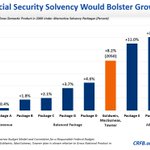
Restoring solvency to the Social Security trust funds could grow the economy and help fix the debt, according to recent estimates of different Social Security solvency packages from Penn Wharton @BudgetModel (PWBM).
PWBM estimates the seven Social Security solvency packages they analyzed would increase 2060 GDP by anywhere from 0.4% to 12.1% and reduce the debt-to-GDP ratio by 14% to 27% in that year.
Click here to learn more about the analyzed solvency packages and estimates ➡️ crfb.org/blogs/pwbm-shows-so….

🚨 The growth in the debt-to-GDP ratio over the last quarter century is responsible for an estimated 1.5% of interest rates. #DebtFacts
📝 ICYMI: Yesterday, former Representative and Governor of Ohio, and current CRFB Board Member, @JohnKasich published an opinion piece for his Substack “Keep Faith America” breaking down his long experience working on fiscal policy, where his mission to balance the budget began, and what made past efforts successful. Importantly, he also writes on how to answer the most important question: how could Washington do it again?
Click here to read the full piece 👉 johnkasich.substack.com/p/ba….
🚨 NEW: U.S. Ran a $2 Trillion Deficit Last Year
Fiscal Year (FY) 2026 ended yesterday. Although official figures have not yet been released, our preliminary estimates show high and rising deficits and debt. For FY 2026, we estimate:
➡️ A budget deficit of $2.0 trillion, or 6.2% of GDP.
➡️ Debt held by the public of $32.3 trillion, or 100% of GDP.
➡️ Spending of $7.4 trillion, or 22.9% of GDP.
➡️ Revenue of $5.4 trillion, or 16.7% of GDP.
➡️ Interest costs of $1.1 trillion, a record 3.4% of GDP.
➡️ Interest was the second largest line item in the budget, costing more than defense or Medicare.
At $2.0 trillion, we estimate budget deficits were about $210 billion above FY 2025 levels, $135 billion above the @USCBO February projections, and about $305 billion higher than what the Council of Economic Advisers had projected.

Learn more about our estimates here 👉 crfb.org/blogs/us-ran-2-tril….

CRFB.org retweeted

🚨A new fiscal year begins with our national debt exceeding $40 trillion. Congress must act now.
The Problem Solvers Caucus has endorsed bipartisan solutions to stabilize the debt, balance the federal budget, and better prepare for future emergencies.
Republicans and Democrats must advance these proposals and put our country on stronger financial footing. Further delay will only leave future generations with a larger bill.
problemsolverscaucus.house.g…
