

Concentrated public-markets investor. Weekly research on exceptional businesses. ↓
Joined September 2014
- Tweets1.4K
- Following133
- Followers11.4K
- Likes96





Pinned Tweet
$GE sells the engine once. The economics can last for decades.
GE Aerospace has roughly 50,000 commercial engines installed globally. Those engines can stay in service for decades, generating parts, maintenance, repairs, and shop-visit revenue.
That installed base is what makes the business interesting to me.
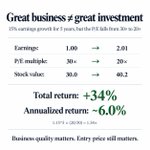
But a great business isn’t automatically a great investment. Price still matters.
I wrote up the moat, economics, risks, and valuation here:
therobbenletter.com/p/ge-aer…
This is how I think about business quality, valuation, and risk.

Owning real estate and public businesses overlap more than they look.
Most options in both are mediocre. Good Airbnb location gets better guests, they pay more and cause less trouble. Extra cash lets you improve the place, which gets even better guests. Marketing speeds it up when the spot is already strong. When it isn’t, more attention just means more problems.
Same idea in public markets. Durable business throws off cash you can put back into making it harder to leave. I underwrite whether that keeps going. Not selling is what lets the compounding and the tax advantage both work.

The intensity that matters in investing is understanding which few businesses are actually durable and then holding them.
Constant activity in mediocre industries just creates taxes and new mistakes.
Compounding and the tax advantage of not selling both require the underlying thing to last. Most don’t.
S&P Global guides $17.50 to $17.75 adjusted EPS this year.
At my $400 cost I am paying about 23x the midpoint for a business that should compound earnings at double digits for years. I will take that trade. (I own $SPGI)
There are whole industries I just don’t spend time on anymore.
Not because they never get cheap. It’s that the quality doesn’t really compound. Once I realized that, the cheapness stopped mattering as much.
I’ve made exceptions. Early on I’d still take a few of them when the valuation looked stupid. Returns were usually fine for a year or two. Then the same issues the original work had already flagged would show up, and the multiple would compress on top of it.
After a couple of those I mostly stopped.
I like the economics of $MCO and $SPGI.
If you're raising billions in debt, you're not shopping around for the cheapest credit rating. You need one investors will accept.
That gives these firms pricing power that's difficult to replicate. Regulation only reinforces it.
AI could lower their costs without putting much pressure on fees.
The businesses are cyclical, but their competitive positions are hard to displace. The risk is paying too much for that durability.
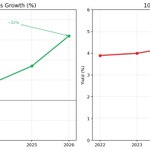
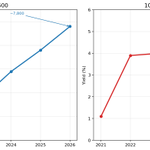
FactSet expects around 32% S&P 500 earnings growth in 2026. The 10-year yield is above 5%.
Valuations have compressed. The market’s gains have come almost entirely from profits.
via FactSet / FRED

AI risk on S&P Global?
A language model can summarize a bond issuer. It won't create market acceptance for an official credit rating or replace the benchmark behind trillions in indexed assets.
Data plus embedded workflows wins. (I own $SPGI)
The people who are actually good at investing are often not the best at looking good while they do it.
The ones who look the best are usually focused on looking good instead of on the actual investing.
Most of the alpha in public markets comes from owning a small number of exceptional businesses and doing nothing.
High returns on capital, pricing power, and a durable competitive position compound far more reliably than constant portfolio turnover or elaborate risk systems. The real edge is identifying those businesses early and having the conviction (and the capital structure) to hold them for a decade or more while the market frets about the next quarter.
Everything else is usually just activity that reduces after-tax returns and introduces new ways to be wrong.
Owning businesses has taught me not to get too excited about impressive financial returns.
A company can report a 25% return on equity, but if it takes a mountain of debt to get there, I'm not impressed.
I'll take a business earning 15% with little debt and decades of room to reinvest.
How those returns are generated matters a lot more to me than the headline number.
Raising prices isn’t the hard part.
The hard part is raising them without the gains leaking out through churn, volume declines, discounts, or other concessions.
New piece on what I actually look for when a company claims pricing power:
therobbenletter.com/p/pricin…
A few questions I come back to when looking at a company:
1. Is demand for the product likely to be substantially higher ten years from now?
2. Does the company have enough differentiation to raise prices over time?
3. What prevents a well-funded competitor from recreating what it has?
4. Can management reinvest capital at attractive returns?
5. What could permanently change the economics?
6. What return am I likely to earn from the price available today?
I have found that getting the first five right makes the list of interesting companies pretty small.
Number six tells me if I'm going to own the stock.
$ICE has reported record annual revenue for 20 consecutive years. In 2025, net revenue reached $9.9 billion, adjusted operating margin was 60 percent, and adjusted free cash flow reached $4.2 billion, up 16 percent.
The company clearly generates plenty of cash. The question is how much of that cash should go toward acquisitions, debt reduction, repurchases, and dividends. With MarketAxess coming, I would put debt reduction ahead of aggressively increasing buybacks.
This is where founder-led capital allocation matters. Jeff Sprecher built ICE around electronic energy trading and has spent more than two decades expanding through acquisitions: the NYSE, Interactive Data, Ellie Mae, Black Knight, and now MarketAxess. That has created enormous value historically. It also means acquisition discipline matters more here than it does at a company that simply returns every excess dollar to shareholders.
This is where I care less about whether an acquisition is immediately accretive and more about whether the acquired asset becomes more valuable inside the existing network. The skill is not buying businesses. The skill is buying infrastructure that becomes more valuable inside ICE than it was on its own. MarketAxess will be another test.
The biggest question for me is capital allocation, and the answer is not in the press release. Let's see what the next two years of debt reduction and integration look like.
Disclosure: I own shares of Intercontinental Exchange.
The 10-year yield has more than quadrupled since early 2021. The S&P 500 is still up more than 100%.

Most investors chase growth and stories.
I look for barriers to entry and whether the product is essential.
Growth with no barriers is a trap. Airlines grew for 100 years and never made money. It keeps happening.
I own businesses with multiple reinforcing barriers (IP, installed base, regulation, switching costs) plus pricing power and demand that doesn’t vanish over night. High returns on capital that last.
Good companies stay good. Bad ones stay bad. That’s why I hold for years. I act like an owner.
Risk isn’t volatility. It’s not knowing what you own and why the advantages will still be there in 10 or 20 years.
Everything else is noise.
I own a small number of global monopolies and duopolies. If the barriers aren’t obvious, I pass.
I used to spend more time looking for cheap stocks. Now I spend much more time looking for businesses I want to own for years.
An average business at 8 times earnings may stay average. Why do I want to own an average business that can get worse?
A great business at 25 times earnings can prove cheaper if earnings compound for a decade.
Valuation always matters, every time. But I personally start with business quality and then wait for a price with an attractive return. I don't need to own every company.
Running businesses taught me that not all growth is good growth.
Anyone can grow revenue by spending more money.
What's rare is a business that can raise prices, retain customers, and reinvest profits at high returns year after year.
Find enough of those businesses, buy them at sensible prices, and give them time.
That's the kind of investing I want to spend the next 30 years doing.
This week's Robben Letter: Intercontinental Exchange. Everyone knows it owns the NYSE. That is not why I own the stock.
The networks behind it are the business: exchanges, clearing, energy benchmarks, fixed-income data, mortgage software. therobbenletter.com/p/ice-ex…
Disclosure: long $ICE.

Public markets are strange.
Everyone says they want to own great businesses for a long time.
Then the stock falls 20%, the headlines get ugly, and suddenly their time horizon becomes 20 minutes.
The edge is often simpler: own a small number of exceptional businesses, know them deeply, and be willing to look wrong for a while.