

Product & GTM veteran; pursuer of cooking, history, and gardening. AI for productivity, automating workflows & prototyping. GitHub: enalbenerraw
Research Triangle
Joined July 2007
- Tweets14.1K
- Following862
- Followers1.9K
- Likes1.5K






Pinned Tweet
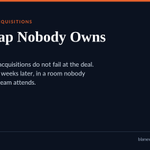
Most product acquisitions do not fail at the deal. They fail three weeks later, in a room nobody from the deal team attends. 🧵

Later is not free. Two unmerged roadmaps fight for the same engineering time. Two GTM teams tell different stories. The acquired team reads the silence as a signal, and the strongest people update their resumes first. The conversation shifts from integration to lost momentum.
Five levers close the gap: ownership, a unified vision, roadmap convergence, positioning stability, people integration. None require a reorg or a new budget. They require an owner and a sequence.
Full framework, and the free 90-day PDF: blanewarrene.substack.com/p/…

Stop guessing what to plant and when. Tell the AI your USDA hardiness zone, and this kit of five scaffolded prompts builds your whole year, customized to where you actually garden.
Inside the kit:
Annual Planting Calendar prompt — month-by-month, keyed to your zone
Companion Planting prompt — what to pair and what to separate
Organic Fertilizing prompt — a feeding plan without synthetic inputs
Pest Management prompt — an integrated, low-spray defense
Season-Shift prompt — how to roll beds from spring to summer to fall
How it works:
Copy a prompt, paste it into Claude, ChatGPT, or Gemini
Type your USDA zone (and your beds, if you want)
Get a plan written for your conditions, not a generic printout
Works for any zone, any raised bed, or in-ground plot. Includes a quick-start guide so your first plan comes out right.
zone8a.com/kit/

Get the Zone-Smart Companion Garden Planting Prompt (Free) on @Gumroad enerrawen.gumroad.com/l/jmlw…

Blano retweeted

I’m in a text group with 30 AI-pilled enterprise executives.
Someone in the group asked: “What is the highest ROI AI use case/initiative in your business?”
There were a ton of great answers, but mine was the 10x leverage engineers are getting from coding agents.
A group member asked me to explain what I meant. So I slacked two of our engineering leaders and said “Why are you guys so cracked?”
Here’s what one of them (@dan_zakon) said:
Software engineering is becoming more unrecognizable every day.
Historically, detailed system architecture planning was expensive and rarely done. “Agile development” became the industry buzzword to justify not planning upfront. Even the strongest engineers could not hold the whole file structure, code conventions, dependencies, edge cases, and product requirements in their head at once.
Now we spend 95% of the time and effort planning and 5% executing.
Over the past year at @tenex_labs, we’ve built custom tooling for structured engineering context that self-improves. It gives agents instant access to things like product intent, architecture, conventions, delivery workflows, and plans.
With this process, we use agents to map out whole systems far in advance with a level of coherence that used to be impossible.
Then the system can almost assemble itself. Long-running agents execute against the plans, implement scoped work, adhere to conventions, run tests, fix issues, update GitHub, sync Linear, refresh documentation, and revise the original plans as progress is made.
The result is a fundamentally different operating model for engineering.
Across Tenex, we are consistently proving it with small teams that are building complex, ambitious products in months.
Work that used to require huge teams, multi-year timelines, and massive coordination overhead is now becoming the baseline for what small, elite engineering teams can take on.
I turned one season of our Zone 8a garden into software.
One 4x8 bed, run as a relay: spring spinach, then nitrogen-fixing summer beans, then fall and winter brassicas. Each crop feeds the next. (We'll add the remaining five beds and hoop house across the summer.)
Built with Astro, shipped on Cloudflare's edge. Why I did it, and why it transfers to other ideas to capture and share knowledge interactively:
blanewarrene.com/2026/06/26/…

There is a technical reality about AI tools like Claude that is well documented in developer circles but almost never discussed in a business context.
Long threads degrade.
Not dramatically. Not with an error message. They just quietly get less precise over time as the conversation grows beyond what the model can hold in sharp focus. Early context gets compressed. Conflicting inputs create silent noise. You get responses that feel slightly off, and you blame the tool.
The architecture that solves this exists. Leverage Projects. But most business professionals haven't heard it framed that way.
I learned this the hard way on a board-level strategic project.
Months of research, financial modeling, scenario analysis, and stakeholder input were woven into a single running thread. It was productive. By the time I was deep into the work, I had a context problem I could not see — the thread was carrying too much history with too little structure. Early decisions were getting compressed. Later responses were subtly less grounded than they should have been.
The fix was straightforward once I understood it. A Claude Project acts as a persistent, curated memory that loads fresh with every session. Instead of one bloated thread accumulating noise, you maintain a clean instruction layer — your master brief — and run focused sessions inside it.
The pattern applies across many scenarios beyond board projects. It is highly effective for:
➡️ An ICP research and market pursuit — iterating on customer profiles, competitive positioning, and outreach sequences over weeks — has the same architecture problem and the same solution.
➡️ An executive CxO job search with multiple companies in play, each with its own stakeholder maps and positioning thesis, should never live in one thread.
The principle is simple: every long-running engagement has a natural information architecture. The tool you use should reflect that structure.
Most people are not doing this yet. Not because they are using Claude wrong, but because this architecture was not clearly visible.
If you are running any high-stakes, multi-session work in Claude, it is worth ten minutes to understand how Projects change the quality of what you get back.
Happy to share the migration runbook if it's useful. Shoot me a DM.
Great news!

Apple just made Docker Desktop optional on Mac.
And it is completely free.
This is apple/container. 26.5k stars no Github.
You can now run Linux containers natively on your Mac without installing Docker Desktop, without a background daemon hogging your RAM, and without paying $21 a month per developer for a commercial license.
Here is what it does:
→ Runs Linux containers as lightweight VMs directly on Apple Silicon using macOS 26 virtualization
→ Fully OCI compatible. Pull any image from Docker Hub, GitHub Container Registry or anywhere else
→ Written in Swift and optimised specifically for Apple Silicon. Faster and lighter than anything Docker Desktop does on Mac
→ Standard container CLI syntax. If you know Docker commands you already know how to use this
→ Push images you build to any standard container registry and run them anywhere
Docker Desktop charges $21 per developer per month for commercial use. Apple's version costs nothing and ships as open source under Apache-2.0.
Microsoft made Docker Desktop optional on Windows with WSL Containers last month.
Apple just did the same on Mac.
Docker is not going anywhere. But the era of paying for a GUI wrapper around containers on your own machine is quietly ending.
Repo here: github.com/apple/container

Blano retweeted

Today we're launching Intercept: a $500M philanthropic initiative to make respiratory infections, like the common cold and flu, a thing of the past.
We treat respiratory infections as a minor nuisance, but that’s really not the case. Most of us will spend 5% of our lives (!) sick from these viruses, they kill 1M people a year, cost $600B annually in productivity, and periodically threaten civilization through pandemics.
So, if they’re such a big problem, why haven’t we dealt with them yet? Last year we convened ~40 leading scientists, pharma R&D leaders, biotech investors, and regulatory experts to better understand that.
We heard two main reasons:
(1) First, it’s just technically very challenging: respiratory viruses represent hundreds of distinct, mutating strains across several families. Fortunately, recent breakthroughs make this newly possible.
(2) Second is a lack of funding: broad-spectrum solutions have historically been underfunded, in part because they’re not a great fit for most philanthropic or commercial funding (and while COVID generated a burst of activity around preventing and understanding respiratory infections through an influx of new funding, that hasn't been sustained).
We think that with enough focus and funding, this might be solvable. Intercept is a $500 million philanthropic initiative that will take advantage of new tools to catalyze the development and deployment of two types of products: broad-spectrum preventatives and air cleaning technologies.
This problem is undoubtedly difficult. But it’s more tractable now than it’s ever been. We think we should give it our best shot.
We’re enormously grateful to our anchor funders: @stripe, @AnthropicAI, @TheFluLab, @FoundationOAI and individuals from Jane Street.
And, I’m very excited to be building this with @incredutility and the rest of the team.


My use of Claude spans both professional and personal outcomes. Most recently, my wife, who is our master gardener, is expanding the scope of our raised beds. I kicked off a research project on Zone 8a gardening, with the first goal of creating a June to December 2026 planting calendar from summer into winter.
I've added organic pest management ideas, companion planting ideas, and a full calendar of seed-to-harvest plants that thrive in this window. I'd welcome hearing from other gardeners on this!
zone8a.com/
Everyone obsesses over which model to use. Wrong question.
The real unlock: four Claude Code agents sharing one Notion brain, so they answer "what did we decide?" with authority instead of guessing.
The most useful agent in my fleet doesn't write code 👇
open.substack.com/pub/blanew…

Take the time to do a quick audit. I found some linked apps to knock out. Thanks @thisdudelikesAI

Most people stop at "I connected Notion to Claude."
That's not the part that matters.
The part that matters is deciding where every durable fact lives before any surface reads it. One routing question. Three tiers (Claude Chat, Cowork, and Code). An afternoon to set up.
Notion serves the Claude Context Hub for you as you move across those modalities.
It will provide a substantive efficiency boost.
blanewarrene.substack.com/p/…


The AI pitch is that better scoring closes the gap. It won't. When a model regenerates the backlog in seconds, the score feels like a draft, not a position. Easy to produce is easy to dismiss.
What actually survives the escalation: blanewarrene.substack.com/p/…
