

Hacker, Researcher, Engineer. Previously: XTX Markets, Google, DeepMind, Mimecast, Cisco et al.
London, UK
Joined November 2007
- Tweets11.3K
- Following2.5K
- Followers2K
- Likes22.2K







Francisco Ribeiro retweeted

Last week, a critical vulnerability in Java was made public.
It's called Java4Shell (CVE-2026-114938). Researchers at Calif report that an attacker can send deliberately broken text to a server running tools like Jira, Confluence or Jenkins, and take it over without a password.
@fede_k and @hkashfi at @Xbow recreated the bug in our lab to see what it can do. Here are 5 things you should know:
- Researchers found the bug in one hour and had a working attack two hours later. Time to exploit is shrinking fast.
- In our lab, a test server returned about 5x the data it should have, including a secret marker only the server knew.
- Don't wait for a confirmed attack before you patch. Even a rumor of a flaw like this is reason enough to act.
- It only affects certain Intel and AMD chips that support AVX-512. ARM chips are unaffected.
- A fixed version of Java came out on November 17, and there's a temporary workaround if you can't update right away.
See which chips and cloud machines could be at risk with our Security Lab's searchable matrix. It covers CPU models and the machines offered by AWS, Microsoft Azure, Google Cloud and seven other cloud providers.
Read the full field notes here:
xbow.com/labs/field-notes/ja…
Francisco Ribeiro retweeted

awesome AI security engineers github.com/mimoo/awesome-ai-…

Francisco Ribeiro retweeted

👾 930+ bug bounty programs. 47,000+ in-scope assets. One searchable hub.
Search, filter, and track live public bug bounty and VDP programs across HackerOne, Bugcrowd, Intigriti, and YesWeHack. Look up wildcards (*.example.com), find paid bounty vs VDP targets, inspect asset types (Web, API, Mobile, Hardware), and open complete in-scope lists without switching between four platforms.
securitycipher.com/bug-bount…

Francisco Ribeiro retweeted

🛫 CodeCrucible: A blueprint for LLM-driven SAST
Blog: engineering.block.xyz/blog/c…
Author: @swarley777, Alex Rosenzweig & Andrew Kitis


Francisco Ribeiro retweeted

Learn Bug Bounty Automation Using GitHub Actions
github.com/Raunaksplanet/Bug…
#bugbounty #bugbountytip

Francisco Ribeiro retweeted

amosblomqvist/learnharness: Agent harness for learning difficult things. github.com/amosblomqvist/lea…

Francisco Ribeiro retweeted

The Dutch Institute of Vulnerability Disclosure has released the full forensic report of the September hack of its network, which used ARTEX. It took 1.3 seconds to hijack an admin account and 20 minutes to take full control of server. Report is here: divd.nl/documents/DIVD-2026-…


Francisco Ribeiro retweeted

Skip the paid AI security course for now.
Practice on these first:
github.com/microsoft/AI-Red-…
github.com/AISecurityConsort…
github.com/ppradyoth/prompt-…
github.com/pwnedlabs/ai-secu…

Francisco Ribeiro retweeted

How Bug Bounty Hunters Are Using Claude Code.
infosecwriteups.com/how-bug-…

Francisco Ribeiro retweeted

If there is a factoring breakthrough I’m looking forward to learning the answer to Rivest’s time capsule challenge! csail.mit.edu/time-lock-cryp…


Francisco Ribeiro retweeted

We’ve open-sourced SemSec — 146 battle-tested Semgrep rules to catch real vulnerabilities before they reach production.
🔍 Taint analysis for SQLi, RCE, SSRF, XSS, XXE, and Path Traversal
💻 Python, JavaScript, Java, and PHP
🔑 Secret detection across 75+ providers
⚙️ SARIF output for easy CI integration
Find vulnerabilities earlier. Ship safer code.
⭐ Explore the rules, try them on your codebase, and contribute:
github.com/RobustaStudio/sem…

Francisco Ribeiro retweeted

We tried a new fuzzer called STICH.
LLM writes the fuzz harness (STITCH, CMU).
jsoncpp: 2.4x libFuzzer's coverage and a use-after-free the stock harness never reaches.
rlottie: none of the 10 bug classes libFuzzer found.
Read more:
djini.ai/posts/stitch-llm-fu…
Francisco Ribeiro retweeted

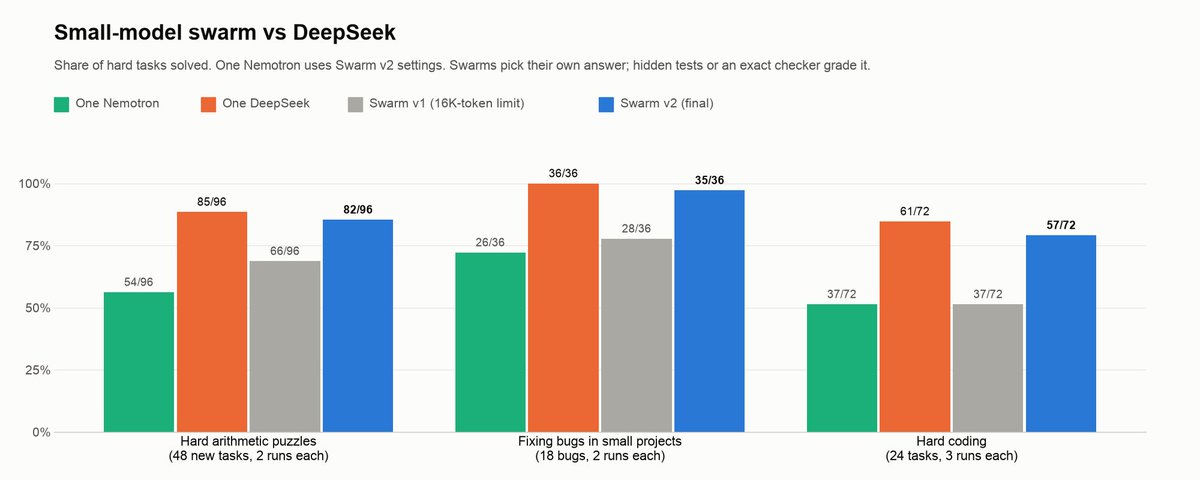
I spent days trying to make a swarm of small Nemotrons match DeepSeek V4.1 on 4 DGX Sparks. Democracy, self-repair, evolution, reviewers, a self-judge… Here is what worked, what flopped and what it really costs.
Francisco Ribeiro retweeted

Agentic Offensive Frameworks have cost me a few nights of sleep over the last three months.
I'm convinced we're entering a new era in cybersecurity, and to be honest, it frightens me. I expect a lot of friction and some havoc, and I'm not sure how many organizations can withstand it.
The way I see it, the internet as we know it only worked because nobody had the time to look closely at most of it. Every system got scanned, but almost nothing got a careful second look. #AOFs remove that limit. Now everything gets that look. And I don't just mean source code, vulnerabilities and exploits. The whole threat landscape shifts.
So I kept asking myself what this means for the future, and for the things we build tomorrow. I came up with a term for my answer: defensive minimalism.
I think it's the way forward.
In the post I explain what I see as the core problems, and why I think tomorrow will look very different from today in many ways.
Blog
cyb3rops.medium.com/the-age-…
Slide Deck
figma.com/deck/JxNquRkBMZ9IA…


Francisco Ribeiro retweeted

your laptop probably runs software with
known-exploited CVEs.
find out in under a minute with one command.
securitycontext shows what's vulnerable and what to fix first.
scan now: go.projectdiscovery.io/hosts…


Francisco Ribeiro retweeted

We’re introducing Shirudo, an open-source Linux runtime allowing agents to defend systems without downtime. It lets agents write dynamic eBPF controls to shield systems from exploits, giving defenders more time to test and roll out patches. Built by @cisco together with OpenAI.
Shirudo is a first step toward self-defending infrastructure that can adapt to new threats while keeping services running. Our goal is for defenders to work with AI agents to find affected systems, test and share shields, and deploy them without disrupting workloads.
openai.com/index/introducing…


Francisco Ribeiro retweeted

A new MIT research shows that LLMs can be fine-tuned using Evolution Strategies, without backpropagation, gradients or even Adam.
And the interesting part is how simple the idea is.
Instead of calculating gradients and updating billions of parameters through backpropagation, you make small random changes to the model's weights, run it, measure the results and keep the changes that actually improve performance.
No gradient calculations. Just testing, comparing and evolving the weights.
Why does this matter?
Backpropagation is a major memory bottleneck when training large models. You need to store activations, gradients and optimizer states, which makes fine-tuning increasingly expensive as models get bigger.
Evolution Strategies take a different route. They remove that entire gradient-based optimization process.
This doesn't mean backpropagation is suddenly obsolete. But it does show that there are other ways to improve LLMs, without relying on the training methods we've used for years.
Honestly, I find this direction really interesting. We've spent so much time making gradient-based training more efficient. Now researchers are exploring whether we can skip gradients altogether.
