

Building people-first leaders. EVP @morewellgroup · MBA · MSHRM · MSML · Cornell CBA. Coach energy. Always rooting for your growth.
Palo Alto, CA
Joined July 2024
- Tweets555
- Following520
- Followers50
- Likes172
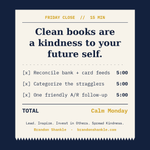


Clean books are a kindness to your future self.
My 15-min Friday close:
- Reconcile bank + card feeds
- Categorize the stragglers
- One friendly A/R follow-up
Total cost: 15 minutes. Total payoff: a calm Monday.
What's your non-negotiable Friday habit?

Brandon Shankle, MBA, MSML, MSHRM, SHRM-WIC, CBA retweeted

He’s still here. He’s got a fan club.
Including us.

Onboarding is the first promise you keep.
Day one: laptop and access ready. A real person to ask the "dumb" questions. A 30-day check-in already on the calendar.
Cheap to do. Expensive to skip. What made your best first week feel like a welcome?

Automate the busywork, not the people.
Every signature chase and copy-paste between systems is time stolen from coaching, problem-solving, and taking care of each other.
Good systems give your team their time back. What's one task you'd automate tomorrow?

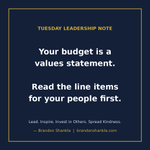
Your budget is a values statement.
If "people first" is on the wall but training and manager coaching are the first cuts every quarter, the spreadsheet is telling the truth.
What's one line item you'd protect for your team no matter what?


Monday leadership hack: ask one person "What's getting in your way?" Then go remove it.
Cheapest productivity tool ever invented. Zero license fees.
What's yours?
My first Sunday Letter is live. It's on psychological safety and why people-first cultures win. Read it here: brandonshankle.com/blog/lett…

Exactly. People don’t just ask “Am I allowed to say this?” — they ask “Will this be handled fairly if I do?” Justice and safety travel together.

Employees do not decide whether to speak based on an invitation alone.
They also watch whether the workplace is fair.
From an Industrial/Organizational psychology perspective, psychological safety and organizational justice are deeply connected. Before raising a concern, challenging an assumption, or reporting an error, employees often evaluate three signals:
• Distributive justice: Are outcomes, rewards, burdens, and consequences equitable?
• Procedural justice: Are decisions consistent, transparent, accurate, and unbiased?
• Interactional justice: Will I be treated with dignity and respect if I disagree?
When these dimensions align, fairness builds trust. Trust reduces the interpersonal risk of speaking. That makes employee voice, learning, accountability, and better decision-making more likely.
When fairness breaks down, even a sincere invitation to “speak up” can produce silence, defensiveness, hidden risks, and disengagement.
Five practices leaders can use to strengthen the justice-to-voice pathway:
Explain decision criteria.
Invite questions and appeals.
Apply standards consistently.
Protect respectful dissent.
Follow through visibly.
The central lesson is straightforward:
Fair process + respectful treatment = trusted voice.
My book, Psychological Safety At Work, examines this relationship through 33 chapters, 32 applied models, and 28 case studies—connecting employee voice with organizational learning, ethical action, adaptation, and sustained performance.
Explore the book: a.co/d/0adzsMlO
What teaches employees more about psychological safety: the invitation to speak—or what happens after they do?
#PsychologicalSafety #OrganizationalJustice #IOPsychology #EmployeeVoice #Leadership #WorkplaceCulture #OrganizationalLearning #OrganizationalDevelopment

This is the part leaders miss. Inviting feedback isn’t enough if people don’t feel safe delivering it. When fear is in the room, the org is flying half-blind.
Psychological safety is not a slogan.
It is the difference between what employees know and what organizations actually hear.
When people are afraid to speak honestly, organizations lose access to the very information they need most: risks, mistakes, questions, concerns, ideas, and early warning signs.
That silence affects trust.
It slows learning.
It weakens communication.
It limits innovation.
It reduces organizational performance.
That is why I wrote Psychological Safety At Work: Through the Lens of Industrial/Organizational (I/O) Psychology.
This book examines psychological safety as a workplace condition shaped by leadership behavior, team norms, organizational systems, accountability, culture, well-being, employee voice, and performance.
The book serves as the foundation of the series.
The two companion workbooks extend the work into applied organizational practice and graduate-level teaching.
Psychological Safety At Work
For I/O psychologists, consultants, educators, leaders, organizational decision-makers, and professionals who want a deeper understanding of psychological safety through an I/O psychology lens.
Organizational Companion Workbook
For leaders, HR professionals, consultants, coaches, I/O practitioners, and teams who want to move psychological safety from concept to practical application.
Graduate Professor Companion Workbook
For graduate faculty, program directors, course coordinators, and students who want to teach, discuss, analyze, and apply psychological safety in advanced academic and professional learning settings.
Each book can stand alone.
Together, they provide a practical resource series for understanding, teaching, diagnosing, and strengthening psychological safety in modern organizations.
Available now on Amazon:
Psychological Safety At Work
a.co/d/0adzsMlO
Organizational Companion Workbook
a.co/d/0drKLYRz
Graduate Professor Companion Workbook
a.co/d/01Ichhqk
Dr. S. Steven Whitaker (DrSSWΨ)
Industrial/Organizational (I/O) Psychologist
#PsychologicalSafety #IOPsychology #IOPsych #Trust #Learning #OrganizationalPerformance #EmployeeVoice #TeamVoice

I didn’t get into leadership to collect titles.
I got into it because the best days at work are the ones where someone leaves a conversation taller than they walked in.
That’s the job. Build people. The results follow.
