Assistant Professor of Business, Organizations and Society @NYUAbuDhabi. Previously: @uwmadison
Joined October 2019
- Tweets3.6K
- Following4.7K
- Followers2.8K
- Likes27.6K






Pinned Tweet
New paper in @OrganizationSci with Andy El-Zayaty & Martin Ganco! We find that vague language in startup pitches usually reduces investor interest—unless the founders have strong communication-related human capital. In those hands, strategic vagueness can actually boost appeal.

Bek Khoshimov retweeted

AI cracking unsolvable math problems while being kinda mid at writing is a much-needed W for humanities majors after a rough 21st century.
Bek Khoshimov retweeted

“Are you teaching this semester?” is the academic equivalent of “Some weather, huh?”
Bek Khoshimov retweeted

Interesting QJE paper on fairness views of 65,000 individuals in 60 countries covering 85% of world population and 88% of global GDP. Meritocratic views more prominent in richer Western societies. Econ development and cultural factors account for ~80% of cross-country variation.

Bek Khoshimov retweeted

going from academia to startup, i had failed to fully unlearn accuracy and precision in wordings
in academia, indicates / shows / proves / demonstrates / suggests all mean v different things
i would be so much better at twitter if i could unlearn this completely
Bek Khoshimov retweeted

Used to try to respond to all emails from high-schoolers interested in research but I'm now getting a dozen or so a day and nearly all 100% AI generated. Bummer.
Bek Khoshimov retweeted

One data point in technology making everyone richer: the cost of lighting has decreased by over 1000x.


Link to our patent: warf.org/wp-content/uploads/…
Paper is coming soon! Hopefully.
Bek Khoshimov retweeted

Notice the role reversal.
Universities, whose comparative advantage is supposed to be basic research with diffuse and uncertain social returns, increasingly justify themselves through "impact," donor appeal, media visibility, and other measurable near-term social outcomes.
Meanwhile, frontier tech companies, whose comparative advantage is commercially useful innovation, spend conspicuous resources on pure intellectual prestige goods. Theorem proving, open math conjectures, fundamental science, benchmarks with obscure immediate commercial value.
Bek Khoshimov retweeted
Hahaha @ProfDavidDeming and co-authors got Norwegian administrative data to prove that meetings are good.
nber.org/papers/w35706


used to host dinners in grad school: one Russian lit PhD at the table, plus Russians who'd studied lit seriously in school growing up. arguments over literature turned into full shouting matches. people unrelated to the fights had no idea why any of it mattered that much.

Bek Khoshimov retweeted

turns out the attention span crisis is atleast
*checks notes*
two thousand years old


Bek Khoshimov retweeted

Met a German founder this week and asked him if all the stories one reads about the challenges of startups in Germany are exaggerated. "No, they're understated." Proceeded to describe spending a full day having a 90-page investment contract read to him (mandatory under German law; § 13 BeurkG) by a notary that then charged €30,000. That was for his first company. His second company, needless to say, was not incorporated in Germany.
Bek Khoshimov retweeted

If no one is criticizing you, you're probably not doing anything very important.
Looking forward to the panel!

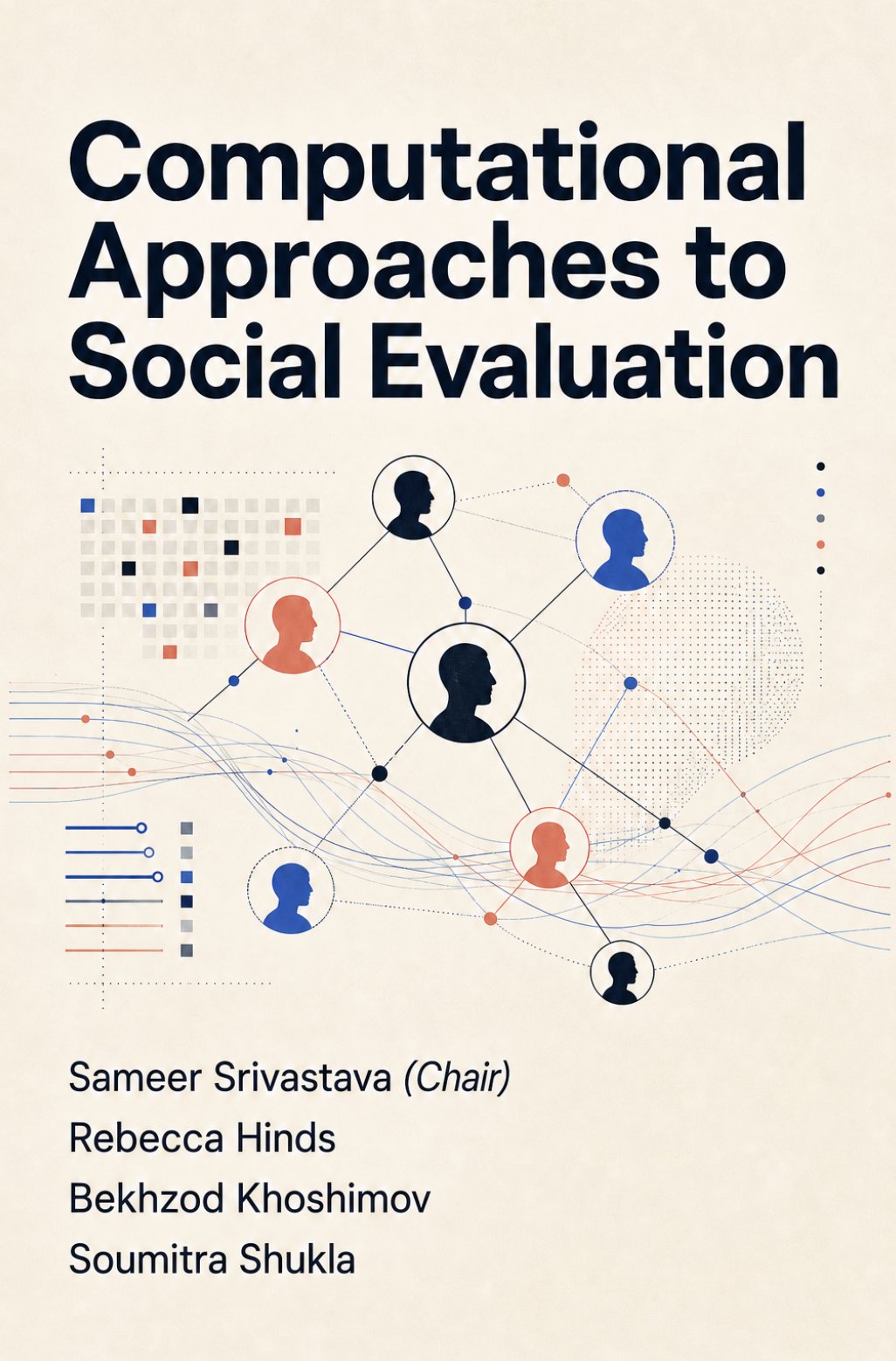
1/2 Next week I'll be at the @UniofOxford on a panel titled "Computational Approaches to Social Evaluation," chaired by Sameer Srivastava, alongside Rebecca Hinds and Bekhzod Khoshimov.
Sameer's work shows that organizational culture is measurable using communication patterns that emerge from everyday language in the workplace.
My paper applies similar computational methods to caste discrimination in elite Indian hiring, using LLMs to analyze nearly a million words of personal interview transcripts. While group debates (another screening round) are focused on policy topics, LLM analysis reveal that the personal interviews bring out, in subtle and indirect ways, caste- and class-coded biography: hometown, schooling, hobbies, family background, and parents' occupations.
The big benefit of the LLMs that underpin this analysis is that they help reveal how social evaluation happens through language. How is biography made legible? How is "fit" constructed? How do informal judgments and allocations of advantage and disadvantage based on identity reproduce and entrench existing inequality?
My results show that screening on "cultural capital" is not necessarily productive, challenging the common managerial assumption that “cultural fit” is a reliable signal of future performance.