

Marketing: Building demand engine for borderless businesses @engravegrowth @BSCNews || @bitvillecrypto || Web3 ‘16 🇵🇹
On-chain
Joined December 2010
- Tweets16.4K
- Following1.4K
- Followers1.7K
- Likes72K




Pinned Tweet
I've been thinking about why we built this.
The crypto industry has never been more innovative. Genuinely. The amount of infrastructure being built right now is staggering:
Stablecoins. Self-custody wallets. Instant cross-border payments. Private money. Tokenized stocks. Tokenized collectibles. Perps on everything. Global 24/7 markets. Borderless savings accounts. Prediction markets. Crypto neobanks. Proof of humanity. Onchain reputation. x402. MPC wallets. Account abstraction…
Incredible technology. Real breakthroughs. Thousands of engineers building at the frontier of what's possible.
And yet - the average crypto user doesn't care about most of it.
Not because they're unsophisticated. Because most of it doesn't directly put money in their pocket.
You know what does?
Trading.
Always has. Probably always will.
Trading is the single activity that brought most people into crypto. It's the reason people open exchange accounts. The reason people stay up watching charts. The reason people learn about blockchains in the first place.
Not stablecoins. Not onchain reputation. Not tokenized real estate.
Trading.
And yet — look at what's been built FOR traders in the last 5 years.
More exchanges (that profit from your volume).
More leverage (that accelerates your losses).
More tokens to trade (that dilute your focus).
More influencers selling signals (that they don't track).
More courses teaching strategies (that they don't verify).
Very little has been built to make the trader BETTER.
To help them understand their own performance. To remove emotion from their execution. To give them honest, trackable signals they can verify independently.
That's the gap. That's what Bitville fills.
The PNL Tracker is free because the traders who need it most can't afford another $99/month subscription. And because the thing that actually improves your trading - seeing your own data - should never have a paywall on it.
Bitora exists because I watched myself and dozens of other traders set perfect stops, plan perfect exits, and then panic-close at the worst possible moment. Over and over. The AI doesn't panic. That's the whole value proposition.
The signals channel exists because I was tired of Telegram groups with rocket emojis and no entry/exit parameters. Every signal has an Entry, TP, and SL. Track them. Verify them. Drop them if they don't work for your execution.
I'm not going to tell you Bitville will make you 100% profitable. That's on you.
What I will tell you is that after today, the excuse "I didn't have the tools" is gone.
The tracker is free. Bitora has a free trial. The signals are clear.
Now it's just you and your data.
bitville.cc


FINALLY! The “TOOLS” FOR THE TRADER NOBODY BUILDS FOR.
Not the whale. Not the institution. Not the VC-backed fund with a quant team and six-figure data infrastructure.
The trader sitting alone at 2 AM. Chart on the left screen. Telegram on the right. Trying to figure out if they're actually profitable or just telling themselves a story.
The trader who's been at this for months — maybe years — and still can't answer the three most basic questions about their own performance:
What's my real win rate?
What's my actual risk-to-reward?
Which setups are making me money and which ones are bleeding me dry?
Not because they're stupid. Because nothing in this space was built to help them answer those questions. Everything was built to sell them something else — another course, another indicator, another signal group, another token.
Today we're changing that. Bitville is live.
Three tools. One mission. Make traders better through data, execution, and clarity.
🔹 PNL Tracker — Completely Free.
Log your trades in 30 seconds. Auto-calculated win rate, R:R, equity curve, best/worst tickers, monthly performance (many more). No paywall. No trial. No "premium tier" hiding the features you need.
This is the tool I wish existed when I was bleeding money and blaming the market instead of looking at my own data. It didn't exist, so we built it.
Try it here: bitville.cc/pnl-tracker
🔹 Bitora — AI Trading Agent
An AI agent that connects to @Aster_DEX and executes trades based on its in-built multi-layered reasoning engine. Entry, TP, SL, size. No emotion. No hesitation. No moving the stop because "it might come back."
Your keys stay with you. Trade-execution-only permissions. It can't withdraw. It can't transfer. It just does the one thing most traders can't do: follow the plan.
Start with the free trial. See what disciplined execution feels like.
Bitora: bitville.cc/bitora
🔹 Signal Trading — Telegram Channel
Every signal comes with a clear Entry, TP, and SL. No vague "BTC looks bullish." No "NFA" after a reckless call with no risk parameters.
Track every signal you take in the PNL Tracker. Verify the results yourself.
This isn't a promise that you'll make money. We're not selling dreams. We're selling mirrors.
The PNL Tracker shows you where you actually stand. Bitora removes emotion from your execution. The signals give you structured trade ideas with clear parameters.
What you do with that is on you.
But for the first time, you'll know exactly what you're doing — because the data will be right there.
Bitville is live. Start tracking. Start executing. Start knowing your numbers.
bitville.cc
Everyone wants the same opportunities you want.
Your only advantage in this very competitive AI era is speed.
Learn fast. Implement fast. Fail fast. Iterate fast.
3
55
NEW: @OpenAI is willing to pay you up to $8,000 a month to sit in a local restaurant, auto shop, or retail store and show the owner how to use AI.
The program is called OpenWorks.
OpenAI funds local “Partners” (individuals or small teams) to work hands-on with independently owned small businesses.
The owners pay nothing. They also get three months of ChatGPT Business free.
The pilot is live in 20 U.S. cities, from New York and Los Angeles to Fargo and Incline Village. Software companies, venture-backed startups, and private-equity-owned businesses are excluded.
On the surface this looks like pure generosity. Dig one layer deeper and it is a classic distribution play.
Most small business owners are not going to discover the right AI workflows by watching YouTube or scrolling Twitter.
They need someone they already trust, sitting across the table, mapping AI to the specific mess of their actual operations: quoting jobs, answering customers, writing social posts, chasing invoices. OpenAI is paying for that last-mile human distribution because software alone has not been enough.
Now the harder question: who loses when every small business owner suddenly has a capable AI operator?
The first losers are the local service providers who currently charge $150–300 an hour for the exact work AI now does in minutes.
-Bookkeepers who only enter receipts.
-Marketing freelancers who only write captions and schedule posts.
-Basic graphic designers.
-Virtual assistants doing data entry and email triage.
Many of these people are themselves one- or two-person businesses. When their clients can do 70% of the work with ChatGPT plus a local coach, the remaining 30% becomes a commodity and the price collapses.
The second group is the “AI consultant” who was charging premium rates in 2024–2025 for basic prompt engineering and tool setup.
OpenWorks is subsidizing that exact service down to zero for the businesses that need it most.
The consultants who survive will be the ones who move up the stack into systems design, custom agents, and change management.
The third, quieter loss is the remaining advantage of simply being early.
For the last two years, the small business that figured out AI had a real edge in speed and cost.
Once the median bakery, plumber, and boutique has a local partner walking them through it, that edge shrinks.
The new differentiation will not be “we use AI.” It will be what they build on top of it that competitors cannot easily copy.
OpenAI is not just giving tools away. It is compressing the timeline on which an entire layer of local knowledge work becomes optional.
The businesses that treat this as free help will get a temporary lift. The people whose livelihood was the help itself are the ones who now have to move.

Through our new program OpenWorks, we fund local AI experts to help small businesses develop the tools and skills they need to grow their own business, at no cost to them.
We invite AI experts who love teaching others and small business owners who want to learn to implement AI to join us at openai.com/openworks.

1
4
217
Nwokwu retweeted

SmartBallot : Towards credible and Transparent Ballot
I have consistently believed that technology, combined with the creativity and resourcefulness of young Nigerians, can help reinforce our democracy and advance free, fair, and credible elections.
I am pleased to endorse SmartBallot (smartballotapp.com), a platform developed to facilitate grassroots mobilization, civic engagement, and election monitoring.
I urge our supporters and NDC candidates to register on SmartBallot and examine how its tools can assist them in organizing their communities, coordinating voters and polling unit agents, expanding grassroots engagement, and supporting transparent election monitoring.
Through the effective use of technology and collective action, we can reinforce our democratic institutions and help ensure that every vote is counted.
Credible elections require preparation, active participation, and peaceful vigilance. Let us make full use of every available resource to create a more organized, engaged, and empowered electorate.
A New Nigeria is Possible. -PO

Don’t know what’s worse. The women or the people in the comments saying this is absolutely normal in Manchester!

In Manchester, UK, hat sich ein seltsamer Nightlife-Trend entwickelt.
In den wohlhabenden Vororten von Manchester wohnen die schwerreichen Fußballspieler von Manchester United.
In den frühen 2000ern war es üblich, dass die Spieler oder Manager Clubs mit besonders schönen und leicht bekleideten Frauen „abernteten“, um diese auf ihre privaten Club-Partys zu fahren, sodass die Manchester-Spieler umgeben von massig gutaussehenden, leicht bekleideten und vor allem willigen Frauen feiern konnten.
Das hat sich unter der weiblichen Bevölkerung von Manchester herumgesprochen und man hofft selbst, auf eine dieser Partys mit schwerreichen Spielern eingeladen zu werden und die Chance zu haben, sich einen zu angeln.
Da die Frauen in Konkurrenz stehen, mussten die Kleider immer noch enger und noch knapper werden, um aufzufallen.
So dass 20 Jahre später Manchester freitags und samstags Nacht von einer Flut junger GoldDiggerGirls überströmt ist, die alle fast aus ihren viel zu knappen Kleidchen fallen. 😀
(Video ist falsch betitelt, das ist nicht Stockholm)
64
Jesus is the King of Kings. Lord of Lords.
End of story!

Hey @grok, concise, no spin.
A Jewish prayer, recited three times daily, contains a curse calling for the destruction of followers of a particular religious figure.
Who was that figure?
Full name only.

3
53
Google Ads just told advertisers not to launch a separate #BlackFriday campaign.
Use the one you already have.
The reason is simple: Smart Bidding needs the historical conversion data sitting inside your existing campaigns. Starting fresh throws that away right when demand is about to spike.
Their new Promotion mode lets you pre-schedule the sale dates (3–14 days), set a temporary ROAS tolerance (5–90%), and optionally boost daily budget.
When the sale ends, it automatically reverts both the target and the budget. No manual cleanup.
This is the quiet shift happening in paid media right now.
The old playbook was “duplicate the campaign, raise budgets, lower targets, then pause everything Monday.” The new one is “keep the learning intact and give the algorithm a temporary window to spend more aggressively.”
It only works well if your existing campaigns are already healthy and have enough conversion data. If they don’t, Promotion mode just gives a weak campaign more rope.
For most advertisers the practical move is clear: stop building one-off sale campaigns and start treating your core campaigns as the system that runs year-round, with temporary promotions layered on top.
Don’t fight the algorithm with manual campaign structures. Feed it clean data and get out of the way.


If you’re in Thailand and want to work at @binance, be at the #BinanceBlockchainWeek for an in-person screening!

Your next career move could start at #BinanceBlockchainWeek!
For the first time, Binance is bringing its recruitment team to the BBW floor.
→ Meet our recruiters face-to-face
→ Explore career opportunities
→ Get a chance for an on-the-spot HR screening
Drop by our booth at the fair and speak with our HR team in person - learn about open roles, get resume tips, and ask all your questions.
Prepare your CV. Let's talk!
🗓️ 2 days, Nov 28 to 29
📍 Booth: Queen Sirikit National Convention Center (QSNCC) Hall 3

62
Sales teams have spent years bouncing between a CRM, a call recorder, a prospecting tool, and a notes app just to prepare for one conversation.
@OpenAI is trying to collapse that stack into the chat window they already have open.
On November 17 the company launched @ChatGPT for Sales: a new Sales plugin plus more than 30 new and enhanced partner plugins that connect ChatGPT to the tools most revenue teams already use. The list includes Salesforce, HubSpot, Gong, ZoomInfo, Clay, Apollo, Attio, Docusign, and others.
Once connected, the idea is that a seller can ask ChatGPT to build a prioritized account list from CRM data, pull in enrichment signals, draft a meeting brief that includes recent call notes, write a follow-up, and propose the CRM updates—all in one place, with the human still approving anything that goes out or changes a record.
One early user estimate cited by OpenAI put the time savings at roughly 65% on tasks like prospect research, CRM enrichment, opportunity prioritization, and personalized outreach.
What makes this different from earlier ChatGPT plugins is the combination of a purpose-built Sales plugin (with prebuilt workflows for account plans, meeting briefs, follow-ups, and pipeline reviews) and a broad partner ecosystem that can both read and, in many cases, write back to those systems.
Admins on Business and Enterprise plans control which plugins are available.
OpenAI has also said it does not train models on customer business data.
For marketers and revenue ops: Could this become where the work of selling starts to live?
It is still early. The product is available through ChatGPT Work, and how reliably the agents handle edge cases or sensitive deal details will determine how much real pipeline work actually moves into the chat.
For now, the clear signal is that OpenAI is treating sales as one of the next high-value places to embed agents that can act on existing enterprise systems.

Close. Those. Deals…with the new ChatGPT for Sales experience.
It brings together our new Sales plugin and 30+ new and enhanced partner plugins to put your sales tools and customer context to work—so your team can spend less time on busywork and keep deals moving.
openai.com/index/introducing…
120
You can now ship a product in a weekend with Cursor or Claude Code.
Getting the first hundred users still takes months, because the work that actually finds them lives in a dozen other tabs.
Okara just moved that work into the same chat you already have open.
The company builds an AI CMO that runs more than ten specialized agents (SEO, GEO for AI answers, content, Reddit, LinkedIn, X, influencer outreach, and even a coding agent that opens GitHub pull requests for technical fixes).
Until today, those agents lived inside their own dashboard. The new MCP server lets you paste one URL into Claude, Cursor, Codex, ChatGPT, or Grok and start giving the CMO instructions from the same window where you write code.
Building got dramatically cheaper. Distribution did not.
A founder who finishes a working prototype on Friday still has to open Search Console, draft LinkedIn posts, hunt for relevant Reddit threads, check whether ChatGPT is citing the product, and decide whether any of the pages are leaking traffic.
Each of those steps used to require its own tool and its own context switch. Okara’s pitch is that the same model that just helped you ship the feature can now also tell you the three pages losing clicks, draft a week of posts in your voice, and surface the threads worth answering - then wait for you to approve anything that goes public.
They list a handful of early results.
-Relate doubled organic search clicks and grew users 23 percent in four months.
-Qlero grew Google impressions 8.5x and started appearing in 14 of 20 tracked AI answers.
-PuppyDog reached 200 times its follower base at launch and lifted signups 30 percent.
-Lovie improved click-through rate 73 percent and U.S. traffic 20 percent.
These are self-reported and from teams already using the product, so the usual caveats apply, but the pattern is consistent with what other lean teams have been saying: the bottleneck moved from “can we build it” to “can we get anyone to see it.”
The interesting second-order question for marketers is where the judgment still has to sit. Okara’s own documentation is clear that posts, replies, and ad spend wait for human approval.
The agents can research, draft, and even open pull requests; they cannot (yet) decide whether a post matches the brand voice closely enough, or whether a Reddit reply will get the account banned.
That boundary is the real product. Tools that collapse the distance between the code editor and the distribution channels will keep appearing.
The ones that also make the remaining human decisions faster and higher-signal are the ones that will actually change how small teams allocate their time.
The MCP is live at okara.ai/mcp. One URL, then you ask.

Today, we're introducing Okara MCP.
Connect it to Claude, Cursor, Codex, or any LLM, and it finds gaps, fixes issues, and publishes your posts across socials to help you grow traffic and revenue.
Try it now at okara.ai/mcp
5
225

The AI boom isn’t just changing how software gets built. It’s quietly deleting the bottom rung of the career ladder.
Since ChatGPT launched in November 2022, employment for software developers aged 22–25 in the US has dropped 20%. The 26–30 group is down 4%. Meanwhile, developers aged 41–49 are up 20%. The 35–40 cohort grew 11%. The gap between the youngest and oldest groups is now 40 percentage points.
The entry-level hiring market is getting hollowed out in real time.
What’s actually happening is easy to see once you look past the hype. Companies discovered they could get a huge amount of the junior work done with models.
The tickets that used to go to new grads - basic features, tests, documentation, internal tools, first-pass code reviews - can now be handled by a strong engineer with a good AI setup in a fraction of the time.
So the natural response has been to hire fewer juniors and lean harder on the people who already know the systems, the edge cases, and the institutional knowledge.
The seniors aren’t being replaced. They’re being leveraged. One experienced engineer with AI can now cover a bigger surface area than they could two years ago. The juniors who used to absorb the simpler work and slowly learn by doing are the ones getting squeezed.
This creates a second-order problem that most of the discourse is still missing.
If you stop hiring and training the 22–25-year-olds today, you don’t just have a hiring problem in 2026. You have a senior shortage in 2031–2033. The people who would have been your mid-level engineers and future tech leads simply never got the reps. You can’t skip the apprenticeship layer forever and expect the talent pipeline to keep working.
We’ve seen versions of this before.
Every major productivity tool eventually compresses the junior roles first. Spreadsheets did it to certain accounting functions. CAD did it to drafting. The difference this time is speed and breadth. The compression is happening across almost the entire junior software stack at once.
For marketers and growth people watching this, the signal is useful beyond just “tech jobs are changing.”
The same dynamic is starting to show up in content, research, basic analysis, and campaign execution roles.
The work that used to be a reliable first job is increasingly getting absorbed by people who already have context, plus AI. The people who can operate at a higher level of judgment and taste are becoming more valuable. The people whose main contribution was volume of competent output are becoming harder to justify.
The implications are gloomy.
We’re training fewer of the next generation of builders right now, at the exact moment the industry claims it needs more of them.
That tension doesn’t resolve itself.

The AI revolution is leaving younger tech workers behind:
US software developer employment among workers aged 22-25 has fallen -20% since November 2022, when ChatGPT was launched.
Over the same period, the 26-30 age group has recorded a -4% decline.
By comparison, employment among developers aged 41-49 has surged +20%.
The 35-40 and 31-34 cohorts have grown +11% and +6%, respectively.
As a result, the employment growth gap between the youngest and the oldest group has risen to 40 percentage points.
The AI boom is destroying job opportunities for entry-level tech workers.

2
3
233
Nwokwu retweeted

Just so everybody gets a clear image about this.
If the board removes him as CEO, several clear boundaries apply:
• Every share Jensen Huang already owns outright is his legal property. He retains full voting rights for those shares and can hold them, borrow against them, or dump them on the open market whenever he chooses (subject only to standard SEC insider trading blackout windows if he remains on the board, or Rule 144 volume limits if he steps down completely).
• The only shares a board can claw back or cancel upon termination are unvested performance stock units (PSUs) or restricted stock units (RSUs) that have not yet met their time or performance milestones. Given that Jensen co-founded Nvidia in 1993 and holds roughly 3.5% of the company outright, the vast majority of his multi-billion-dollar stake is long since vested.
• Because he is Nvidia's largest individual shareholder, firing him against his will creates an immediate existential headache for the board. As an outside shareholder, he could launch a proxy fight to replace the board directors at the next annual meeting, start a rival silicon venture and poach Nvidia's top CUDA and architecture leads, or threaten to liquidate tens of billions of dollars in stock, cratering the share price for institutional investors.
In short, firing a founder who owns over $100 billion in vested stock does not strip him of power; it just turns him into an activist shareholder with infinite capital and zero fiduciary obligations to protect the board.


In case you’re still unaware, @OpenAI just let businesses claim their own profile inside the ChatGPT.
Think Google Business Profile, but for ChatGPT.
Once verified, you can update your info, drop in a product feed with live prices and stock, and see basic metrics on mentions and site clicks.
The real shift: ChatGPT is starting to favor the clean product data you hand it directly over whatever it scrapes from the open web.
Messy titles, outdated prices, or vague descriptions mean the model has less to go on when someone asks for recommendations. You get harder to find.
For years, ranking meant writing the right keywords. Now it also means keeping a tidy, accurate feed of what you actually sell.
Treat that data like it matters every day and you show up more. Skip the maintenance and you keep getting skipped.
Still early and limited (Business Agents mainly for eligible US online stores right now).
But the direction is clear. When people ask AI what to buy, the companies with the cleanest data have the best shot at being the answer.
Now in beta: Businesses in ChatGPT.
Claim your business, manage your information, and get insights on how people engage with you.
Eligible businesses can also build a Business Agent to answer customers’ questions and help them explore what you offer.
openai.com/index/introducing…
1
98
Most trading agents are marketed with impressive win rates and screenshots of winning trades.
We decided to test ours for 6 months and publish the numbers, including the losses.
@bitvillecrypto’s Bitora (May–Oct 2026):
Style: BALANCED
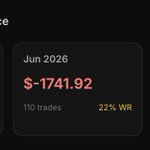
May: +$506.53 | Jun: -$1,741.92
Jul: +$1,046.52 | Aug: +$819.10
Sep: +$804.43 | Oct: +$444.38
6-month P&L: +$1,879.04
Style: AGGRESSIVE
May: -$111.05 | Jun: +$143.46
Jul: +$1,239.44 | Aug: +$1,221.11
Sep: +$1,451.95 | Oct: +$938.82
6-month P&L: +$4,883.73
Both accounts started with $20K in testing capital.
The interesting part: in the last 3 months alone, Balanced made $2,067.91 while Aggressive made $3,611.88. Both were profitable every month.
I also paused the agent at different points, as a regular trader would. This wasn't uninterrupted automated trading.
A few things about the setup:
•$20K is the demo account balance, not a minimum requirement.
•Maximum $2K margin per trade for accounts above $5K.
•Maximum 2 concurrent trades.
•$3K–$5K accounts could potentially achieve similar dollar profits under comparable conditions, with proportionally higher gains and losses.
Bitora doesn't hold user funds. It connects to Aster DEX via API and cannot withdraw funds.
We're building something traders can judge by actual performance, not marketing promises.
Try it: bitville.cc/bitora
PS: Trading involves substantial risk. You can lose your capital. Past performance doesn't guarantee future results.


Over the last 3 months, we ran an interesting experiment with @bitvillecrypto's automated trading bot "Bitora" to find out if it's actually profitable.
Below, I've attached screenshots of the monthly performance from 2 accounts.
Here's what we found out:
Account 1 (Trading style: Balanced)
May: +$506 (36% WR, 107 trades)
June: -$1,741 (22% WR, 110 trades)
July: +$927 (37% WR, 70 trades)
3-month total: -$308 (-1.5% of starting capital)
Total trades: 287
Account 2 (Trading style: Aggressive)
May: -$111 (36% WR, 95 trades)
June: +$143 (27% WR, 134 trades)
July: +$1,443 (36% WR, 88 trades)
3-month total: +$1,475 (+7.4% of starting capital)
Total trades: 317
Both accounts averaged around 31-33% win rate across the 3 months, which is standard for real professional systems that compound through favorable risk-to-reward ratios.
The most interesting takeaway is that both styles ran nearly identical win rates, but the cumulative outcomes were very different. Aggressive was catching bigger winners when it won, which is what drove the outperformance.
In June, Account 1 suffered heavy losses (-$1,741) as Bitcoin & the entire market moved in extremely choppy directions. A smart manual trader would rightfully turn off the bot in choppy markets/months, but we left it on for testing.
The counterintuitive finding was that "Aggressive style" on Account 2 not only stayed nearly flat in June's unstable conditions (+$143 vs Account 1's -$1,741) but also became significantly more profitable in July.
Aggressive's worst month drawdown was -$111 (0.56% of starting capital). Balanced's worst month drawdown was -$1,741 (8.71% of starting capital). Roughly 16x smaller downside on the Aggressive account over this sample.
So far, "Aggressive style" has performed better overall in both returns and drawdown control.
Our initial guidance was to recommend "Balanced" to inexperienced traders because it takes slightly fewer trades. Based on this 3-month data, we may reconsider that. Aggressive took only 10% more trades but delivered better returns with smaller drawdowns. We'll keep tracking before formalizing any change.
Context: Both accounts started with $20,000 (testing capital, applicable to every registered user). To protect users, each account trades with a maximum of $2,000 margin per trade (at capital above $5,000), restricted to 2 concurrent trades. A starting capital of $3,000-$5,000 will produce similar dollar profits, which translates to a substantially higher percentage return at that account size.
All details are available in the documentation: bitville.cc/bitora/docs
We'll continue running this test for 6 months and share updated results across both accounts. If the pattern holds, we may be able to say Bitora is one of the more useful and profitable trading tools available to retail traders.
PS: Bitora doesn't keep user funds. It trades on Aster DEX via API connection. Users remain in full custody of their funds.


Man must develop the audacity and tenacity to reinvent himself, if he must truly attain that which he’s destined for!
43
Just deployed a B2B prospecting engine for @engravegrowth.
I got tired of generic lead scraping.
Pulling info@, contact@ and hello@ from company websites is easy. Finding the actual people who make buying decisions is a different story.
And sending emails to unverified addresses is how you damage your domain reputation.
So I built a pipeline.
What it does:
→ Scans hiring boards and startup directories for companies actively hiring for roles related to what we offer.
→ Uses Apollo's API to find decision-makers, starting with Founders, CEOs, CMOs and Heads of Growth.
→ Looks up one contact at a time and stops as soon as it finds a verified email.
→ Discards unverified contacts.
→ Tracks API credit exhaustion and alerts me from the admin dashboard.
I'm particularly happy with the lookup logic.
I'm currently testing Apollo's free credits, so I needed to be smart about enrichment.
Instead of spending credits on several contacts at the same company, the system follows a priority order and stops at the first verified match.
Simple. Less waste.
Built the whole thing into EngraveGrowth's admin platform.
This is the part of building a business I enjoy.
Find a problem. Figure out how to solve it. Build the solution.
The more I build, the more I realise growth engineering is where it all leads.
Understanding growth is great. Being able to engineer the systems that drive it is even better.
Back to building.
3
7
354