Bio-soft actuation @CNRS IUSTI, Aix-Marseille University
Marseille, France
Joined October 2018
- Tweets338
- Following534
- Followers882
- Likes1.6K
Pinned Tweet
Fresh off the press @NatureComms, our work on wing deployment in Drosophila 🪰:
nature.com/articles/s41467-0…
Work by: @HadjajeS, @Ignacio00432963, Marie-Julie Dalbe and Raphaël Clément
Fresh off the press in @ScienceMagazine! @fluidity_x and Yoël’s work on the actuation of the Venus flytrap. 🪴⚡
No muscles. No nerves. So what powers the trap?
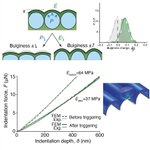
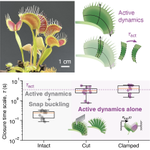
Cutting the trap suppresses its mechanical amplifier, the snap-through instability, and reveals the active motion.
Together, these measurements rule out rapid water transport or sudden turgor changes as drivers of closure.
Instead, closure is triggered by rapid softening of the epidermal wall: bending comes from release of pre-stress in the turgid mesophyll after weakening of the outer layer
The molecular origin of this rapid softening remains unknown. Future studies and new genetic tools are needed to uncover the signals driving the ultra-fast mechanical remodeling of the cell wall.
Paper here: science.org/doi/10.1126/scie…
Ever since Charles Darwin proclaimed the carnivorous Venus flytrap one of the “most wonderful” plants in the world, scientists have been trying to work out how it snaps shut so quickly on its prey. A research team has now snapped a key piece of the puzzle in place.
go.nature.com/4oktoRc
Joel Marthelot retweeted
The Venus flytrap is renowned for its ultrafast snap traps, which can capture insects in a fraction of a second.
New research reveals that trap closure is triggered by a rapid softening of the epidermal cell walls, uncovering the physical mechanism behind this remarkable movement.
Learn more this week in Science: scim.ag/4fG2Bg3
Joel Marthelot retweeted
Advertisement for an advanced course in Udine, Italy 🇮🇹 this summer ☀️. Learn about mechanics for the fabrication and programming of soft robots 🦑. cism.it/en/activities/course…
organized along with @biosoftact
Joel Marthelot retweeted
La mouche drosophile est capable de prouesses pour déployer ses ailes l.sciencesetavenir.fr/H7M
Joel Marthelot retweeted
New preprint: arxiv.org/abs/2501.01875
"Dense array of elastic hairs obstructing a fluidic channel"
Explanations below 🧵👇
How insects deploy their wings. Highlight by @IBDMmarseille on Simon's paper in Nature Comms @NaturePortfolio: ibdm.univ-amu.fr/how-insects…
Fresh off the press @NatureComms, our work on wing deployment in Drosophila 🪰:
nature.com/articles/s41467-0…
Work by: @HadjajeS, @Ignacio00432963, Marie-Julie Dalbe and Raphaël Clément
Joel Marthelot retweeted
Comment la mouche sortant de sa chrysalide déploie ses ailes en quelques minutes ?
insis.cnrs.fr/fr/cnrsinfo/co… C'est un processus qui combine dépliement d'une structure et étirement du tissu cellulaire.
@CNRSingenierie @CNRS
Des recherches avec des applications dans le domaine des structures déployables ou de la robotique flexible

ALT (a) Instantanés du déploiement des ailes de drosophile. (b) (i) Microtomographie par rayon-X des ailes pliées. (ii) Coupe transverse montrant les plis macroscopiques, la structure des veines (flèches blanches) et les piliers internes. (iii) Section perpendiculaire révélant l'organisation hexagonale des piliers. Le croquis résume la structure de l'aile : deux plaques reliées par des piliers organisés en réseau hexagonal. (c) Le sang, visualisé par des billes fluorescentes, est injecté dans toute l’aile au cours du déploiement. (d) Mesure de la pression interne d'un insecte. Le déploiement des ailes a lieu dans le segment grisé à une pression constante. © S. Hadjaje
Joel Marthelot retweeted
#RésultatScientifique 🔎 | Comment la mouche déploie ses ailes
🔬 @biosoftact @iustiumr7343 🤝 @univamu @CNRS 📍 @CNRS_dr12
🔬 @IBDMmarseille 🤝 @univamu @CNRS 📍 @CNRS_dr12 @CNRSbiologie
insis.cnrs.fr/fr/cnrsinfo/co…