

🧬 Advanced Peptide Research ⚡ Mitochondrial Wellness 🧠 Longevity • Recovery • Performance 🔬 13 Foundational Peptides & Growing
Joined April 2026
- Tweets47
- Following5
- Followers13
- Likes124




BioLight Labs retweeted

I ranked 12 major peptide categories and picked one standout for each.
Tissue repair. Mitochondria. Fat loss. Cognition. Inflammation. Longevity. Skin. Stress — and more.
The catch: “best” doesn’t mean proven. Some have meaningful human data, while others are still highly experimental.
Save this Reel as your peptide cheat sheet — and share it with someone who keeps asking, “Which peptide is best for what?”
BioLight Labs retweeted
A new MOTS-c study found a way to protect diabetic kidneys — but the most surprising part wasn’t blood sugar, inflammation, or oxidative stress 💉🧬
It was what the kidney cells were doing with fat.
Researchers found that MOTS-c reduced kidney injury, lipid buildup, and inflammatory signaling in diabetic mice.
But the real clue came when they looked at the cell’s cleanup system.
MOTS-c appeared to activate lipophagy — the process cells use to break down and recycle stored fat.
And when researchers disrupted that pathway, much of MOTS-c’s protective effect disappeared.
So the bigger question is:
Could one of MOTS-c’s most important effects be helping metabolically damaged cells clean themselves up?
This was preclinical research, not a human trial — but the mechanism is fascinating.
Watch to the end for the pathway researchers believe may explain it — then save and share this with someone following mitochondrial or peptide research.
BioLight Labs retweeted
Cartman Discovers Peptides 🤣💉
Director’s notes: This took waaaay longer than it had any business taking. 😂 And yes, there are some hilariously questionable moments courtesy of AI hallucinations. 🤪
But hey, that’s the beauty of AI filmmaking… you never quite know what you’re gonna get. 🍿
Enjoy the chaos! 😂
BioLight Labs retweeted
What if a NASAL SPRAY could deliver peptides to your brain in ways an injection can’t?! 🧠⚡️
Researchers are exploring how intranasal delivery could bypass parts of the blood-brain barrier through specialized pathways connecting the nose and brain. 👃🧬
From cognition and stress regulation to neuroprotection and mitochondrial health, the research possibilities are intriguing — even if many applications remain experimental.
Because it’s not just WHAT you’re delivering… it’s WHERE you’re delivering it.
BioLight Labs retweeted
GHK-Cu might be one of the most interesting peptides in the anti-aging world.
It’s only 3 amino acids long, yet research suggests it may influence pathways tied to:
• collagen + skin remodeling
• wound repair
• inflammation
• antioxidant defense
• hair growth
• tissue regeneration
That’s why you’ll hear about the “GHK glow” and why GHK-Cu is becoming such a major part of peptide protocols.
But there’s a catch: the mechanistic and preclinical science is far ahead of the human clinical evidence.
Topical GHK-Cu has the strongest support. Injectable use is intriguing, but still largely unproven in humans. Oral use has even less evidence.
BioLight Labs retweeted
What if a peptide made of just 4 amino acids could influence some of the biology we associate with aging? 🧬
Epitalon has been linked to telomere maintenance, circadian regulation, oxidative stress pathways, and mitochondrial changes in cellular and preclinical research.
That’s why it’s become one of the most talked-about peptides in longevity.
But there’s a major catch: we still don’t have a well-powered human trial showing that Epitalon actually slows aging or extends lifespan.
The mechanism is fascinating. The human proof is still missing.
BioLight Labs retweeted
Scientists just found a way to make aging egg cells act younger — and the signal came from a peptide produced in the mitochondria 🔬⚡️
In a new 2026 study, MOTS-c improved mitochondrial energy production, reduced oxidative stress, and enhanced maturation-related outcomes in aged oocytes, while also strengthening the metabolic support cells that surround the egg.
The treated eggs didn’t fully return to youthful levels — but they moved in that direction.
It’s still preclinical, not a human fertility treatment. But it raises a fascinating possibility: reproductive aging may be partly a mitochondrial energy problem — and mitochondrial peptides could become one way to target it.
BioLight Labs retweeted
Peptides are moving fast — and 2026 may be the year the field starts to fundamentally change. 🧬⚡️
MOTS-c entering pharmaceutical research. SS-31 becoming a clinical reality. The rise of amylin, next-gen metabolic peptides, intranasal delivery, oral therapeutics, and major FDA decisions reshaping access.
The peptide world is evolving from experimental frontier → serious therapeutic science.
“The BIGGEST Peptide Breakthroughs of 2026”
🎙️ New episode on The Energy Code podcast
BioLight Labs retweeted
What if there’s a missing link that could make your peptides (both endogenous and exogenous) work better?
It may explain why the same peptide can deliver incredible results for one person and barely move the needle for another.
The future of peptide therapy may not just be better peptides — it may be healthier mitochondria.
We break down the science in the newest episode of The Energy Code 🎙️
BioLight Labs retweeted
GLP-1s may be doing a lot more than making you eat less. 🧬
New 2026 research is pointing toward a fascinating connection between GLP-1 signaling and mitochondrial function — including cellular energy production, mitochondrial quality control, oxidative stress, and metabolic resilience.
In other words, some of the effects we’re seeing from GLP-1 drugs may be happening far deeper than the scale.
The research is still emerging, but the GLP-1–mitochondria axis could become one of the most interesting areas to watch in metabolic health and aging.
BioLight Labs retweeted
Cancer’s greatest advantage may be its ability to hide from the immune system 🦠
That’s exactly why Thymosin Alpha-1 is getting attention.
A new 2026 review highlights Tα1’s potential to support T cells, natural killer cells, dendritic cells, and even improve immune infiltration into so-called “cold tumors.”
It’s also being studied alongside chemotherapy, radiation, and immunotherapy.
Not a cancer cure. Not proven as a standalone treatment.
But as researchers look for ways to make tumors more visible to the immune system, Thymosin Alpha-1 is a peptide worth watching.
BioLight Labs retweeted
Intranasal peptides are quickly becoming one of the most exciting areas of peptide research. 🧠
By leveraging the nasal pathway, researchers are exploring more direct ways to target the brain, nervous system, mitochondria, inflammation, sleep, and cognition.
The nose may be a gateway to the next frontier in peptide delivery.
BioLight Labs retweeted
Intranasal peptides are opening up one of the most fascinating frontiers in brain health and longevity. 🧠
By leveraging unique nose-to-brain pathways, certain peptides may influence focus, stress resilience, sleep, neuroinflammation, brain recovery, mitochondrial function, and healthy aging in ways other delivery methods may not.
In this episode of The Energy Code, we explore the science behind intranasal delivery and peptides including Semax, Selank, Humanin, BPC-157, KPV, Oxytocin, SS-31 + MOTS-c, DSIP, Pinealon, Epitalon & more.
The bigger takeaway: brain health may ultimately be an energy and cellular communication problem long before it becomes a disease problem.
🎧 The Ultimate Guide to Intranasal Peptides: Brain Repair, Focus, Sleep, Longevity & More
Now on The Energy Code Podcast.
🤖 Made with AI

BioLight Labs retweeted
Peptides may be moving from the world of “biohacking” into something much bigger: regenerative medicine.
A new 2026 review highlights five peptides — FGF-18, TB4, GHK-Cu, MOTS-c, and Tesamorelin — and how they may influence cartilage repair, angiogenesis, extracellular matrix remodeling, mitochondrial signaling, and tissue remodeling.
The biggest takeaway?
These peptides work through completely different pathways, yet may converge on the same outcome: restoring tissue structure and function.
And MOTS-c may be one of the most interesting of all, potentially linking mitochondrial stress signaling directly to regeneration.
The science is still evolving — and much of the evidence remains preclinical — but the direction is hard to ignore.
Peptides may not just help us recover. They may eventually help us direct repair biology itself.
Article: preprints.org/manuscript/202…
BioLight Labs retweeted
🧬 MOTS-c May Be More Than a Metabolic Peptide
New 2026 research is revealing a fascinating new side of this mitochondria-derived peptide.
Researchers found that MOTS-c demonstrated direct antibacterial activity, including against E. coli and MRSA. Even more interesting, inflammatory signals caused human immune cells to increase their own production of MOTS-c.
Another recent study found that MOTS-c reduced inflammasome activation and inflammatory signaling in the hearts of diabetic rats.
Put it together, and MOTS-c may sit at a fascinating intersection:
⚡ Mitochondria
🛡️ Immunity
🔥 Inflammation
🔋 Metabolism
The research is still largely preclinical, but it raises an intriguing idea: mitochondria aren't just producing our energy — they may also be helping coordinate our immune defenses.
And MOTS-c could be one of the signals connecting the two.
BioLight Labs retweeted
Something BIG just happened in the peptide world. 🧬
An FDA advisory committee voted YES on 6 of 7 peptides:
✅ BPC-157
✅ KPV
✅ TB-500
✅ MOTS-c
✅ Epitalon
✅ Semax
This is NOT FDA approval — but it could signal a major shift toward bringing peptides out of the gray market and into a more regulated, physician-guided compounding pathway.
Peptides are officially entering the mainstream conversation.
🎙️ I break down what happened — and what comes next — on the latest Deep Dive on The Energy Code.
🚨🧠 SEMAX GETS A YES!
Another major vote for the peptide world: the FDA advisory committee voted 8 YES, 5 NO, 1 ABSTAIN to recommend Semax for the 503A Bulks List.
Semax is one of the most intriguing neuroactive peptides, with research exploring its potential effects on BDNF signaling, neuroplasticity, cognition, memory, neuroprotection, and recovery from neurological injury.
This is an advisory recommendation—not final FDA approval—but it represents another important step forward for peptide research and potential access.
From BPC-157 and MOTS-c to Epithalon and now Semax… peptide science is having a remarkable week. 🧬⚡️🧠
🤖 Made with AI

🚨 EPITHALON GETS A YES! 🧬⏳
Another big development in the peptide world: the FDA advisory committee voted 7 YES, 4 NO, 1 ABSTAIN to recommend Epithalon for the 503A Bulks List.
Epithalon has attracted significant interest in longevity research, particularly around cellular aging, telomere biology, circadian regulation, and healthy lifespan.
This is an advisory recommendation — not final FDA approval — but it marks another meaningful step in the evolving regulatory landscape for peptides.
MOTS-c yesterday. Epithalon today. The future of longevity medicine is getting interesting. ⚡️🧬
🤖 Made with AI

🚨 DSIP (Emideltide) gets a NO vote.
The FDA advisory committee voted 6 YES, 7 NO, 1 ABSTAIN on recommending DSIP for the 503A Bulks List.
While this one didn’t go the way many in the peptide community hoped, the story isn’t over. This advisory vote will be considered as the broader regulatory process continues.
After YES votes for BPC-157, TB-500, KPV and MOTS-c, DSIP becomes one of the peptides that didn’t clear this stage.
🧬 The science continues. The mission remains.
🤖 Made with AI

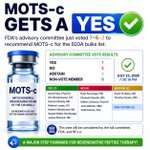
🚨 THIS ONE IS BIG FOR MITOCHONDRIAL MEDICINE. 🧬⚡️
MOTS-c just received a YES vote.
The FDA advisory committee voted 7 YES, 5 NO, 2 ABSTAIN to recommend MOTS-c for the 503A Bulks List.
What makes this especially exciting? MOTS-c is a mitochondrial-derived peptide—encoded within mitochondrial DNA and studied for its role in metabolic signaling, cellular energy, glucose metabolism, exercise adaptation, and healthy aging.
For those of us who have been talking about mitochondrial health as the foundation of human health, this is a fascinating development.
The vote is a recommendation—not final FDA approval—but it represents a significant step forward.
The mitochondria are having a moment. ⚡️🧬
🤖 Made with AI
