

BigVector retweeted

Bitcoin developers just formalized a proposal to freeze over $450 billion worth of Bitcoin.
> Quantum computers are coming. Old wallets with exposed public keys will eventually be crackable.
> They want to freeze them before someone else cracks them.
> The proposal is BIP-361. Co-authored by Jameson Lopp. It just hit Bitcoin's official repo this week.
> The mechanism is a soft fork. Three years after activation, you can no longer send Bitcoin to old wallet types.
> Two years after that, those coins become permanently unspendable.
> Around 6.5 MILLION $BTC affected. Roughly 25% of all supply.
> Lopp himself acknowledges what this is. He rejects the word "confiscation" and prefers "burning."
> Here is the part nobody is talking about.
> The chain cannot tell the difference between Satoshi's dormant coins and a longterm holder waiting for $500,000 to sell.
> They look identical on chain. The early miner who set up a wallet in 2011 and forgot about it.
> The OG who bought at $200 and never moved them.
> The cold storage wallet sitting in a safe. All burned together.
> But the deeper question is how this is even possible.
> Five people have merge authority on Bitcoin Core. One person merges roughly 65% of all code.
> Six mining pools control 96 to 99% of all blocks. Activation requires their signaling.
> A coordinated decision by maybe two dozen people can change the rules and burn 25% of the supply.
> Bitcoin has done this before. In 2010, a bug created 184 BILLION $BTC out of thin air.
> Satoshi himself coordinated a fork to erase it. The chain rolled back 50 blocks.
> Ethereum did it in 2016. The DAO got hacked for $60 MILLION.
> Developers rewrote history to take the money back from a wallet whose owner had not signed off.
> The principled chain that refused to fork is now called Ethereum Classic and it is a fraction of the size.
> The lesson is the same in both cases. When the cost of the principle is high enough, the principle bends.
> Bitcoin was supposed to be the one thing nobody could touch.
> What Bitcoin actually is and what this proposal is forcing into the open, is a network that can be changed when enough of the right people agree.
> Most of the time they don't but the option has always been there.
> Decentralized at the participation layer. Coordinated at the change layer.
> The freeze might never happen. Activation requires consensus that does not exist yet.
> Tether's CEO Paolo Ardoino has already pushed back. "Code is law" he says. Don't touch the rules.
> The plan is already written down. The way to do it is already worked out. The list of people who would need to say yes already exists.
> The only question left is whether someone, someday, decides the reason is good enough.
The freeze might never happen. The fact that it could is the part that matters.


BigVector retweeted

This is INSANE:
Massive US Stock Market reversal.
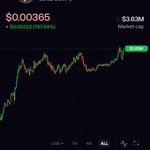
$4,590,000,000,000 has been added to U.S. stock market since the US/IRAN bottom.


BigVector retweeted

1/ Meet @WheresBroox (Broox Bauer), one of the multiple @AxiomExchange employees allegedly abusing the lack of access controls for internal tools to lookup sensitive user details to insider trade by tracking private wallet activity since early 2025.


BigVector retweeted
The founder of FedEx once gambled his company's last $5,000 at a blackjack table in Las Vegas.
In 1965, Fred Smith wrote a paper at Yale proposing an overnight delivery service.
His professor said the idea wasn't feasible and gave him a C.
But he built it anyway, put $4 million of his own money in and raised another $91 million.
FedEx launched in 1973.
On its first night, it delivered 186 packages.
The company grew fast, but it was expensive to run with planes, fuel and trucks across the country.
Then the 1973 oil crisis hit and fuel costs nearly doubled overnight.
FedEx started losing over $1 million a month.
Smith went to every investor and bank he could find asking them for funding, but they all said no.
The money kept draining, until one day there was nothing left.
All he had was $5,000 in the bank and a $24,000 fuel bill due Monday.
Without fuel the planes couldn't fly, and without planes there was no FedEx.
Smith made one last attempt, he flew to General Dynamics for emergency funding.
But they said no.
On his way home, he decided to land in Las Vegas instead.
He took the last $5,000 his company had and sat down at a blackjack table.
A few hours later he walked out with $27,000.
His business partner found out Monday morning and asked how he could gamble the company's last dollar.
Smith said: "What difference does it make? without fuel money we couldn't have flown anyway".
The $27,000 covered the fuel bill and bought FedEx one more week.
That week, he raised $11 million in new funding.
By 1976 revenue hit $75 million.
FedEx went public two years later.
Today it moves 17 million packages a day across 220 countries and brings in $88 BILLION a year.
All because a man whose professor gave him a C bet his last dollar at a casino rather than let his company die quietly.