


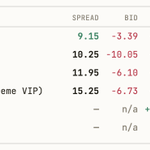




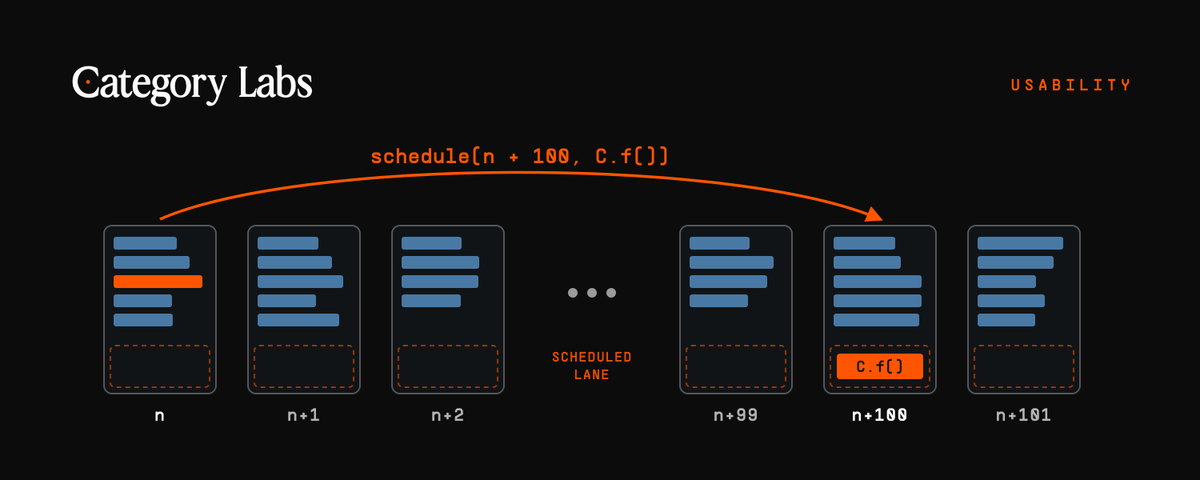
Blockchain has long been missing a native crontab. Check out this design for scheduled transactions on Monad by Category researchers @CAndrei1998 and @liobaheimbach.
Automatic compounding, recurring payments… What use cases are most interesting to you?

Currently, it seems like AI can generate tremendous results but suffers from lack of interpretability or weak exposition. Pairing leading researchers with the AI is a win for producing *understandable* revelations for a human audience. @komasito55 does this for a new algorithmic bound improvement to Dolev-Strong.
No shortage of research talent at Category Labs!
Dolev–Strong is arguably the best-known consensus protocol, and for roughly 45 years, no deterministic protocol improved on its O(n³) communication.
A new paper by @komasito55, Yuval Efron and Ling Ren improves that bound to O(n² log⁴ n) for Byzantine Broadcast, tolerating t < n faults in O(t) rounds.
After thinking about the problem on and off for years, they started leveraging AI models. The paper is the result of a month of human experts digesting and simplifying the discourse with AI.
Andrej Karpathy’s autoresearch post was a lightbulb moment (remember those ancient Opus 4.6 days?). The magic to me was in properly scoping the harness and scope of the task.
On a highly performant and complex code base like Monad, autoresearch felt difficult to apply. But here, Anne-Laure, @__inshorts, and Sam Balco apply the approach effectively in a fresh domain: optimizing the Monad client for ZK execution and yielding 57% improvement.

Fun fact: @jason_of_cs is one of the authors of Automated Market Making and Loss-Versus-Rebalancing, with @ciamac, @Tim_Roughgarden and @alz_zyd_ . He, Ozan Solmaz, and fellow Category Labs researcher @liobaheimbach dig into profitability of the next generation of AMMs. Their paper examines the last year of propAMM historical data across Solana, Base and Monad.
If you don’t have time to read the paper, check out this article!

Ben retweeted

Everything you need to know about Monad Private Settlement
@JanCamenisch, Staff Researcher at @category_xyz, breaks it down 👇

This work feels particularly refreshing to me. HFT is naturally secretive and closed-source while building in the open on Monad helps push the frontier of blockchain technology forward.
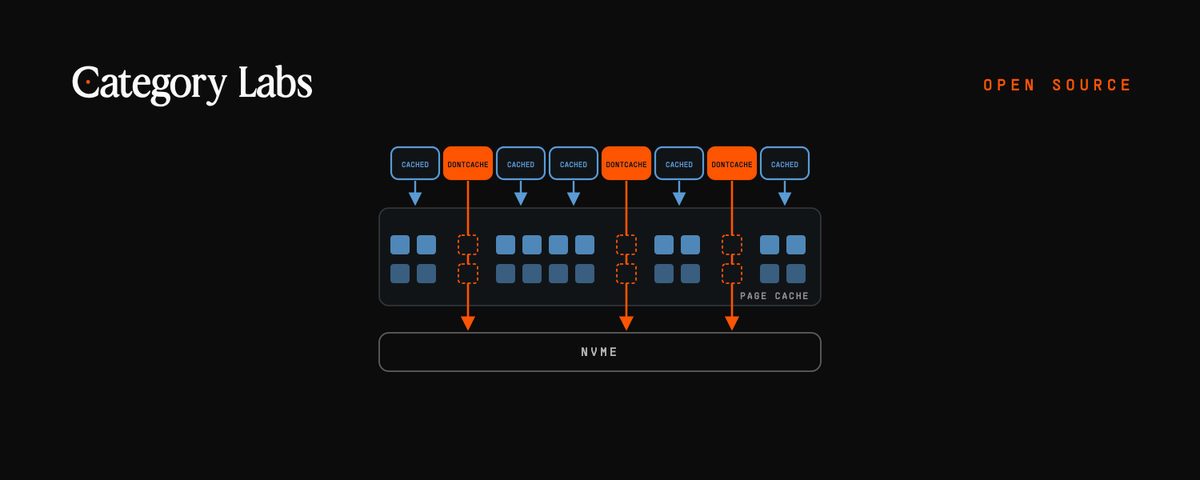
In this blog post, @talzuss breaks down how an optimization intended for MonadDB (a narrow crypto implementation) turns into a win for Linux (one of the largest OSS distributions).
Get it in linux 7.3, dropping in a couple weeks.
A lot of Batched Threshold Encryption work going on recently, this pushes state of the art even further!
Congrats Champ on a successful research internship!
Check out our latest cryptography paper, Batched and Weighted Threshold Encryption with Silent Setup. Building on BTX, this scheme supports many desirable properties of an encrypted mempool:
⚡ Weighted decryption (ideal for Proof-of-Stake blockchains)
⚡ Silent setup (key generation no longer requires interaction between parties)
⚡ Batch and index independence (more user friendly and fewer constraints on decryption)
We’re excited about the future of encrypted mempools!
Paper link: eprint.iacr.org/2026/2087
Authors: Amit Agarwal, Champ Chairattana-Apirom (Category Labs intern ‘26), @sourav1547, Babak Poorebrahim Gilkalaye

Really excited about this coming to Monad RPC clients. These query methods remove a host of indexer / infrastructure requirements and let developers focus on the stuff that matters.


Category Labs takes security of the Monad client very seriously. We use formal verification extensively (we're hiring!) and our latest blog post explores use of additional techniques like fuzzing to secure the all-important staking module.
category.xyz/category-career…


Ben retweeted

UniswapV2 will use ~half as much gas to swap on Monad next week as MIP-8 goes live.
Instead of slowly one-by-one loading storage slots from disk, Monad will grab 128 slots for the access cost of one slot. Then super cheap and fast to use. (MIP-8 on bottom, 2xing)
Three quick takeaways:
1. Monad consensus has come a long way. monad-viz has come a long way (see last year’s version below). Visuals were pretty crude, but it was no-clanker and featured compiled Monad (consensus) code running in your browser (not a reductive simulation).
2. Internal hackathons are an amazing unlock, especially in the age of AI.
3. Cadence is going to be nutty, will have to start at 0.1 speed to be readable. Gmonads.com will need an epilepsy warning. @rooikat

Kill a validator and watch MonadBFT route around it. A year ago, we released monad-viz, a way to view Monad consensus inside your browser. Since then, MonadBFT has picked up new features, like fast recovery.
During a recent hackathon, @omegablitz_ wrote an upgrade to monad-viz (below). As development on Cadence progresses, tools like monad-viz will evolve with it.
Explaining mera is a challenge because there's a ton of existing, overlapping work, e.g. account abstraction, hosted logins. Mera is OSS featuring a few functions (1600 LOC) and doesn't involve third parties in the signing process.
Website recommended for interactive demos: category.xyz/blogs/mera-cryp…
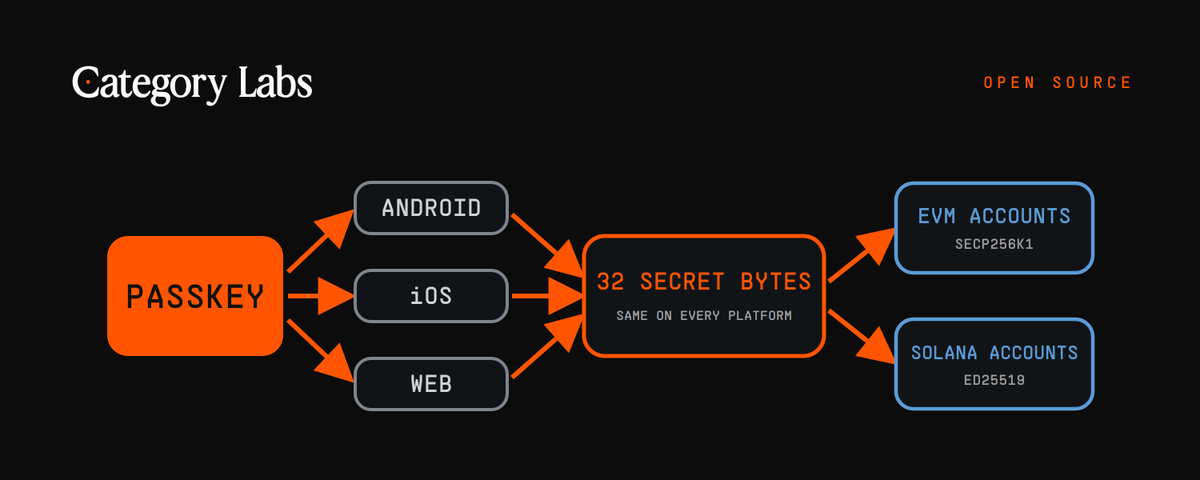
Excited to share more open source work from @category_xyz!
With mera, @mveehkim connected the dots with passkey PRF functionality that took years for adoption and a common crypto pain point. Mera generates crypto keypairs (wallets) from a passkey. When those passkeys are stored in a cross-platform manager like iCloud keychain, Google Password Manager, 1Password, wallet access also becomes cross-platform!
Give the demo and docs a peek at mera.category.xyz!
mera is now open source: one passkey prompt generates a crypto account (secp256k1 or Ed25519) with no smart-account contracts or custody backend. The same account restores on any device that has your passkey. Built by @mveehkim.
Live demo and docs: mera.category.xyz


